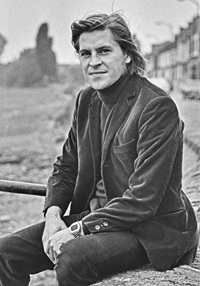
Continuing our series of introductions to musical acts you might not know as well as you should, ALWYN TURNER comes to praise Alan Price.
Here’s a playlist of five selected tracks.
Alan Price’s recording career spans nearly four decades, and – I realised, as I started writing this piece – my own affection for his music has lasted even longer than that. In retrospect, I was lucky to encounter him first when he was at his artistic high, with the single ‘Jarrow Song’, released in 1974, when I was twelve.
That career has been so absurdly diverse as to be unique. The closest comparison is perhaps Ray Davies, with his similarly restless (and low-budget) search for ways to express his creativity, his fondness for pre-rock popular music, and his instinctive sympathy with the dispossessed – but even he’s not that close. Of course, Price has enjoyed neither the critical acclaim nor the commercial success accorded to Davies. Admittedly, that’s largely because Davies is a better songwriter, but even so, Price deserves more credit than he’s given, particularly for his mid-1970s work, which is what I’ve focussed on for the playlist here.
But first, the story so far…
Born in Fatfield, County Durham in 1942, Alan Price went to live with his grandmother in Jarrow at the age of six, after his father was killed in an industrial accident. His childhood was further disrupted when he contracted jaundice, but he passed the 11-plus and went to Jarrow Grammar School. There he began a musical career in the conventional fashion of the times: playing guitar in a skiffle group, the Black Diamonds, before moving onto the piano and rock ’n’ roll with the Frank Hedley Five, and then the Pagans – with singer Eric Burdon and drummer John Steel – and the Kontours, with bassist Chas Chandler. When he went on to form the Alan Price Combo in 1962, now playing rhythm ’n’ blues organ, he recruited Burdon, Steel and Chandler, plus guitarist Hilton Valentine.
The new group were regulars at the Downbeat Club in Newcastle, as described by journalist Nik Cohn: ‘It was stuck on top of some kind of disused warehouse, down towards the docks, and the railway bridge ran right outside it, making it shake. It was cramped, wet, ratty and music made its walls buckle. And it was a fierce atmosphere, it burned.’ Renamed the Animals, they made their London debut at the very trendy Scene Club in Soho, and as the r’n’b boom kicked in, were signed to Columbia Records.

A string of hits followed, most notably ‘The House of the Rising Sun’ (1964), which went to #1 in Britain and America, invented folk-rock and convinced Bob Dylan that it was time to try out a full electric band. Price, however, was unhappy with the accompanying lifestyle and left just before their best single, ‘We Gotta Get Out of This Place’ (1965). ‘I got fed-up with the flying, the drinking, the looning and the no-rehearsals,’ he said later.
So he formed the Alan Price Set, with a horn section (including John Walters, later to be John Peel’s producer in Radio 1), and with him singing in a warm, slightly nonchalant voice that retained his Geordie accent. There followed several top-ten hits with covers of Screaming Jay Hawkins’s ‘I Put a Spell on You’ (1966) and Randy Newman’s ‘Simon Smith and His Amazing Dancing Bear’ (1967). More significant was ‘The House That Jack Built’ (1967), his first self-penned single and – somewhat belatedly – an indication that he might be a decent songwriter.
The Set wore fashionably frilly shirts and paisley brocade, but – unlike Eric Burdon, who was by now in America, purveying full-on druggy psychedelia – Price was making accessible, quirky pop music that didn’t frighten the horses. Consequently, he found a welcome on the cabaret circuit and on variety television shows, particularly after the band split up in 1968. For a couple of years in the early 1970s, he had a successful partnership with Georgie Fame. ’We did the inevitable middle-of-the-road, nice but not nasty cabaret, and TV,’ he reflected.

And yet there was something more serious going on there, as well. Film and theatre director Lindsay Anderson – one of the big names of the British New Wave and riding high on the success of If… (1968) – was a fan and commissioned Price to write the music for his production of David Storey’s play Home (1970), staged at the Royal Court Theatre.
It was also Anderson who inaugurated the great phase of Price’s career, asking him to write songs for the movie O Lucky Man! (1973). These didn’t appear simply on the soundtrack, but were performed on screen by Price and his band, acting as a Chorus, counterpointing the action. The score won him a BAFTA and the resulting album was named Soundtrack of the Year by Rolling Stone. It was his best work yet, casting him in the new role of working-class troubadour.
There was a slight stumble with the next album Saveloy Dip (1974), which was (for reasons I’ve never understood) shelved by the record company and only released in 2016. But then he was back, taking the final track of the abandoned record and turning it into the title-song of his real masterpiece Between Today and Yesterday (1974).
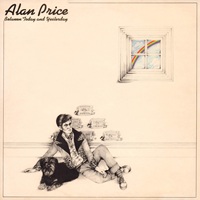
Growing out of an idea for a musical, to be titled The Brass Band Man, the album was split into Yesterday and Today sides, the former documenting the North-East in the 1930s – this was where ‘Jarrow Song’ came from – and blending pop with the older traditions of brass bands, music hall and theatre (the orchestrations were by jazz trombonist Derek Wadsworth). There was also a continuation of the socially engaged lyrics heard on O Lucky Man!, though he shied away from anything too ideological. ‘I’m not really qualified to talk about politics,’ he told the Melody Maker, and demonstrated the point by saying that the 1936 Jarrow Crusade was organised by the National Unemployed Workers’ Movement, which wasn’t the case.
The album was preceded by a documentary in the BBC Omnibus strand that is both a fine showcase for the songs and a wondrous time-capsule of what mid-70s Britain looked like. It was also, however, a very self-contained record that stood apart from everything else that was happening in pop, and which offered no obvious way forward. As the Coventry Evening Telegraph noted in its review, ‘you’re inevitably left wondering which direction his career’s supposed to be taking now’.
And that was perhaps Price’s greatest problem. No one – including himself – seemed to know where he fitted. He was a singer-songwriter who offered commentary rather than introspection, who wrote lyrics that were direct not allusive, whose melodies were catchy but unsophisticated. Over the next few years, he was still a familiar presence on TV, but not in the charts: Between… was his only hit album, and ‘Jarrow Song’ his only solo top-30 single.
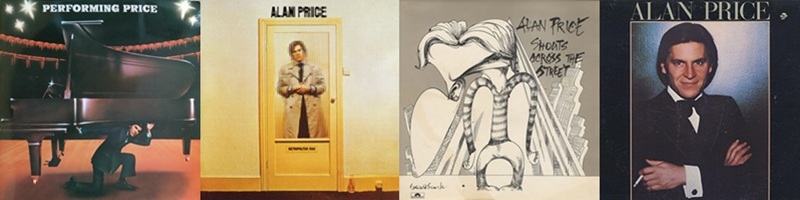
How to market him? The confusion can be seen in the wildly inconsistent album covers from this time. The excellent double-live Performing Price (1975) had a jokey airbrushed painting of him lifting a grand piano on his back; on Metropolitan Man (1975) he looked like a private dick behind a corrugated-glass door; Shouts Across the Street (1976) came with a Gerald Scarfe cartoon; and Alan Price (1977) was a bland photo of him in velvet bow-tie, cufflinks and dinner jacket, with a fag on. What was any of this supposed to convey?
Muddying the waters still further, there was a venture into acting with Alfie Darling (1975), an ill-advised sequel to the 1966 classic, with Price unconvincing in the Michael Caine role, and a stage musical of Andy Capp (1982), starring Tom Courtenay. There was also a surprisingly strong – if commercially unsuccessful – reunion of the original Animals line-up on Before We Were So Rudely Interrupted (1977) and on the less satisfying but better selling Ark (1983).
And the solo albums continued to appear. Mostly they were comprised of new material, but not always. A Rock ‘n’ Roll Night At The Royal Court Theatre (1980) found him playing ‘Sea Cruise’, ‘True Love Ways’ and other classics from the 1950s, while Geordie Roots and Branches (1982) included the likes of ‘Keep Your Feet Still, Geordie Hinny’ and ‘Dance Ti’ Thi’ Daddy’. Neither record did much for his fans, let alone anything to win over a new audience. And still there was the arty side, with his orchestral soundtrack to Lindsay Anderson’s The Whales of August (1987) – starring 93-year-old Lilian Gish and the relatively youthful Bette Davis (just 79) – which was released on the prestigious Varèse Sarabande label.
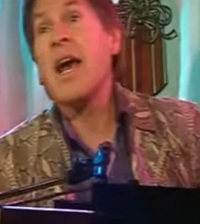
It’s a strange, idiosyncratic, sometimes frustrating career. But pretty much all of it warrants serious consideration. Even his most recent album, the self-released Based on a True Story (2002), was a collection of decent songs, with vaguely jazzy and latiny arrangements. And he was fun as Frankie Rio in a 2004 episode of Heartbeat.
Running through it all is an utterly distinctive voice that strains on the high notes in a most attractive manner. And, possibly, this is the point where I should note that he was also a very attractive man, the first celebrity I had a crush on.
The playlist – five selected songs.
‘O Lucky Man!’ from O Lucky Man! (1973)
Played over the title sequence of the movie, this is one of Price’s best rock songs, barely two minutes long but giving the impression of an authorative denunciation of the modern world, even if it’s not spelled out.
‘Between Today and Yesterday’ from Between Today and Yesterday (1974)
There are two versions of the song on the album, one with just piano accompaniment, the other – this one – with full orchestral backing. I think Price sings better on the piano one, but really it deserves the big production.
‘Under the Sun’ from Between Today and Yesterday (1974)
I rate this as his best song, a lament for miners killed in a pit disaster, from the perspective of the grieving widows at their funerals.
‘Sweet P’ from Metropolitan Man (1975)
A breezy, jazzy, rather lovely song that’s not far off what his old mucker, Georgie Fame, was doing in the 1970s. The arrangement is by Derek Wadsworth again.
‘England My England’ from England My England (1978)
Over the rhythm of what sounds like a Russian folk-song, Price offers a state-of-the-nation address that could almost be Ray Davies:
‘On an island built on coal and with oil beneath the sea,
We struggle to get by and we’ve joined the EEC.
And if you want a steady job, you can take a tip from me:
Work for the union.’
see also:
Discover more from Lion & Unicorn
Subscribe to get the latest posts sent to your email.

I hadn’t realised how much of his music had passed me by. The Jarrow Song was a huge favourite of mine and I have blogged about it. As I was from a staunch Conservative household (albeit the now politically homeless one nation type) it was an early introduction to different ideas. It’s still a great song to listen to.
LikeLike