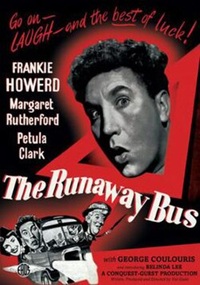
SIMON MATTHEWS watches Val Guest’s 1954 comedy, The Runaway Bus.
Around the time of the Coronation – Elizabeth II’s, that is – Frankie Howerd’s career reached the point where a move into feature films was an obvious step to take. A considerable hit on the variety circuit from 1946, he released records from 1949 (his chaotic version of Three Little Fishes was a favourite of Children’s Hour well into the 60’s), fronted his own radio show from 1951, and seamlessly transitioned to television in 1953.
It was a path others had trodden, and the task of smoothing away the rough edges of his comic persona and adjusting it to the requirements of a 75-minute plot was entrusted to Val Guest, whose qualifications for the task were ideal. Having worked with Will Hay and the Crazy Gang in the 30’s, he was the go-to director for comedians seeking an upgrade for nearly half a century, finally bowing out in 1983 with Cannon and Ball’s The Boys in Blue.
For Howerd’s debut, a budget of £45,000 was available, sufficient for shooting in black and white at the now long-forgotten Southall Studios. Perhaps money was a factor with the script: with it taken as axiomatic that cinema was ‘different’ (i.e. superior) to TV and radio, Guest also wrote the screenplay, meaning that Howerd’s usual partners, Eric Sykes and Spike Milligan, were dropped, resulting in fewer surreal flourishes and less word play.
As a result, the film opens with some semi-documentary-approach establishing shots. A fog-bound city is shown – a standard trope when introducing dramas about London – and there are shots of the old Heathrow Airport, looking about as big as a railway station serving a medium size town, with a voice-over saying there are ‘hundreds stranded’.
Quaint period details abound. An air hostess obliged to work a double shift because of the conditions, comments ‘give me a Benzedrine and leave me to it’. A BOAC bus driver (in the absence of a rail link everyone then was shuttled to and from Heathrow by BOAC or BEA buses) is ordered to take passengers to Blackbushe, a redundant RAF base in Hampshire used until 1960 by the Ministry of Civil Aviation as an overspill airfield for flights to and from Europe. It’s more than a little reminiscent of the famous apocryphal headline ‘Fog in the Channel: Europe Cut Off.’
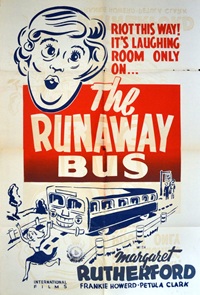
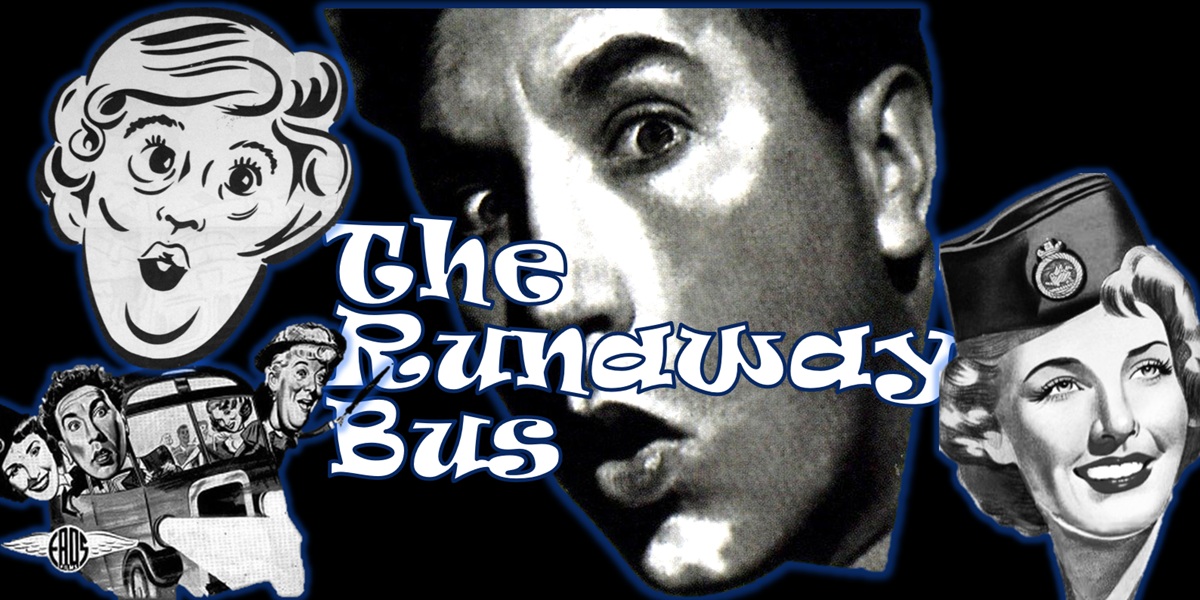
As a dramatic device, though, this setting allows the cast to be gradually introduced from those milling about: Petula Clark (the air hostess), Margaret Rutherford in yet another of her Lady Bracknell incarnations and Howerd himself, stumbling into sight as the bus driver. Two others are of particular note, George Coulouris, a UK actor who moved to the US where he featured in Orson Welles’s Mercury Theatre (he’s in Citizen Kane) and Belinda Lee, reckoned by some film historians to be the closest the UK got to producing a Sophia Loren.
Alongside this, a crime drama evolves, with criminals stealing 200 gold bars from a storage warehouse within the airport perimeter. Having executed their plan, they place the bullion in the luggage compartment of the same BEA coach that Howerd, Clark, Rutherford et al are taking to Blackbushe. Which, if you think about it, is utterly implausible, given they would weigh about 2.5 tons, making it impossible to move the vehicle.
Nevertheless, the cast assemble for their journey and set off at walking speed into the billowing fog. Somewhere in the vicinity of Slough, Howerd takes a wrong turning and they end up in a deserted village used for battle practice by the army. This part of the plot, with a motley group of individuals stranded in a gloomy mock-Tudor public house has echoes of The Ghost Train or vintage Agatha Christie. A dead body is found, and dialogue flies back and forth amidst uncertainty about the identity of the murderer. Bizarrely, we reach a denouement where Rutherford and a supporting actor (Toke Townley, who later graced 789 episodes of Emmerdale Farm) are unmasked as the villains.
Howerd acquits himself well, with a screen persona – a mixture of cowardice, self-deprecation and banter – not unlike that of Bob Hope. Puzzled, frowning, constantly guarding his crushed dignity, he utilises physical humour, falling over a lot, rather like Norman Wisdom. It seems to have been expected that comedians should do this, but he is a much better performer than that, with none of Wisdom’s syrupy sentiment. Instead, his heavily suppressed vulgarity remains well to the fore. The script allows him to deliver two very funny monologues, telephoning his long-suffering, elderly (and deaf) mother from a call box, explaining why he won’t be coming home that night.
On its release in February 1954 Howerd, Rutherford and Clark shared top billing, a precautionary measure to avoid Howerd’s career being damaged if it wasn’t a success. In the event The Runaway Bus did well, and Howerd starred in four further films over the next eight years. But he failed to emulate Wisdom, whose undemanding, simple clowning drew substantial audiences. The relatively complex assumptions and dialogue that Howerd’s character required were clearly a trickier prospect. Seven decades later, though, he remains enjoyable, and The Runaway Bus can be viewed as a guilty pleasure.
from the maker of:

see also:


Discover more from Lion & Unicorn
Subscribe to get the latest posts sent to your email.
