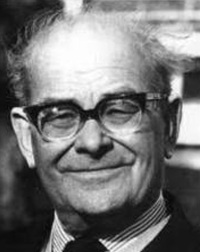
JONATHAN CALDER celebrates one of the great children’s writers.
For much of the twentieth century, the literary landscape set before young readers was a rural one alive with other children exploring, thwarting criminals, and finding buried treasure. Arthur Ransome, one of the early exponents of these holiday adventure stories, won critical acclaim, but for the most part it was a genre that was loved by its young readers and not wholly approved of by adults. Its exponents tended to be published by Armada rather than Puffin, and the books by its most popular exponent, Enid Blyton, were condemned by teachers and banned by librarians.
Somewhere between the poles of Ransome and Blyton stands my own favourite writer as a child, Malcolm Saville. I have taken to describing him as ‘the thinking child’s Enid Blyton’ because the two wrote of children enjoying similar adventures. But Saville’s characters are far better drawn and he sets his books in real places rather than settle for the film-studio flats that Blyton uses. Saville always described these in his forewords as ‘places you can explore for yourself,’ and in later life many of us have.
Saville was a Sussex man, so Rye, Winchelsea and Romney Marsh recur as settings, but it is the Shropshire hills – the Long Mynd and the Stiperstones – with which his stories are most associated. It is when these numinous landscapes inspire him to touch upon the uncanny that his writing is at its best.
I had got used to Malcolm Saville being ignored by the critics, but at the start of this century two appeared who took him seriously: Victor Watson in his Reading Series Fiction and Owen Dudley Edwards in British Children’s Fiction in the Second World War. Dudley Edwards says Mystery at Witchend ‘comes close to being the outstanding novel of children in the Second World War, all the more because it enchanted so many of them during it’. Watson’s verdict is:
Although the war is never more than a background, Saville was attempting something that Blyton was never interested in – the visual and affective representation of the personal, social and geographical atmosphere of wartime England.
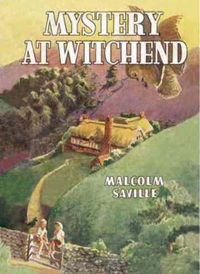
Mystery at Witchend
In the early war years, Malcolm Saville was working for Enid Blyton’s publisher George Newnes by day and fire-watching by night. Yet he still found time to write an adventure story in instalments and post it to his own children, two girls and two boys, who had moved with their mother to the safety of rural Shropshire.
This became Mystery at Witchend, which was published in 1943. It tells the story of David Morton and his twin brother and sister, Dickie and Mary, who had made the same journey with their mother to escape the Blitz. There, they meet Petronella (Peter) Sterling, whose father looks after the nearby Hatcholt reservoir, and Tom Ingles, who has come from London to work on his uncle’s farm.
Having clearly read adventure stories themselves, the five set up a secret society, signing its rules in their own blood. Rule 5 says the club is for ‘exploring and watching birds and animals and tracking strangers,’ and it gradually becomes clear that the strangers they duly track are German spies and fifth columnists intent on blowing up the reservoir’s dam.
Saville certainly had a didactic purpose in Mystery at Witchend: teaching city children about the countryside and how to behave in it. There was more to it than closing gates: when the Mortons first meet Peter Sterling, an excited Dickie has just leapt on to what appears to be an expanse of grass, only to find that it is a bog. It is Peter who knows how to rescue him.
But I wonder if Saville had a second purpose. Take this exchange from later in the book, when Dickie and Mary have been made to spend the night in the saboteurs’ safe house:
‘And there was something else, Dickie. Did you notice what I noticed? Did you hear?’
He looked puzzled for a moment.
‘Wasn’t anything to hear, was there?’
Then they stared at each other without speaking, and Dickie’s second shoe dropped to the floor.
‘Of course,’ he went on. ‘Of course there was something to hear. They were all talking all the time.’
‘Course they were,’ said Mary slowly. ‘But they weren’t speaking English.’
This scene would not have been out of place in the propaganda film Went the Day Well?, which had been released the year before. In it, a German unit that takes over an English village in advance of the invasion is discovered and defeated. Saville, too, may have wanted to post a reminder that any place might be of interest to the enemy, no matter how remote. Certainly, Dickie has to accept that even the dashing RAF pilot he and Mary helped find his way on the Long Mynd was really a Nazi – ‘one of the worst’.
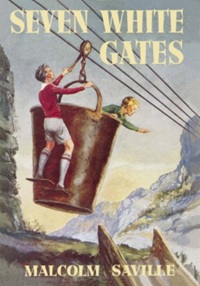
Seven White Gates
If Mystery at Witchend is Went the Day Well?, then the second Lone Pine story, Seven White Gates (1944), is a Powell and Pressburger film. Like A Canterbury Tale the same year and A Matter of Life and Death (1946), it deals with relations between Britain and America, and its setting is that of a third of the Archers’ films, Gone to Earth (1950).
Peter has to spend the next school holidays away from Hatcholt at a farm owned by her father’s brother. It stands beneath the Stiperstones, a harsher, more mysterious ridge to the west of the Long Mynd of the first book. Here she finds a friendly young aunt, the second wife of her fearsome Uncle Micah. He has never been the same since he argued with his only son, who left for America and never came back. He soothes his broken heart with midnight walks to an outcrop of rocks called the Devil’s Chair.
If Micah sounds very like a character from the Shropshire novels of the author of Gone to Earth, Mary Webb, that’s not so surprising. I once heard one of Saville’s sons tell a meeting of the Malcolm Saville Society that he was pretty sure his father had not visited the Stiperstones when he wrote Seven White Gates. The book’s descriptions and eerie atmosphere, he said, came straight from the pages of Mary Webb.
But it is that atmosphere that makes the book stand out. Here are Peter and Jenny, a younger girl whose head is filled with dark local folklore, out at night:
Then the atmosphere became cold and clammy as the fog swirled round them. Suddenly Jenny gave a stifled little scream and pointed up the track which led to the mines. Shadowy in the thickening mist, the two girls seemed to see a figure on horseback waving ghostly arms but no sound of hooves came to their straining ears. Then far away on the hilltop, it seemed to Peter that tiny, gnome-like figures flitted in uncanny procession.
Jenny turned and wailed into Peter’s shoulder.
‘Peter. It’s true. It’s them. They’re riding again. What shall we do, Peter? We must hide our eyes. We mustn’t even see them. Don’t look, Peter.’
Jenny is convinced they have seen Wild Edric and his hunt, but later we realise that they were American troops on an exercise. Then the twins take it into their heads to follow Uncle Micah on one of his nocturnal rambles and find themselves trapped in one of the abandoned lead mines that are a speciality of these hills.
The pair are rescued by the Americans, and Mary in particular notices how much their officer already knows about the countryside here and how interested he is in the farm. She realises that he is Uncle Micah’s lost son and brings about a meeting between them. In A Matter of Life and Death a romance symbolises the reconciliation of Britain and America: in Seven White Gates it is the reuniting of father and son.
This adventure story without villains was a mark of Saville’s originality, but that was not to last.
The price of popularity
Malcolm Saville had published around ninety children’s books by the time of his death in 1982 – a rate of productivity that his nephew Lord Saville of Newdigate, whose report on Bloody Sunday appeared twelve years after his inquiry began, must have envied.
At any one time, Saville had several series featuring different sets of child characters on the go, and his most loved series, the Lone Pine stories, ran to twenty books. Children getting tangled up with criminals or a hunt for buried treasure even once would be remarkable; for it to happen again and again to the same children strains credulity. That didn’t worry Saville’s readers, but it did present him with the challenge of regularly minting fresh and convincing plots, a challenge to which he was not always equal.
Saville did set aside his readers’ wishes and allowed his most-loved characters to grow older, but they did so remarkably slowly. Peter and David, who meet as fourteen-year-olds in 1943, get engaged in 1978 having aged only four years. But grow older they do. The Famous Five, by contrast, remain trapped in prepubescence for all eternity. It’s no wonder they have taken to ginger beer.
There are good things in the later Lone Pine books, notably Saville’s best villain Miss Ballinger, a stout artist with a booming voice and a penchant for tweeds. But she also demonstrates the problems caused by the glacial rate at which the children age. The Ballinger regularly gets caught and imprisoned, only to be found having established herself in a new line of villainy and a successful cover business a couple of school holidays later. Then there is the book where the children are told all about Shropshire in the Second World War, despite the fact that they were there – nineteen years before.
Saville himself was growing older at the usual rate. He was already 42 when he published Mystery at Witchend, so it is not such a surprise that by the Seventies his teenage characters did not sound much like Seventies teenagers. And where Saville did take notice of social change, such as it no longer being credible for the Morton twins to roam the countryside the way they did in the Forties, it made the books less entertaining.
In his later years, it was the whole holiday adventure genre that was in decline. Victor Watson argues that it was born because the agricultural depression of the late nineteenth century and the losses of the First World War had left rural England run down and rather empty – a safe and picturesque playground for middle-class children. And it died, he says, because of Dr Beeching and the EEC’s Common Agricultural Policy.
Reading Saville today
I am pleased when I hear of children who read and enjoy Malcolm Saville’s books, but the market for them today is among adult collectors.
First a warning. Most Saville paperbacks that you come across will have been severely abridged from the original hardbacks. As most of the period detail and the character development were sacrificed in this process, they offer a distinctly inferior version of the author’s work.
The first bat squeak of attraction between Peter and David, which comes in a swimming race at the reservoir not long after they have met in Mystery at Witchend, is described by Watson as ‘a careful attempt to suggest the complexities of early adolescent friendship and flirtation, with some anger and provocation, and a power struggle masquerading as horseplay’. It’s just the sort of scene that makes Saville more interesting than his peers, but none of it survives in the Armada paperback.
But Saville hardbacks, with their attractive dust jackets and indispensable endpaper maps, can reach three-figure sums. Girls Gone By Publishers did issue paperbacks with the full text of the Lone Pine books, and are working their way through Saville’s lesser series, but these too have become collectors’ items.
So the best advice I can offer is to join the Malcolm Saville Society. There you will find help in acquiring his books at reasonable prices and much more about this interesting author.

Visit Jonathan Calder’s excellent blog Liberal England.
see also:

Discover more from Lion & Unicorn
Subscribe to get the latest posts sent to your email.
