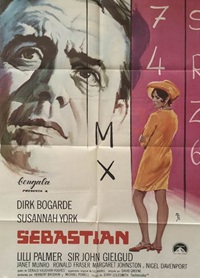
SIMON MATTHEWS watches Sebastian, David Greene’s 1968 movie of Swinging London.
Michael Powell became unemployable at the age of fifty-six. Despite having been nominated three times for an Oscar, once for a BAFTA and carrying off awards at the Berlin and Cannes Film Festivals, the opprobrium that greeted Peeping Tom (1960) ended his career in British cinema. It counted for little that Alfred Hitchcock was lauded for the equally violent and peculiar Psycho the same year, or that Powell’s subsequent projects – agreed prior to Peeping Tom – were the perfectly respectable, if rather dull, multi-generational military drama The Queen’s Guards (1961) and a typically colourful version of Bartok’s opera Bluebeard’s Castle for West German television (1963).
Refusing to retire quietly from the scene, he took refuge in TV, where, working on some episodes of the ITV series Espionage, he met US producer Herbert Brodkin who agreed to put together funding for a UK feature. Powell would co-produce and work through proxies. It was decided to do a spy thriller, angled at the US market, about the tribulations of a university don, Sebastian (he has no surname) who works for the UK security services. Dirk Bogarde was cast in the leading role, with Susannah York co-starring. Filming began in the summer of 1967.
As per many 60s spy capers the plot – assuming one is bothered enough to follow it – is somewhat contorted. Whatever logic it has comes second to Powell and his team aping other recently released films, as they aim to make something that will be popular with audiences. We start in Oxford, with shots of Sebastian (Bogarde) running through the streets in an academic gown. For the moment we might almost be watching Accident (1967), whose cameraman, Gerry Fisher, worked on this too. It turns out Sebastian is an Alan Turing-like cryptographer.
This is followed by scenes that remind one of the US TV series The Man From UNCLE. Sebastian works in a gleaming new office full of whirring computers the size of sideboards, operated by immense button-like controls. Some of this was actually shot at the Jodrell Bank observatory, some of it in newly built ‘modernist’ buildings in the City of London. A large number of young women, decked out like typical 60s ‘dolly-birds’, help Sebastian decipher messages.
Sebastian has a girlfriend, an unsuccessful pop singer. This feels rather odd. Bogarde was forty-seven when he played the part. (Alan Turing would have been fifty-two). Both were young men in the late 1930s, and both served in the war. Assuming Sebastian is supposed to be about fifty, would he have been involved with a ‘pop singer’, half his age? It would have been more plausible to have Sebastian in a relationship with a washed-up, alcoholic, big-band/cabaret singer, but the film is so concerned at being on-trend that interesting dramatic situations like this are sacrificed to marketability.

Anyway, Sebastian is soon attracted to new recruit Becky (Susannah York). He dumps the pop singer. Sebastian and Becky become an item. We know this is the case because they go shopping in the King’s Road – as everyone does – and drop into a fashionable boutique where – as it always is – a band is playing (Max Baer and the Chicago Set Back). They do a couple of songs, neither of which were released, and Baer, not the boxer but a soul singer from Detroit with similarities to Geno Washington, later climbed on board the skinhead/reggae bandwagon.
Meanwhile, work becomes complicated. The leading code-breaker, Elsa (Lilli Palmer) is an émigré – presumably a Jewish refugee – and suspected communist. She passes information on to a left-wing group. The jilted pop-singer, meanwhile, is involved in a nasty sado-masochistic relationship with Toby (a typically seedy Ronald Fraser). Given the script is by Leo Marks, who wrote Peeping Tom, and did in fact work at Bletchley Park as a cryptographer, neither of these sub-plots is surprising.
Sebastian despairs, resigns, and goes back to academia. Things go from bad to worse and eventually the Head of the Secret Intelligence Services (John Gielgud, who better!) comes down to Oxford to ask him back. He returns and after resolving everything, the film swerves into its final segment, echoing Georgy Girl (1966), as Sebastian locates York who is living as a single mother. He realizes the child is his. They decide to stay together and she goes back to work with him. The film ends.
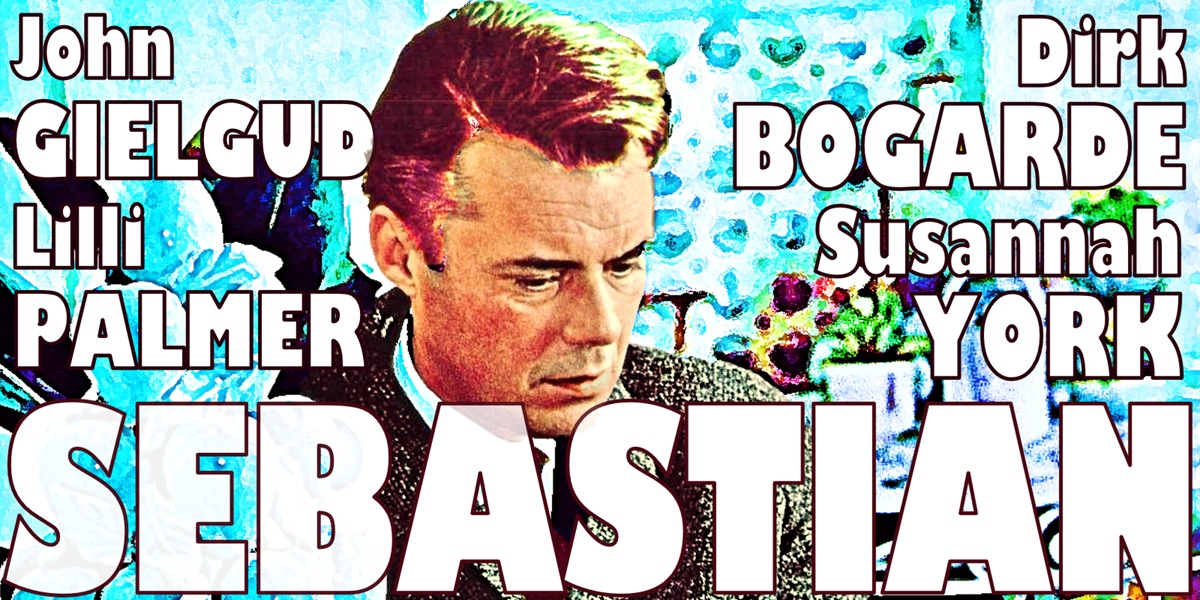
Hopes were high. Paramount agreed a distribution deal, and Jerry Goldsmith, responsible for The Man from UNCLE and In Like Flint, was hired to produce a score. Anita Harris sings the main title theme, ‘Here Comes the Night’, which sounds like something that might have been used to market a Mills and Boon romance.
It premiered at New York in January 1968, to no great effect. Assembled from various composite ingredients it didn’t know quite what it wanted to be, and today is easily confused with Derek Jarman’s nude sandals-and-togas epic, Sebastiane (1976). But for cinema historians and the curious, this is Michael Powell’s swinging London film. With plush production values and assured performances, particularly from Bogarde, it remains an agreeable way to pass the time.
from the maker of:

see also:


Discover more from Lion & Unicorn
Subscribe to get the latest posts sent to your email.
