
IVAN KIRBY revisits Britain in the mid-1960s, courtesy of the BBC’s documentary series.
Deep Into the Sixties, the latest instalment of Tales of a New Jerusalem, David Kynaston’s acclaimed history of post-war Britain, has just hit the shelves (both physical and virtual). It’s surely an indicator that the projected end of the series – Thatcher’s victory in 1979 – still remains some way off that the 700+ pages of this one tome focus entirely on 1965 and 1966, key years that split the decade neatly into two halves. To prepare for the book’s publication, I’ve been watching factual TV programming from those years, made available by the always brilliant BBC Archive YouTube channel.
1965 saw the debut of the BBC’s flagship current affairs series Man Alive. Edited by Desmond Wilcox and Bill Morton, and introduced with one of Tony Hatch’s most rousing theme tunes, the series’s thirty-minute episodes (expanded to an hour in the 1970s) explored an eclectic range stories from contemporary life.
These were international in scope, but there was a strong slant toward British society, as seen in all the 1965–66 episodes currently uploaded by BBC Archive. Each one is a fascinating look at an aspect of Britain (well, almost entirely London, if we’re honest) as it moved into the second half of an especially eventful decade. And each features vivid portraits of everyday (though not necessarily ordinary) British people.

Fourth Girl Wanted (original broadcast 25 November 1965)
The story of four middle-class girls sharing a flat in then-seedy Kensington. There’s worldly, head-girlish Anne, sensible, engaged Hermione, and the more childlike Susan, who’s dominated by a ghastly boyfriend and spends weekends with her parents in ‘the comfortable subtopia of Sevenoaks’ while the others enjoy the social whirl of Sixties London.
Their manner and style belong to the first half of the decade, but when their former flatmate marries, they’re joined by the more obviously swinging figure of Pauline, with her big eyelashes, blonde Vidal Sassoon hairdo, loudly patterned clothes and go-ahead job with one of the new boutique chains revolutionising the country’s fashion. She’s even got a French boyfriend! (Though the voiceover notes that at a party thrown by the girls, she ignores him ‘to dance with a friendly hairdresser’.)
The set-up of girls of good background sharing a flat would become an especially familiar one; fictional depictions include Agatha Christie’s novel Third Girl (1966), the BBC drama series Take Three Girls (1969–71) and Jilly Cooper’s shortlived sitcom It’s Awfully Bad for Your Eyes, Darling (1971).

Not in Our Class, Dear! (original broadcast 23 February 1966)
Man Alive’s ace reporter Trevor Philpott (soon to spin off into his own investigative series, The Philpott File), casts a thickly bespectacled eye over something which has caused permanent anxiety for the British, but never more so than in the 1960s: social class. In particular he’s interested in the implications of the now-familiar NRS social scale, which assigns each class a letter, in descending order from A to E.
We first see him chatting to a pair of solidly middle-class ladies carrying out a survey using the scale, themselves far from objective observers (‘Those ghastly artificial flowers!’ one gasps with horror recalling a visit to a C2 family). At the bottom rung, an elderly widow living on the lowest level of subsistence but content with her cat and her weekend pint of Guinness is contrasted with a retired nanny, equally poverty-stricken but fiercely clinging to her gentility and memories of the posh families she’s worked for.
We meet various other more or less stereotypical citizens: a sexy Irish London Underground workman, a butcher and his tea-lady wife (who spent a £200 pools win on sending their only daughter on a package holiday to Los Angeles), a jolly prep-school master (with a clearly adoring wife) who only vaguely ponders what else he could have made of his life, a nice-but-dim old Etonian with private income, a vicar all too painfully aware that despite his high social status most of his parishioners further down the scale earn considerably more than him. At the top of the tree are film and TV director Peter Duffell and his young family (‘they fill the fruit bowl several times a week’, we’re informed).

The Night People (original broadcast 20 April 1966)
‘Twentieth-century technology demands night slaves’ says reporter Jeremy James, before introducing us to people who keep themselves occupied in a wide variety of ways while most of the country sleeps. In fact some keep themselves busy while sleeping – a charmingly Doctor Who-ish sequence shows us people using the SleepTeach system to learn German while they repose.
Brawny Cockney printer Pat Kent’s wife (who has much the vibe of a young Dot Cotton) is coy about the reasons she’s not thrilled about her late nights until James elicits the admission that ‘It definitely takes a lot of the romance out of it’. Apparently buoyed by this, James later blatantly asks an embarrassed nurse what effect her shift pattern has on her sex life.
Plummy stripper Annette dashes between four Soho clubs each night ‘with the expediency of a fireman answering an alarm’ in order to provide for herself and her boyfriend Colin, a ‘poet, painter and designer of Aztec jewellery’ (parasitic waste of space, in other words).
We’re granted the none-more 1960s sight of an ‘all-night bowling alley near London airport’, where the clearly knackered Mrs Beard serves burgers dusk till dawn before returning home to spend the day as a housewife, mum and carer to her disabled mother-in-law. We also see some of the young hoodlums who frequent the bowling alley as a way of avoiding the police, as well as another group of youngsters who, for no apparent reason, spend all night playing cards in a launderette.
The Private Eye (original broadcast 18 May 1966)
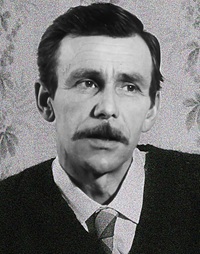
Trevor Philpott enters the thoroughly unglamorous world of the real life private detective. A succession of comically dreary men are seen hiding out to spy on malingerers, repossessing TV sets, and checking up on dodgy boyfriends on behalf of suspicious fathers. ‘It’s not a job for a man who needs to be loved’, Philpott notes.
Eventually we meet two particularly vivid characters: eighty-two-year-old Cyril Fluck, who continues in the business in order to ‘keep me away from my wife, who hates the sight of me’, and the flashy Barry Quartermaine (‘Mr Q’), who recruits youngsters looking for excitement and provides it with the kind of skulduggery (bugging offices, bursting into hotel rooms with camera in hand) at which the country’s official private-eye establishment holds its hands up in horror.

A Roof Over Your Head – The Tenant (original broadcast 20 July 1966)
An example of Man Alive’s crusading journalism, this exposes the thoroughly grim living conditions faced by many of the country’s renters, whether their landlord be the London County Council or a particularly fearsome (sadly unseen) woman who terrorises her tenants by arranging ‘unpleasant incidents’ and sending thugs to illegally evict anyone who questions their suspiciously high rent.
The rousing overall impression is of forthright working class women standing up for their rights. Less impressive is a well-remunerated communist university-lecturer justifying his refusal to vacate his especially prime council flat so a more needy family can have it. A type that remains with us.
Rag Bone (original broadcast 5 October 1966)
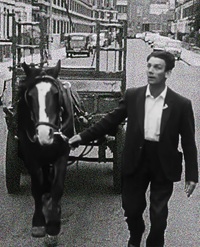
Trevor Philpott asks the pressing question: ‘Would you let your daughter marry a man who trod the streets crying “rag-bone”?’ Ronnie Curd’s wife’s parents apparently did. He’s a rag and bone man, a totter; but according to Mrs Curd, back when they married so was everybody in Notting Hill. Now they live on a nice estate in Roehampton and she’d prefer their eight children to think of him as an antique dealer.
Ronnie’s not a fan of Steptoe and Son, which he thinks doesn’t take his trade seriously enough. Surprisingly (to Trevor Philpott as much as to us), the rag and bone business wasn’t necessarily dying at that time. There are young men joining it for its ‘excitement and sex appeal’ (I think Mr Philpott is perhaps being ironic here), although the strategy they boast of – fleecing the naive, recently immigrated mother of a ‘coloured family’ whose husband will later return home and ‘black her eye’ when he discovers how cheaply she’s sold an item – may make us mourn the trade’s eventual passing a little less.

In 1967, Man Alive would show how-up-to-the-minute (and headline-grabbing) it could be with ‘Consenting Adults’, a two-part edition interviewing homosexuals of both sexes, broadcast a week ahead of decriminalisation. A milestone in showing gay people on television, it can claim some significance in shifting both public and parliamentary opinion. Heterosexuals would also have an unflinching eye cast on them with a three-part investigation on the meaning of marriage in an era of changing sexual mores. Later instalments would include ‘Gale is Dead’ (1970), which had a major effect on the national conversation around institutional care (Gareth Roberts writes about it movingly here).
In 1982, after nearly 500 episodes, Man Alive was replaced with the equally well-remembered 40 Minutes strand, which covered an equally eclectic range of subjects, but in a wider variety of styles. Fly-on-the-wall looks at groups of eccentric characters like ‘Holiday in Benidorm’ and ‘Last Days on Grand Parade’ owed a lot to Man Alive‘s probing into everyday lives, and gave rise to the docusoap genre of the 1990s, which would in turn lead to reality TV as we know it today. So, sixty-plus years on, the legacy of Man Alive remains, well, alive.
The BBC Archive channel on YouTube is one of the wonders of the internet. Watch it here.
IVAN KIRBY lives by the sea and writes about film and television from the 20th century, when not being terrorised by his cat. He wrote the Fulchester Crown Court blog and spends far too much time being silly on social media. He can be found in all the usual places as @hellothisisivan.
see also:


Discover more from Lion & Unicorn
Subscribe to get the latest posts sent to your email.
