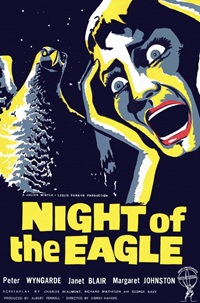
IVAN KIRBY thrills to Peter Wyngarde’s most masculine turn.
Last time I looked at the career of Peter Wyngarde it was to consider a role that allowed him to show off his considerable skills as a character actor. This time I’m at the other end of the scale, visiting the film that gave him his big chance as a romantic leading man.
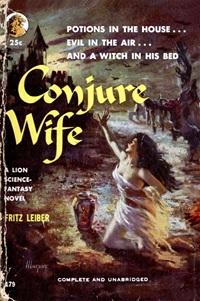
It may not seem the grandest of prospects: a small-scale 1962 occult horror movie called Night of the Eagle — or if you went to see it in the USA, Burn, Witch, Burn. It’s an American story in fact (despite being made and set in Britain) adapted by Richard Matheson, Twilight Zone mainstay and novelist of repute (I am Legend, The Shrinking Man) from Fritz Leiber’s classic 1943 pulp novel Conjure Wife. (If that title seems hard to parse, think of a Conjure Man, the African-American witch doctor.)
Leiber’s bold premise is that the entire female half of humanity are in fact what would be called witches, continually involved in occult rituals about which their menfolk are entirely in the dark. (Women reading might argue that this is nonsense, but then they would, wouldn’t they? How can we poor male saps know it’s not true?) Conjure Wife centres on academic Norman Saylor, who learns the truth of this from his wife Tansy, who has been using her magic to advance his career. In arrogant male fashion, he demands she give up her spells and charms, thus leaving the couple frighteningly vulnerable to the darker forces wielded by some of the faculty women.
Conjure Wife was first adapted for the screen the year after its publication, as a Universal B-movie with the charmingly blunt title of Weird Woman, starring the ever-bovine Lon Chaney Jr as Norman. It would also receive a more comic (and uncredited) adaptation as Witches’ Brew (1980), starring Teri Garr and Richard Benjamin. That film is chiefly notable for featuring Lana Turner’s final screen role.
None of the adaptations fully engages with Leiber’s notion of witchcraft as universal throughout the women of the world: in fact, Night of the Eagle explicitly rejects it, with Tansy having learned magic not matrilineally but from a West Indian warlock (significantly, a man). It’s a shame, as the sexual politics implicit in Leiber’s premise can bear a range of interpretations, from misogynist to feminist, and an adaptation that confronts it could be fascinating.
That’s not to say that Night of the Eagle is a disappointment. Not a lot more than 100 pages long, Conjure Wife moves at the breakneck pace of great pulp fiction. Matheson and director Sidney Hayers don’t try to reproduce this; instead the film takes a series of the book’s set pieces and stretches them to wring out maximum tension and atmosphere.
Norman’s discovery of Tansy’s magic, and her reluctant disavowal of it, happens within the first ten pages of the book but takes up most of the first third of the film. Norman’s turning over of the couple’s home to reveal a succession of bizarre protective charms; Tansy’s horror as a photograph of her husband accidentally falls into the fire; the sense of something terrible being unleashed as soon as this happens: it’s an incredibly tense sequence that easily bears comparison with the similarly titled but much better known Night of the Demon (1957). The later assault on the house by unseen forces; Tansy being driven against her will to drown herself at an abandoned nocturnal beach; and the sceptical Norman’s desperate turn to the very occult rituals he’d earlier been so scathing about in order to save his wife — all are lifted from the book and expanded to great effect.
In researching for this piece, I was surprised to learn that American actress Janet Blair, a former big band singer and leading lady for the likes of Danny Kaye, had rarely been seen in dramatic roles prior to her performance as Tansy. In Night of the Eagle, she is thoroughly convincing as a woman who is utterly terrified — initially by the prospect of exposure, then later by the knowledge of the horrors her marriage is facing. As their tormentor — the black magic-wielding college administrator Flora Carr — Margaret Johnston is equally effective, particularly in the big scene where she confronts Norman, her previous sweetness and equanimity curdling into vicious scorn for the younger couple. Reassuringly familiar British character faces fill the smaller parts. Colin Gordon is all jolly obliviousness as Flora’s husband, while as one of the faculty wives Kathleen Byron turns in a performance of bitter jealousy only slightly more restrained than her Sister Ruth in Black Narcissus (1947).
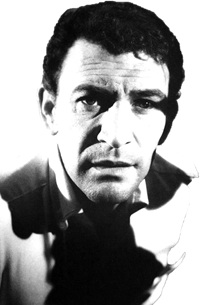
But it’s Wyngarde’s film. In fact, it’s the Wyngarde film: never again would he get to show off what he could do as a proper movie star, but here he bestrides the screen with a hugely charismatic portrait of male virility and arrogance. The renaming of his character as Norman Taylor robs me of the opportunity to do a ‘Hello Saylor’ joke (although I suppose I just have), but this is all to the good as there is absolutely nothing camp about Wyngarde’s performance this time, nothing remotely Jason King-like.
Jason’s unlikely irresistibility to women becomes a joke, but here Wyngarde oozes sexiness — in the muscly physique we see rather a lot of, in the handsome yet unusual face (which we get to see properly without the domineering moustache), and in the sheer masculine force of his performance. (Of course it helps that he’s playing an anthropologist, the sexiest of all academics — see also The Avengers’ Cathy Gale.) So masculine is he in fact that while Leiber’s battle of the sexes concept isn’t fully carried through to the film, we still pick up on the idea of a man blundering into a feminine realm where he was never meant to tread.
The climax of the movie — inspired by a scene which features earlier in the book — is not entirely successful, featuring as it does Norman being pursued at night through the halls of the empty college by the giant bird of the film’s title. This is realised by the use of a real eagle made to look bigger through back projection. The already limited effect isn’t aided by the guide rope that we can clearly see tied to its leg. The poor bird is supposed to be a stone figure from the college’s crest brought to life. In the book the animated beast is a dragon, but it was presumably considered that this could be even less convincingly realised.
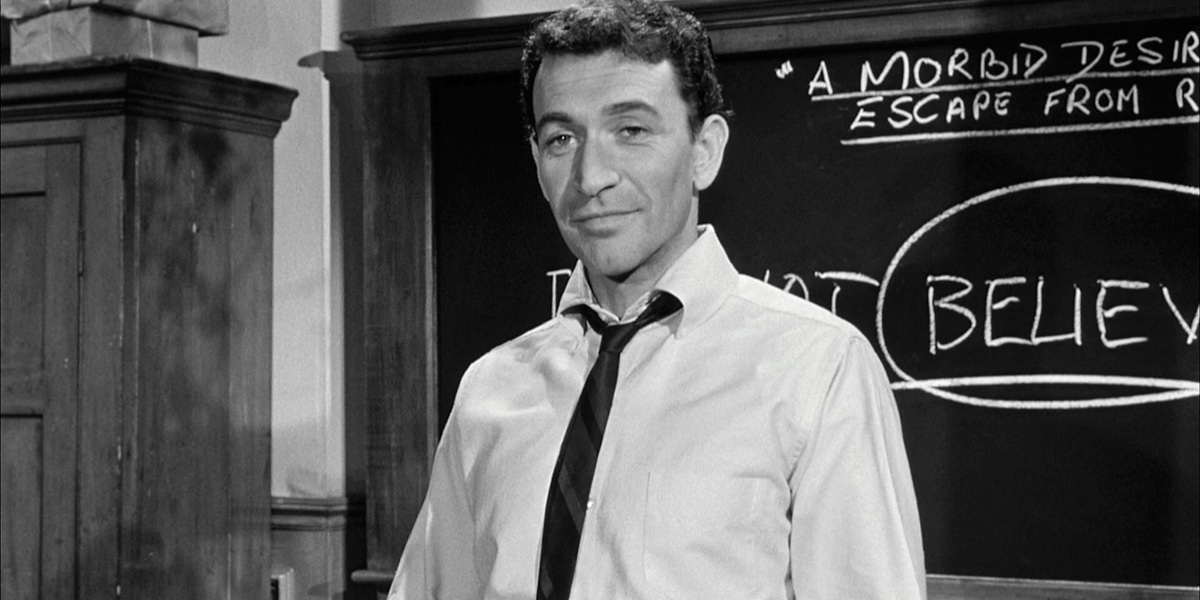
Wyngarde absolutely sells the scene however. The arrogant, dismissive scepticism with which he begins the movie has taken a battering thanks to the occult forces ranged against him, and here it deserts him entirely as he sinks against his blackboard in stark terror. He opens the film scrawling ‘I do NOT believe’ on that board. Now his gibbering form obscures the ‘NOT’.
It’s a fantastic performance in a still underappreciated feature, and it allows us a peek into another universe where, rather than camping it up on TV, Wyngarde was able to make his name in the movies as a serious actor and quite a sex bomb. Who knows, he could have been the next Dirk Bogarde — whose performance in Modesty Blaise (1966) is, after all, camper than anything Wyngarde ever did.
see also:

Discover more from Lion & Unicorn
Subscribe to get the latest posts sent to your email.
