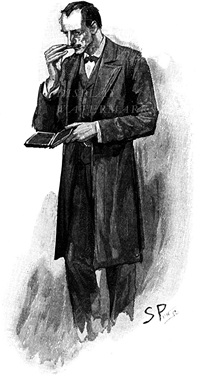
Who’s been the best Sherlock Holmes? ALWYN TURNER assesses the options.
Let’s start with the obvious: Sherlock Holmes is the greatest of all fictional characters. The official canon of Arthur Conan Doyle’s fifty-six short stories and four novels is utterly magnificent. But the question we’re here to explore is who was the best screen incarnation of the Great Detective.
Actually, that’s obvious as well. But still, I wanted to consider the other runners and riders. And it seemed to me that the fairest way to do so was to judge them on how they approach the same source material. And that means The Hound of the Baskervilles (1902), the third of the novels, since that’s the most filmed story of them all.
A brief recap… Back in the seventeenth century, the dissolute Sir Hugo Baskerville, whose house was on Dartmoor, abducted a young woman. When she escaped from Baskerville Hall, he chased after her over the moor, and – presumably as some kind of karmic retribution – was killed by a savage, demonic hound. The woman died of fear. Family legend says that the Baskerville family have been stalked by the hound ever since.
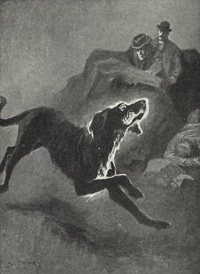
The most recent baronet, Sir Charles Baskerville, who believed in the legend, has just died, seemingly in fear at seeing the hound. His heir, now Sir Henry, is arriving from Canada and there are fears that his life might also be in danger.
Part of the pleasure of the tale is the wonderful range of settings on the moor, among them a Neolithic settlement, a disused tin mine, and Grimpen Mire, a treacherous bog where one false step can mean death. There’s also the prison at Princetown, from which escapes Selden, the Notting Hill murderer, a case ‘in which Holmes had taken an interest on account of the peculiar ferocity of the crime and the wanton brutality which had marked all the actions of the assassin’. In short, the pudding is delightfully over-egged.
But however good a book it is, it’s not a great Sherlock Holmes story. It wasn’t originally going to include him at all; Doyle had killed him off in 1893, and this was going to be a Gothic thriller. Holmes was then added in, but he has little deduction to do, and for large parts of the book, he’s simply absent, having sent Dr Watson down to Dartmoor on his behalf.
To be any good, then, an actor has his work cut out, since Holmes doesn’t get the same chance to dominate proceedings as he does in most of the stories.
For the purposes of this piece, I watched ten screen versions, with nine actors (Peter Cushing did it twice). I decided, though, that it would be unfair to include Peter O’Toole, who voiced Holmes for Australian animation, The Baskerville Curse (1983) – let’s just note that his dry delivery sounds just like one would imagine Sherlock would sound in a 1980s cartoon.
Here are the others, ranked:
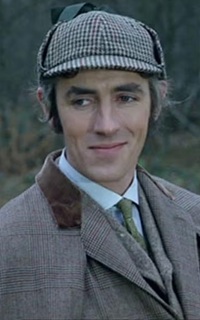
8. Peter Cook (aged forty-one)
The Hound of the Baskervilles (MGM, 1978)
In both Great Balls of Fire (1989) and again in One Foot in the Algarve (1993), Peter Cook was very good at portraying a sleazy Fleet Street hack, a role that he attacked with some relish. Beyond that, however, he was a terrible actor, and as Sherlock Holmes, he was truly dreadful, an insult to the character and to himself.
The film’s meant to be a comedy, of course, and the likes of Kenneth Williams, Terry-Thomas and Hugh Griffith are pressed into service, but there are no laughs. In the opening scene, Cook recycles bits of his Great Train Robbery sketch from Beyond the Fringe, the original of which was very funny – here it doesn’t raise the faintest of smiles. His voice veers between East End spiv and Jewish money-lender, while Dudley Moore plays Watson with a Welsh accent. After a bad start, the film goes downhill, and not even Max Wall and Irene Handl as the Barrymores (the married servants at Baskerville Hall) can do anything to save the day.
It was directed – and co-written – by Paul Morrissey, who used to make very bad low-budget films for Andy Warhol, and was now showing that with more money behind him, he was still rubbish. This is eighty-five minutes long, which is about eighty-six minutes too many.
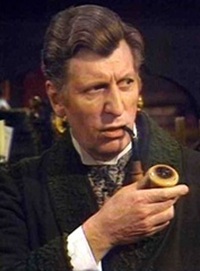
7. Tom Baker (aged forty-eight)
The Hound of the Baskervilles (BBC Television, 1982)
You can see why some people must have thought this a good idea at the time. Baker had recently completed his stint in Doctor Who and was a big star in search of new roles. And surely Holmes and the Hound was an absolute banker. But it’s really very poor indeed, a terribly stagey production that looks – and is performed – as though it’s being put on by a respectable repertory company. A fearfully dull affair.
Baker delivers his lines competently enough, but the truth is that he’s a very limited actor. Wonderful voce, of course, seems like a lovely chap etc, but best suited to grotesques and jokes, from Rasputin in Nicholas and Alexandra (1971) to Captain Rum in Blackadder II (1986). Here, he doesn’t even vaguely inhabit the character of Sherlock. He’s just Tom Baker tricked out in the familiar threads. It feels like he’s trying not to be gimmicky, with the result that there are no flashes of genius, no charisma, no anything really. Similarly, Terence Rigby – formerly of Softly, Softly: Task Force – is a stolid, nothing-y sort of Watson. (And Nicholas Woodeson is a curiously short Sir Henry.)
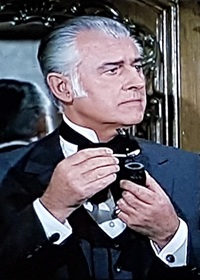
6. Stewart Granger (aged fifty-nine)
The Hound of the Baskervilles (Universal Television, 1972)
By contrast, it’s hard to see why anyone thought this a good idea. Admittedly, Granger had already starred in major adaptations of a couple of nineteenth-century classics – King Solomon’s Mines (1950), The Prisoner of Zenda (1952) – but that was two decades back. He’d never been a great actor and was certainly well past his peak now.
Also, he doesn’t match anyone’s image of Holmes. Indeed, he makes little attempt to fit in with Doyle’s character, saving only the deerstalker, which doesn’t suit him. At one point, he appears briefly in disguise and it’s the most convincing moment – because he genuinely looks nothing like Sherlock Holmes.
Despite which, I rather like him. He treats the role as though Sherlock is a slightly boring detective from a 1970s American series, like a period Banacek (there’s one for the teenagers). As long as you take it in that spirit, he’s fine. I mean, you can see why the proposed series never materialised, and you can see why Granger’s performance is not exactly revered by Sherlockians, but it was a one-off aberration, and I’m prepared to be contrary in my endorsement.
Bernard Fox – formerly in the cast of the sitcoms Bewitched, The Andy Griffith Show and Hogan’s Heroes (more for the teenagers) – is a cheerful and jolly Watson. Elsewhere, William Shatner gives us both Sir Hugo Baskerville and George Stapleton, and is mostly harmless. The more interesting casting is Alan Caillou as Scotland Yard detective Inspector Lestrade, who’s older than normal and rather distinguished-looking – a far cry from the ‘little sallow rat-faced, dark-eyed fellow’ described by Doyle, yet perfectly plausible.
The production does try. The script adds a raft of minor deductions, and Holmes is more prominent, accompanying Watson to Dartmoor, before announcing his return to London. It was made for American TV and features gratuitous shots of St Paul’s Cathedral, the Houses of Parliament and the Natural History Museum for the tourist market. You’ll be surprised how steep a hill Baker Street is.
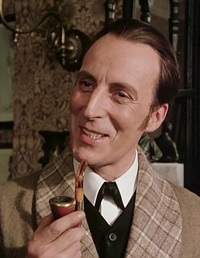
5. Ian Richardson (aged forty-nine)
The Hound of the Baskervilles (Mapleton Films, 1983)
Unlike the previous entrants, Ian Richardson was an excellent actor. But he’s still not Sherlock. He smiles a lot. Far too much, in fact – Holmes just shouldn’t be this cheerful. ‘Pleasant little tune,’ says Watson, as Holmes plays the violin, which isn’t the appropriate response to the ‘exasperating solos’ described in the books.
Watson is played by Donald Churchill and is mostly bland and bumbling. His best moment is teasing Lestrade (Ronald Lacey), who retaliates by expressing his shock that Watson should be here without Holmes. ‘He isn’t in one of his silly disguises?’ he asks. And, of course, he is, and the disguise is silly.
Like the Stewart Granger version, this was made for American TV with British actors. Even Sir Henry Baskerville is played by Martin Shaw (with his voice dubbed by Canadian ex-pat Kerry Shale). Others in the cast include Denholm Elliott, Glynis Barber (then in the midst of her stint on BBC Two as Jane, the semi-dressed comic-strip heroine of the Daily Mirror) and Connie Booth.
The most significant departure from the original is Booth’s character, Laura. ‘She married an artist named Lyons, who came sketching on the moor,’ wrote Doyle. ‘He proved to be a blackguard and deserted her.’ This artist doesn’t actually appear in the book, but he turns up here, and he is indeed a blackguard, an ‘uncouth bounder,’ according to Watson. He’s played by Brian Blessed – insofar as Brian Blessed ever plays anyone apart from Brian Blessed – and is a very welcome addition: there’s plenty of room in Holmes for over-the-top cameos. At one point, he bends a poker into a U-shape (just as Dr Grimesby Roylott did in ‘The Speckled Band’). He’s a good man, says his wife, but ‘unfortunately he was cursed with a vision of genius and only a mediocre talent to express it’. Well, we all know the type.
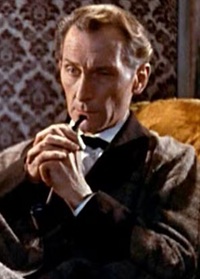
4. Peter Cushing (aged forty-six)
The Hound of the Baskervilles (Hammer Films, 1959)
Hammer had just found its stride with revivals of Frankenstein and Dracula, starring Peter Cushing and Christopher Lee, and it shows – this Hound goes full-throttle on the Gothic paraphernalia, throwing in tarantulas, ritual sacrifice, buxom wenches, a man with webbed fingers, and another who’s tortured over an open fire. It’s a rattling good film, and the interiors look wonderful – just like a Hammer movie, in fact.
It opens with a ten-minute depiction of the old legend, the dastardly Sir Hugo Baskerville being played by David Oxley (he’d recently given us his Gilles de Rais in Saint Joan, so historical monsters were well within his grasp).
When Cushing does finally appear, he’s a bit disappointing. He’s okay as a man of action, he’s got the face and physique for the role, and he makes good use of the props: he smokes a variety of pipes, for example (including a churchwarden, which is always a pleasure to see). But he’s not very Holmesian somehow. There’s no real sense of overwhelming intelligence, and the deductions are unimpressive. And despite some quirks – he writes his appointments on his shirt-cuff, and pins his correspondence to the mantelpiece with a dagger – there’s no real eccentricity.
André Morell – star of the original TV version of Quatermass and the Pit (1958) – is a straight-bat Watson, but there’s no chemistry with Sherlock, no indication of why Holmes lives with him. That relationship has to be right for Sherlock himself to make sense.
As for the rest, Christopher Lee is fine as Sir Henry Baskerville, though it scarcely taxes him. Barrymore is supposed to be one of the suspects for a while, but that’s hard to believe when he’s being played by John Le Mesurier. Best of all is Miles Malleson as Frankland, a genial, bibulous old buffer of a bishop – despite being a departure from the text, he’s great fun, a very music-hall sort of clergyman.
Cushing returned to the role in the BBC’s television series of 1964–68, with the Hound taking up two of the twenty-nine episodes. It’s a much more sober and faithful adaptation, and rather pedestrian. Nigel Stock made little of Watson.
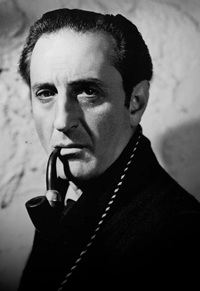
3. Basil Rathbone (aged forty-seven)
The Hound of the Baskervilles (20th Century Fox, 1939)
This was the first of Rathbone’s fourteen movies as Sherlock, and the best of them. He looks right and he approaches the role with a brisk, matter-of-fact precision: the logical calm at the centre of a melodrama, strong on the intellect if not the oddness. He’s also entertaining, if entirely unconvincing, when in disguise as a tinker.
Nigel Bruce’s Watson is bungling, bluff and hearty, like he’s auditioning for a role as either Charters or Caldicott. It’s a monstrously unfair take on the Doyle character, but hugely enjoyable nonetheless.
Of the minor characters, Dr James Mortimer – the man who first brings the case to Holmes – is rather thrown away: Lionel Atwill was fifty-four at the time, as opposed to the ‘young fellow under thirty’ in the book, and there’s no sign of the original’s fascination with phrenology; instead, he’s a spiritualist and his wife is a medium. On the other hand, Frankland is as written – an eccentric neighbour with a passion for litigation – and Barlowe Borland is terrific in the role.
The film ends on a reassuring note. Made at a time when the storm clouds were gathering over Europe, Mortimer is still optimistic: ‘Seeing how you work, knowing that there is in England such a man as you, gives us all a sense of safety and security. God bless you, Mr Holmes.’
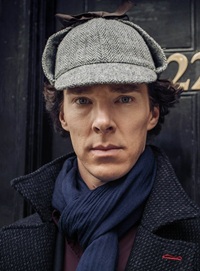
2. Benedict Cumberbatch (aged thirty-six)
The Hounds of Baskerville (BBC Television, 2012)
The BBC’s updating of Sherlock had its faults, but the central casting was flawless. Cumberbatch was magnificent as Holmes, rude, insensitive and utterly convinced of his own genius. The speed at which he delivers his deductions, accompanied by rapid-cut editing, are superb – no one has ever done this better.
And there are subtleties. He has the personal charm that Sherlock needs, turning it on when he needs to get information from ordinary people. And after he first catches sight of the hound, he’s genuinely frightened by what he’s seen and consumed by doubt about his own senses. It’s not very Sherlockian, but Cumberbatch does a convincing display of rage at himself for feeling emotion.
He’s also downright insulting to Watson, in which role Martin Freeman is wonderful (the military gait is particularly admirable). In keeping with tradition, his Watson is slow-witted, but he’s much better at dealing with Sherlock’s moods than most, asking him to stop ‘being all mysterious with your cheekbones and turning your coat collar up so you look cool’. There is a real friendship here.
Among the changes, some are ho-hum (Dr Mortimer is now a woman, a psychotherapist), some are a bit gimmicky (Baskerville is a research establishment dealing in chemical and biological weapons), and some are witty: the signalling from the moor – part of the subplot about the murderer Selden in the book – turns out to be headlights from a dogging site.
Mark Gatiss’s script is mostly excellent, throwing in some nice references, starting with Sherlock’s entrance, covered in blood and carrying a harpoon, straight out of ‘Black Peter’. Regrettably, it also introduces Sherlock’s ‘mind palace’, in which he sits in a semi-trance, making silly hand gestures as he tries to remember something he read once; this is a terrible innovation that will only get worse.
Even more regrettably, Gatiss himself is also seen as Mycroft – not for long, just enough to remind us of what a very bad Mycroft he was. Likewise the brief appearance of Andrew Scott as Moriarty, who had marred the end of the first series; he’s simply risible in the role, hamming it up like a straight-to-video psychopath. Also disappointing was Rupert Graves as Lestrade. (Una Stubbs, on the other hand, is the best Mrs Hudson there’s been.)
The biggest misstep is that Sherlock is seen driving a car. Holmes shouldn’t drive, it’s too irritatingly mundane, that’s got to be Watson’s job.
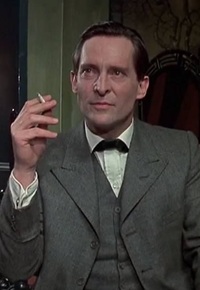
1. Jeremy Brett (aged fifty-five)
The Hound of the Baskervilles (1988)
There’s no revisionist surprise here, no contrarian click-bait content. The world and his wife knows that Jeremy Brett was Sherlock Holmes. His series for Granada TV, which ran from 1984–94 is the gold standard, by which all others will be judged and found wanting. Everything is just so perfect, from the facial tics – the smile that twitches on and off in a sixteenth of a second – to the precision with which he smokes a cigarette. He’s so wonderfully intense, a tightly coiled bundle of intellectual and physical energy that occasionally explodes into action.
Edward Hardwicke (who replaced David Burke in 1986) is an excellent Watson, unimaginative, solid and decent. There’s genuine affection between him and Holmes, such as there is in Doyle.
There’s also an excellent, unflashy supporting cast. Alastair Duncan, in particular, is an appropriately young Dr Mortimer, coming excitedly alive when he gets onto phrenology. And there’s a lovely attention to detail: everyone dresses for dinner in white tie, except for the awkward cuss, Frankland. Also, let’s give full credit for the ending, with Holmes and Watson – as in the original story – going off to see Meyerbeer’s Les Huguenots.
There has never been, nor ever will there be, a better Sherlock.
see also:
Discover more from Lion & Unicorn
Subscribe to get the latest posts sent to your email.

Doyle described Lestrade as a ‘little sallow rat-faced, dark-eyed fellow’? Props to Granada then for the casting of Colin Jeavons.
LikeLike
He’s not applicable since he isn’t ‘on screen’ but my favourite Holmes by far is Clive Merrison from the 1990s radio adaptations.
LikeLike