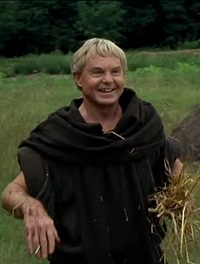
The character Cadfael, a medieval monk who solves murders, was created by Ellis Peters (penname of Edith Pargeter) in a series of twenty novels and one book of short stories, published between 1977 and 1994. The latter year also saw the debut of the ITV adaptation, which ran for thirteen episodes through to Christmas 1998.
The title role was played by Derek Jacobi, then in his late-fifties. He captured the character perfectly: devout but undogmatic, he’s prepared to flout the authority of his superiors when necessary, and is logical in his deductions and generous in his wisdom. He’s liberal even by the standards of the twentieth, let alone the twelfth, century.
The stories were adapted for television by Russell Lewis, later to create Endeavour. So what do they tell us of the times? Here’s a guide to each of the episodes.
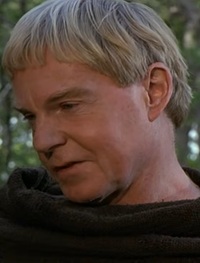
01. ‘One Corpse Too Many’
It’s 1138, and the army of King Stephen has captured Shrewsbury Castle from the rebel forces supporting the Empress Maud. In Shrewsbury Abbey, Brother Cadfael is concerned with the welfare of ‘the innocent and the dispossessed, people least able to defend themselves. We have a duty to them.’
His immediate task is give a Christian burial to the ninety-four rebels who’ve been hanged. Except that there are ninety-five bodies – and the one unaccounted for wasn’t hanged, but strangled. Which means someone has committed murder. Such violence is to be deplored, ‘But when they see kings cut down more than ninety, is it such wonder?’
Cadfael used to be a Crusader – he was at the taking of Jerusalem in 1099 – but now he cultivates his herb garden and prepares medicines. He prescribes an extract from opium poppies, which he calls Papaver somniferum some 600 years before anyone else knew that was its name.
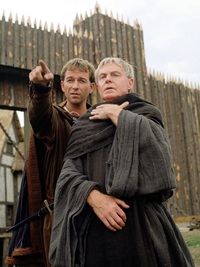
02. ‘The Sanctuary Sparrow’
A goldsmith is assaulted and robbed – and on his son’s wedding-day, as well. A mob decides that a young rebec-playing jongleur is responsible, and he only just escapes them, getting into the Abbey to claim sanctuary. ‘Surely they will deliver him up to the law,’ says the Prior. ‘Yes, by way of the nearest tree,’ retorts Brother Cadfael.
While in the Abbey, the minstrel is visited by the woman he loves and they ‘lay together, as lovers’ in the church. Happily, Cadfael is tolerant of such sacrilege: ‘Where there is mutual love, I find it hard to consider any place too holy to house it.’ And he’s broad-minded enough to recognise that women might also commit murder.
‘You’re not easily deceived,’ his friend, Hugh Beringar, the Under Sheriff of Shropshire, tells him; ‘but I also know you seek goodness in the blackest of hearts.’
There’s a vital clue in scraps of plant found on the body.
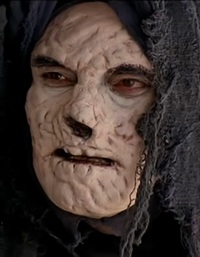
03. ‘The Leper of St Giles’
A young woman is being pushed by her guardians into an unsatisfactory marriage to a nasty nobleman. Luckily, Brother Cadfael – who fought alongside her grandfather at Jerusalem – is on hand, optimistic as ever: ‘Things are not as black as they seem. They seldom are.’
There’s a colony of lepers, excluded from society. ‘We wandering lepers are notoriously vague,’ says one, as he prepares to leave. ‘Relics, we drift from shrine to shrine, staying nowhere long. The fit takes us and the wind blows us away like dust.’ Cadfael tells him that, despite his outward appearance, he has a beautiful heart.
‘I plant for fragrance, as well as colour and medicinal use,’ says Cadfael of his herb garden. ‘I sometimes think that the senses are the gateway to the soul. We should celebrate them more.’ He also makes wine, ‘one of my most sought-after medicines’.
There’s a vital clue in scraps of plant found on the body.
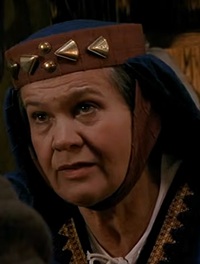
4. ‘Monk’s Hood’
A nasty nobleman is resolved to dispossess his stepson, angered – according to his wife – that the boy ‘chooses to be with simple folk and craftsmen’. Instead, he’s going to leave his estate to the Abbey, but before he can have the documents signed, he’s murdered, poisoned with oil of monk’s hood, taken from Brother Cadfael’s workshop. Few shed any tears for a man who, says a servant, ‘did not treat the womenfolk as a husband and master should’.
Certainly, the widow isn’t overcome with grief, particularly now that she’s seen Cadfael again. She knew him years ago; she was his sweetheart, who he left behind when he went crusading; he was away so long that she married someone else, though her love remained undiminished.
The dead man’s estate is on Welsh land, which means the Norman laws of inheritance don’t apply, much to Cadfael’s satisfaction: ‘I approve and endorse the law of Wales which says that a son born out of wedlock may inherit.’
Cadfael spells out his mission statement. He will give assistance ‘to any who may fall suspect unjustly. And I shall do what I can to uncover the guilty.’ He also offers his advice on how to live: ‘Give your love freely and look for nothing in return. No man is measured by the love he gives to others but by how much he is loved.’

5. ‘The Virgin in the Ice’
Brother Cadfael’s novice, Brother Oswin, has been attacked and left for dead by bandits, who are encamping in the forest. Separately, Sister Hilaria, a nun who was with him, is found dead, having been ‘defiled’ and murdered. They were escorting a young brother and sister.
The latter is betrothed to a nasty nobleman, but is in love with a Crusader, a ‘half breed’ of mixed Syrian and English parentage. His mother was ‘a good woman, of Islam’, and he is ‘got between faiths and peoples’. He’s also, he says, a bastard, though Cadfael isn’t overly concerned: ‘Half humankind matches without ritual blessing. And not necessarily the worse half.’
Cadfael doesn’t hold with worrying about what might have been. ‘There is no profit in ifs. We go from where we stand.’ A monk spins a farfetched hypothesis, and is greeted with disbelief by Hugh Beringar: ‘You might equally suggest that the Earth moves around the Sun!’
There’s a vital clue in scraps of plant found on the body. Fortunately, Cadfael has drawn up a map ‘to locate the position of various herbs in the area’.

6. ‘The Devil’s Novice’
Not all monks are devout servants of God. There’s one here who dresses in rich velvet, over-indulges in wine and lusts after women. He’s travelling on the king’s business as a diplomat when he’s murdered. ‘Civil war breeds felons like a rotting cat breeds maggots,’ observes a churchman. So might this killing be political, committed by those who owe allegiance to the Empress Maud?
Meanwhile, a young man who was one of the last to see the murder victim alive comes to the Abbey, seeking admission as a novice. He’s not really suited to monastic life, though; he’s prone to nightmares and fits of violence. ‘Is it demons?’ wonders another novice. ‘If it is, they shall be exorcised,’ replies the Prior, grimly. Even Brother Cadfael can do little with him: ‘I have never known a novice pursue his vocation with so much passion and so little joy.’

7. ‘A Morbid Taste for Bones’
‘Do you deny the benefits of blood-letting, Brother Cadfael?’ asks the Prior. ‘That it calms the body and therefore the soul?’ It seems that he does so deny: ‘Even in the house of God, there is danger in excess.’
And so there is. Under the influence of blood-letting, a monk has a vision of St Winifred, who is buried in Wales, and the Prior sees this as a sign that she should be brought to Shrewsbury, to add to the glory of the Abbey. ‘Where is the glory in digging up a young girl’s remains?’ queries Cadfael. Despite such misgivings, Father Abbot orders him to join the party sent to retrieve the bones, on the grounds that ‘You have Welsh blood and knowledge of the world’.
When they reach the village where the remains lie, the local lord opposes the removal. He tells the story of St Winifred. She refused the advances of a young nobleman, who ‘sliced her head from her shoulders. Whereupon the miracle. Her head grew back again and she stood up alive, while he melted into the grass like wax in a fire.’* Then the Welsh lord is murdered. Could a holy brother have killed from an excess of zeal?
Some of the other monks doubt Cadfael’s allegiance. ‘You seem to be more Welsh than Benedictine.’
* This is a little garbled. The real story is that her head was joined back onto her body by her great-uncle, Saint Bueno.
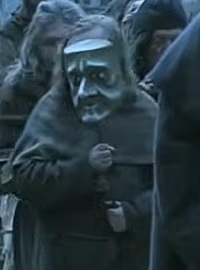
8. ‘The Rose Rent’
Brother Cadfael offers medicine to the wife of a man dying in agony: a tincture of Paynim poppy and hemlock. ‘One thimbleful may dull the pain,’ he says. ‘Two thimblesful and the pain will be dulled – for ever.’ She takes the hint.
Now widowed, and being both beautiful and rich (she runs a cloth-making business), she is ‘desired by many’, including a young monk who, says Father Abbot, ‘had confessed an involuntary love’ for her. The past tense is because the monk has been found dead, murdered. There’s a footprint near the body, from which Cadfael takes a wax imprint.
Meanwhile, the widow is abducted by one of her admirers, who threatens her with ‘marriage by rape’.
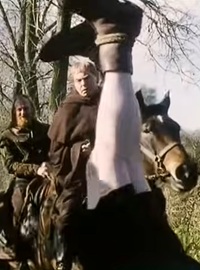
9. ‘Saint Peter’s Fair’
The annual St Peter’s Fair lasts three days and is the biggest event of the year in Shrewsbury. But there are tensions. The shopkeepers of the town object to the royal charter that says traders coming in for the Fair must pay a toll to the Abbey, while they get nothing to compensate for the competition. When Father Abbot rejects their entreaties, a fight breaks out.
And maybe such disputes are inevitable, reflects Brother Cadfael. ‘In a land torn by civil war, our Fairs are merely the battleground for rival factions.’
Later, a visiting wine-merchant is found murdered, with his tongue cut out. The man’s niece worries that he ‘died without absolution’, but Cadfael reassures her that the Church’s ministrations are not entirely essential: ‘Penitence is in the heart, not in the words spoken. God knows the record without need for gesture or word.’
Cadfael explains that it’s important to keep an open mind in investigations: ‘We must always be wary of “musts”. Nothing is certain.’
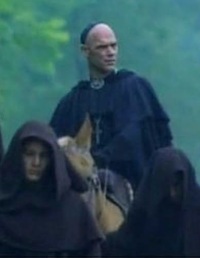
10. ‘The Raven in the Foregate’
There’s a new priest in town, and he’s a hardliner, in matters both profane – he’s ‘a political zealot’, whose allegiance is strongly to King Stephen – and sacred: ‘The letter of divine law admits no compromise.’ His flock don’t take to him, particularly when he reclaims fields that his predecessor allowed the villagers to use. They protest that without these crops they’ll starve. ‘What about our children?’ they ask, and he replies: ‘You should not have had so many if you have not the means to feed them.’
A young woman – unmarried, but pregnant – comes to him to confess, but he refuses to absolve her. Even after she’s found dead, having apparently committed suicide, he refuses to cede any ground. ‘She was a whore,’ he insists. ‘To give absolution to such a jade would itself have been a sin.’ Then he’s found dead, as well.
Brother Cadfael, of course, disapproves of the priest and his interpretation of Christian teaching. So too does Father Abbot. ‘Behind the letter of the law lies something just as great: the spirit of the law. When these two move in conflict, only one thing can resolve it – human compassion.’ But these are not days of compassion. ‘While the civil war lasts,’ says the Abbot, ‘all men are traitors to one cause or another.’
There’s a vital clue in a scrap of plant found on the body.
11. ‘The Holy Thief’
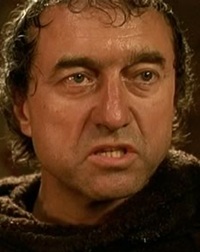
‘The year is 1144. A civil war, unforgiving and cruel, rages in England. King Stephen fights to retain his throne against the pretender, the Empress Maud, a fight that stretches to the furthest corners of the realm – even to the Abbey at Shrewsbury.’
Mind you, some places have it worse. Maud’s forces have burnt down Ramsey Abbey in Cambridgeshire, and the Prior turns up in Shrewsbury. One of his novices has had a holy vision of St Winifred, and now the Prior wants her bones to enable the rebuilding of Ramsey – there’s money to be made from pilgrims to such a shrine. Brother Cadfael takes against him, believes he’s manipulating the novice for his own purposes. ‘Ambition is a vicious mistress.’
A nasty nobleman also wants the bones of St Winifred, though he’s not noticeably reverential towards the relics. ‘Men and iron move the world,’ he says, ‘not long-dead girls from Wales.’
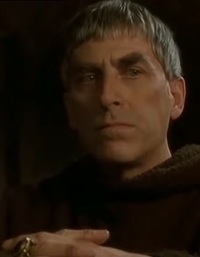
To resolve the dispute, a Sortes Biblicae is held. Each of the claimants are blindfolded, open the Bible at random and point to a verse, the interpretation of which reveals the will of God. Hugh Beringar prefers more conventional means of testing for the truth – ordeal by water usually does the trick.
The Prior from Ramsey insults a young woman, a singer who’s a slave, calling her ‘a tavern slut’. Cadfael is outraged: ‘The Church disapproves of slavery, not the slave.’
There’s a vital clue in a thread found on a dead man’s body.
12. ‘The Potter’s Field’
A potter feels a calling to become a monk. ‘It is God’s will, it is not my doing,’ he says. ‘I am drawn and can no longer resist.’ This infuriates his wife, who has no wish to be abandoned by her man. The lord of the manor – who’s a nice nobleman for the most part, but one whose wife has been seriously ill for many years – provides her with physical comfort. ‘He and I, we have our needs,’ she explains.
Then the nobleman goes off to fight with King Stephen (and gets himself killed) while she goes missing. A year later, the body of a woman is found buried in the potter’s field. The townsfolk decide the potter-turned-monk killed his wife. But Brother Cadfael is by no means convinced.
He’s not convinced, either, by those who believe that through suffering, they can expiate their sins. ‘I myself have grave doubts on the doctrine of suffering.’
13. ‘The Pilgrim of Hate’
It’s Cripples Day, and a hundred or so pilgrims, ‘all sick and crippled’, have arrived at Shrewsbury Abbey to touch the casket containing St Winifred’s bones in hope of a miracle cure. Among them are conmen, charlatans and pickpockets. And among their luggage, there’s a sack containing the dead body of an old man, ‘trussed up like a cooking fowl’. Brother Cadfael decides he needs to conduct a Mos Teutonicus: ‘A vat is filled with vinegar and the body is boiled inside it until the flesh separates from the bones. I need to examine the skull…’
A penitential pilgrim turns out not to be as holy as thought, when he hits a young woman. ‘I am doing God’s work,’ he cries, but Cadfael is contemptuous: ‘God’s work! You’re not fit even to mention His name, let alone presume to act on His behalf.’ There is indeed a miracle, when a lame man casts aside his crutches and walks – except that he wasn’t really lame in the first place.
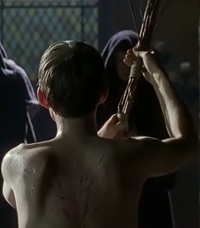
A young novice self-flagellates and abases himself, seeking suffering to pay for his sins, but Cadfael puts him straight. ‘There are so many people in this world born to pain they’ve not chosen. Your prayers are enough. Nothing more is wanted.’
see also:



Discover more from Lion & Unicorn
Subscribe to get the latest posts sent to your email.
