Room 13, serialised in the Daily Express in 1923 and published in hardback the following year, was not one of Edgar Wallace’s better novels, a rather convoluted and not very interesting tale of counterfeiters. It did, though, feature an incidental character who had possibilities.
John Gray Reeder is a diffident, slightly shabby chap in his fifties, who lives in Brockley, south London, and has a tendency to ramble on inconsequentially about poultry-keeping and flowers. Appearances can be deceptive, however, and Reeder is actually a highly intelligent, remarkably well-informed man who works as an investigating agent for the banks – or possibly for the Treasury, it’s never quite clear.
In the denouement, it turns out that the man who’s been called Reeder all the way through is not actually Reeder at all; the real Reeder is a young undercover cop who we thought was a villain. But Wallace clearly liked the ‘middle-aged man, with rather a sad face’ and, in a series of stories that began serialisation in 1924, brought him back, reverting to the name of Mr J. G. Reeder. He was now working for the Director of Public Prosecutions, which meant that he could investigate theft and murder, not just forgery and fraud. In this incarnation, he starred in four books, the last one published in 1932, the year of Wallace’s death.
‘I see wrong in everything,’ says Reeder. ‘That is my curious perversion – I have a criminal mind!’ And that was the primary appeal of the character: the discrepancy between his nondescript appearance and a brain that is sharper than those of the crooks he invariably catches. They tend to underestimate him, and don’t notice that he’s always a couple of steps ahead. He also has an encyclopaedic knowledge of criminal cases that Sherlock Holmes would envy.
There were some early screen adaptations, including a couple with music-hall veteran Will Fyffe (of ‘I Belong to Glasgow’ fame), but the character had pretty much disappeared from view when Thames Television decided to revive him in 1969. The timing was fortuitous. After years of looking to the future, popular culture had suddenly rediscovered nostalgia, with the success of Bonnie and Clyde (1967) in America, and the BBC adaptation of The Forsyte Saga (1967) – it made perfect sense to set a detective show in the 1920s.

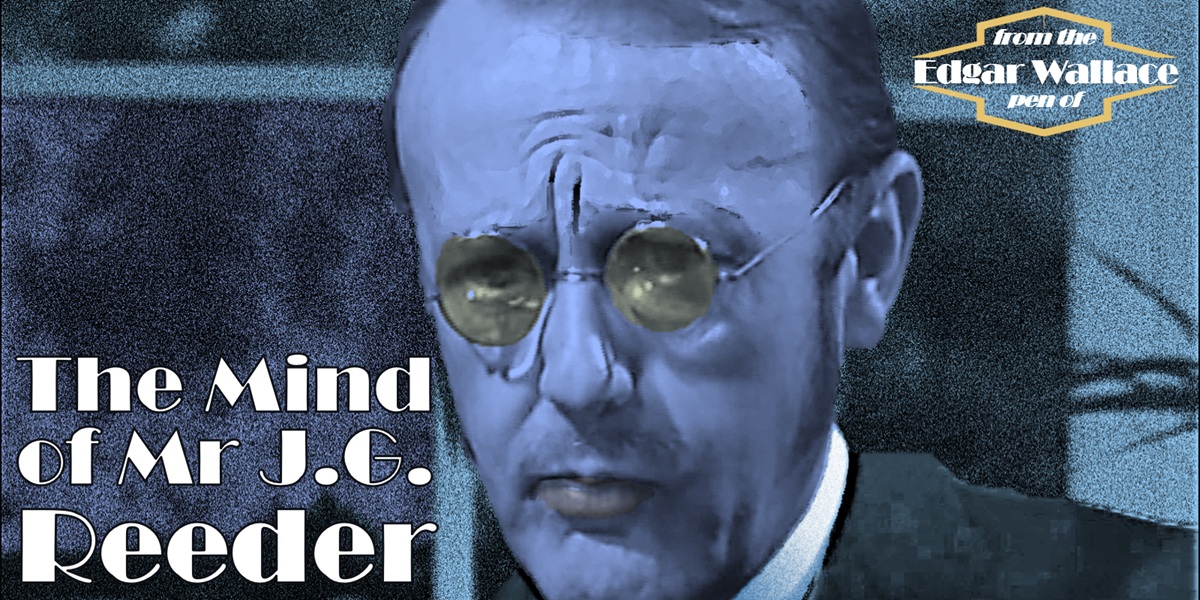
The Thames series, The Mind of Mr J. G. Reeder, took its title from Wallace’s first collection of stories. The plots for the first series come from there as well, and they’re pretty faithful to the originals. Where they’re not, they’re an improvement. In particular, there are a couple of crucial additions.
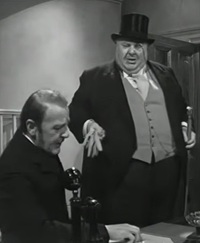
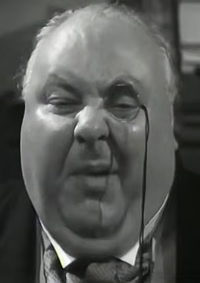
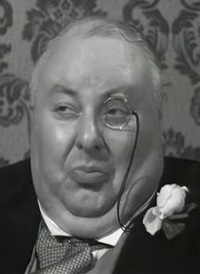
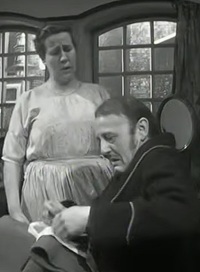
In the original, Reeder’s superior is known only as the Public Prosecutor, and he’s a tolerant, fair-minded kind of man. On television, played with relish by the wonderfully corpulent Willoughby Goddard, he becomes crusty, snobbish Sir Jason Toovey, a brandy-drinking, snuff-taking bully who blusters at the mild-mannered Reeder and takes credit for his successes. The contrast between their adjoining offices spells out their very different status: Sir Jason’s is lavishly furnished and provisioned with alcohol, like a room in a gentlemen’s club; Reeder’s is spartan in the extreme, a desk and chair and not much else. The series also introduces Mona Bruce as Reeder’s Scottish housekeeper, Mrs Houchin, a woman with a veritable fetish for offal. One hopes that Wallace would have approved of the comedy that these two bring to the show.
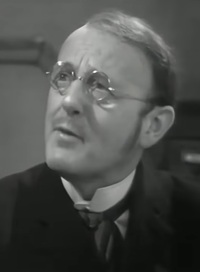
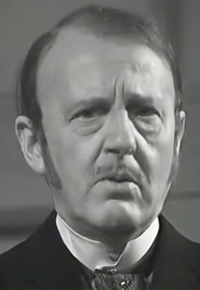
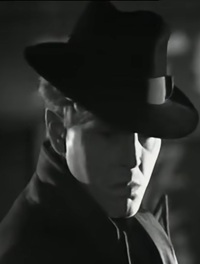
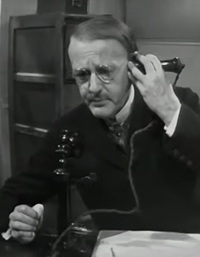
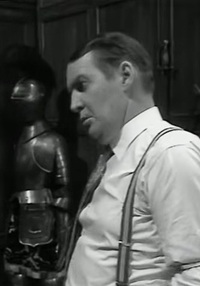
He would surely have approved the casting of Hugh Burden as Mr J. G. Reeder. Burden is simply perfect. He looks just like the first illustration in the Express, and his manner is suitably modest, fastidious and shy. His sideburns are dated, as are his clothes, and his barely-there moustache looks like a mistake. His hesitant pursuit of Miss Belman (first Virginia Stride, then Gillian Lewis) is rather sweet.
For the most part, the stories aren’t mysteries. When we’re not shown who done it right at the outset, we’re seldom in much doubt on the question. Rather, the pleasure lies in seeing Reeder outwit his foes. He’s like a Jazz Age Columbo.
There’s a jaunty theme tune (uncredited), with art-deco titles, and incidental music on the banjo, but what else do we learn of how the mid-1920s were seen? What period details were deemed worthy of mention in 1969-71? Here’s a guide to all sixteen episodes.
Series One
1. The Treasure Hunt
The headlines in the Daily Chronicle read ‘PM flies to League of Nations’ and ‘Lenin dies – Passing of prominent Bolshevik’, so we’re in 1924. There’s a nod to domestic affairs as well; Sir Jason Toovey has received a letter from ‘a young lady friend of Mr Lloyd George’s, who needs some assistance’.
Other signs of the times: mention of a crystal radio set, and convicts sewing mailbags. Reeder is described as being as nervous as ‘a maiden aunt who’s suddenly been frightened by a motor car’, but he keeps a revolver with a silencer in his desk at home, and is a very good shot.
He hardly touched his ‘sheep’s brain and giblet sauce’ yesterday, but Mrs Houchin promises him ‘boiled pig’s head’ tonight.
2. The Stealer of Marble
‘Ramsay MacDonald forms ministry’ is the headline in the Daily Mail. ‘It’s the beginning of the end,’ says Toovey. ‘Sigmund Freud, George Bernard Shaw and a Labour government. The old values are done for, Reeder. You know what we face, don’t you? Anarchy. Bolshevistic anarchy.’
Reeder is more worried about the influence of America: ‘The moving picture, the crossword puzzle, even the ice-cream block may be described as beneficial, but I fear that insecticide is a very different matter. Whenever the word “extermination” crosses my mind, I can’t help thinking it won’t stop at insects.’
Reeder’s secretary, Miss Pangbourne (Alison McMurdo), wants to go to the cinema to see Rudolph Valentino in The Shiek (1921), but her mother won’t let her, so she’s reading the novel by Edith Maud Hull instead.
3. The Green Mamba
Headline in the Daily Graphic: ‘King opens Empire Exhibition at Wembley’. Miss Pangbourne wants to go to the Exhibition, but her mother won’t let her, not without a chaperone. Reeder would like to see the Australian Pavilion, where there’s ‘a statue in butter, in Australian butter, of our great cricketer, Mr Jack Hobbs, executing his famous off-drive.’ (Actually, it showed Hobbs having just been bowled out: it was, after all, an Australian creation.)
A judge, sentencing a forger to seven years,* is outraged by his ‘evil attempts to debase the world’s most stable currency – sterling – thereby striking at the very roots of our industrial and commercial life.’ Miss Pangbourne tells Reeder that his square-top bowler-hat and his square-toed shoes are old fashioned. Toovey is unhappy with being reprimanded by ‘a Labour home secretary’.
* He got twenty years in the book.

4. Sheer Melodrama
In India, Ras Lal Punjabi (Michael Bates) is sentenced to six months’ jail for attempting to steal the jewels of a police superintendent’s wife – ‘their ill-gotten imperialistic gains,’ as he sees it. Back in London, forger Tommy Fenalow (Ken Campbell) is outraged when the police raid his flat. ‘What do you think we’ve got? Machine guns for Ireland?’
Reeder takes Miss Belman to the theatre, to see a new comedy, Marriage for Money. He doesn’t approve of the lax morality. It’s not like when he was a boy and watching Sweeney Todd, the Demon Barber of Fleet Street: ‘Now there was a play. Evil crushed underfoot, virtue triumphant. Why can’t our modern playwrights produce uplifting work like Sweeney?’ Ras Lal, now in London, is also off to the theatre, to see Sybil Thorndyke in Saint Joan by ‘famous anti-British author George Bernard Shaw’.
Toovey has dinner with the home secretary. ‘I’m told that, for a socialist, he keeps a very good table,’ says Reeder.
5. The Strange Case
The Earl of Sellington (John Robinson), under-secretary of state for foreign affairs, is active in charitable work on behalf of the Belgian War Refugees. It’s more than five years since the Armistice, yet ‘The number of refugee children in Europe under the age of sixteen – it cannot be less than a quarter of a million.’
His son, Sir Harry Carlin (Edward Fox) frequents a Limehouse opium den. ‘How long have you been here today?’ asks Reeder. ‘Oh, I don’t know,’ he replies, wearily. ‘Several thousand years, they’ve gone in a flash.’ The opium den is behind a Chinese restaurant, where Reeder confidently orders dinner without looking at the menu. Reeder always carries a tightly furled umbrella – we now learn that it conceals a hidden knife.
Carlin’s estranged wife, Lady Mary (Jennifer Wilson), goes to work as Reeder’s secretary (pay: £2 5s a week), which offends Toovey. ‘I always suspected Bolshevistic tendencies under that meek exterior of yours. To employ the wife of a member of the aristocracy as a common secretary! It’s democracy run mad.’ Toovey is a member of the Reform Club. ‘Not that we wish to reform anything nowadays.’
6. The Poetical Policeman
Reeder has been ‘to the local picture palace to see that admirable cowboy film actor, Mr Thomas Mix and his Wonder Horse’. (That’s Tom Mix and Tony to you and me.)
The new secretary sings ‘Yes Sir, That’s My Baby’ as she goes about her business, so clearly we’ve moved on to 1925. Despite appearing to be an empty-headed flapper, she comes from radical stock (‘her mother was one of the early suffragettes’) and wants to make her own way in the world – like Ivy Williams, ‘the first lady barrister’.
Mrs Houchin can be quite sentimental about her childhood. ‘I can recall to this day as a wee lassie, sitting on my Uncle Hector’s knee, and playing with his magnificent mowser.’ She’s made sheep’s head broth for Reeder’s dinner.
7. The Troupe
A wealthy young man – his father having ‘made six million pounds out of making cups and saucers’ – has other interests in life: he’s the author of Homo Sum, a slim volume of poetry. In short, he’s the kind of dope that attracts the interest of a troupe of confidence tricksters. Luckily, Reeder’s on their tail, though Toovey would rather his attention was elsewhere: ‘I’ve just received a memorandum from the home secretary asking me if we have any information about these Bolshevik agitators.’
Headline in the Morning Post: ‘“Peace is my aim” says Signor Mussolini’. The gang of crooks sing ‘Burlington Bertie from Bow’. Mrs Houchin makes Reeder a picnic of ‘cheese sandwiches and black pudding’.
8. The Investors
Reeder is off to the theatre with Miss Belman, to see William Archer’s play, ‘The Green Goddess, with that admirable gentleman actor, Mr George Arliss’.
Mrs Houchin insists that Reeder eat up his breakfast kidneys: ‘How many times must I tell you never to go investigating on an empty stomach?’ Later, there’s braised liver for dinner. Later still, Reeder catches a cold, and she has to revert to her repertoire of invalid food: ‘I’ve got some nice Spanish onions boiled in milk for your dinner.’
Series Two
9. The Duke
‘I am aware of the evils which have followed in the wake of Prohibition,’ says Toovey. ‘I see no reason to tolerate them in this country.’
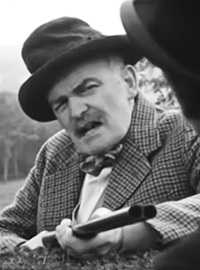
Alphonse ‘Duke’ Dorsey (Ray McAnally), a Chicago gangster, has inherited a big country house in Sussex from the English side of his family. The staff aren’t happy, particularly – reports the butler – the cook: ‘All she’s asked to prepare these days is Italian muck, spaghetti and the like. Very fond of spaghetti is Mr Dorsey.’ That’ll be the Sicilian side of his family.
On his arrival in England, he bought a sawn-off shotgun, which, says Reeder, ‘shares with the Thompson submachine gun a current vogue among the criminal classes in America’.
‘I deplore parvenus and social climbers,’ snorts Toovey. The Duke’s moll (Toby Robins) sings ‘Hard Hearted Hannah (The Vamp from Savannah)’.
10. Man with a Strange Tattoo
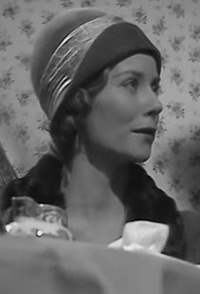
Lady Rothbard (Jane Baxter) has shot dead an Indian in her house, who – she says – was attempting to steal her jewels, attracted no doubt by the status she and her husband enjoyed while in India: ‘After the Viceroy, the Rothbards were the elite of the British Raj.’ In fact, the man was seeking revenge for the theft twenty-five years ago by a British army officer of a ruby from a holy statue in a temple in Bangalore. The back-story is filled in by a couple of veterans, one a Chelsea pensioner (Billy Russell), the other a pub landlord (Leslie Dwyer).
Miss Belman has been looking something up in the papers. ‘Let me guess,’ says Reeder. ‘In the Daily Chronicle, Miss Ethel M. Dell.’ ‘No, the Adelphi magazine, Mr D. H. Lawrence,’ she replies.
11. The Shadow Man
Reeder is on his special subject: bank fraud. He explains how his ‘criminal mind’ allowed him to work out what the crooks are up to: ‘I’ve merely taken the few flimsy facts that were available and projected them into a feasible operation.’
He’s currently reading a book titled Fairy Twinklefeet and the Twelve Genii.
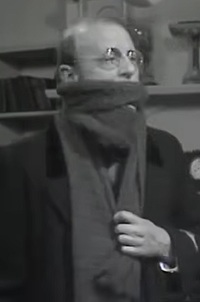
‘Some good beef custard,’ announces Mrs Houchin, bringing in a tray. Regrettably, he doesn’t get a chance to enjoy it, because a man is shot on his doorstep. ‘Whatever will the neighbours think?’ frets Mrs Houchin. Then she sees the blood on the step and shakes her head: ‘That will need to be scrubbed by morning.’ She also worries about Reeder’s health, what with him being out in all weathers, so she’s knitted him a scarf to keep him warm.
12. Death of an Angel
‘The moving picture industry in this country is at its lowest ebb at the moment,’ says Reeder. Financially, it’s outgunned by Hollywood, and there are those who think it downright immoral. On the other hand, there are those trying to raise the tone, such as the Ecclesiastical Kinematographic Association – putting ‘the tools of the Devil in the service of the Church,’ in Reeder’s words.
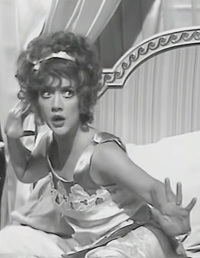
The EKA is run by the Rev. Oswald Ellis (Michael Gwynn), ordained by a dubious-sounding Australian church, the Christian Gospel Temple. Ellis has found a new star, Ethel Gibson (Amanda Barrie). ‘She could be the English Pola Negri,’ he enthuses.
13. The Willing Victim
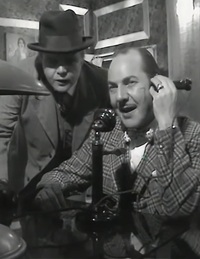
Gangster Lew Kassio (Harry Towb) and his henchman Danny (Geoffrey Hughes) are expanding operations from vice into protection. They try to fit Reeder up for a murder, and Toovey shows the better side of himself by backing his subordinate against Scotland Yard.
Reeder invites Miss Belman to see ‘Mr Henry Kendall’s admirable play at the Haymarket’.
‘I’ve made you a clootie dumpling, Mr Reeder,’ says Mrs Houchin. ‘It was my late husband’s favourite.’
14. The Fatal Engagement
The new secretary is the daughter of Lord Trottingham-Fox. ‘It appears that today some young ladies wish to be something more than debutantes,’ explains Toovey. ‘Can’t think why.’ Reeder describes her as ‘a girl of quite exceptional background and breeding,’ though these are ‘qualities which unfortunately are not always accompanied by intelligence and common sense.’
We’re back in 1924, and Philip Snowden has just delivered the first (rather disappointing) Labour budget. Meanwhile Hetty Malone, a musical-comedy actress, has been murdered, and her contacts book turns out to be full of well-connected names, including peers of the realm, a KC and a bishop. Also, the proprietor of the Daily Citizen, ‘the one remaining newspaper which stands for everything that the people refer to as Victorian morality,’ according to Reeder. ‘Mrs Houchin swears by it.’
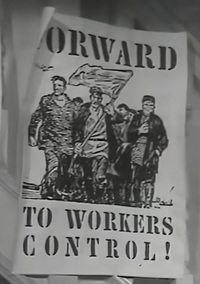
If these pillars of the establishment are implicated in the murder, worries Toovey, it might mean revolution. ‘With the country in the state it is – strikes, unemployment, marches,’ he says; ‘with the Bolshevik ready to strike, this could be just the spark to set it off.’ ‘This is England,’ protests Reeder. ‘I hardly think there’s likely to be a revolution here.’
The young editor of the Red Dawn is uncertain how to proceed. ‘We have to be on our guard against extreme militant deviations on the one hand and petty-bourgeois cowardice on the other.’ He is, we discover, the estranged son of the Daily Citizen’s owner. He’s also a theatre-goer; he’s been to see The Vortex by a new writer, Noël Coward. (‘A promising talent, by all accounts,’ says Reeder. ‘Slightly decadent, I believe.’)
Ultimately, Toovey is sanguine, having heard a rumour that the Russian government is in trouble. ‘Before the winter’s out, we shall have a Czar back in Moscow again.’
15. Find the Lady
Young ladies in high society are going missing. ‘Dammit, sir!’ expostulates the Lord Chamberlain. ‘It could be a Bolshevik plot.’ Reeder fears it might be might be even worse than that: ‘We may have stumbled on a fiendish white-slave traffic in the finest flower of English maidenhood.’
Reeder goes undercover, disguised as an organ grinder, along with Chief Inspector Pyne (Windsor Davies, who’s had a rapid promotion – he was only a desk sergeant in series one).
‘Empire’s not what it was,’ laments the 37th Earl of Colebrook (John Barron). Later, he meets Reeder and is unimpressed: ‘Country’s going to the dogs, but I never knew we had such weedy policemen.’ Mind you, Reeder doesn’t think much of the aristocracy either: ‘I cannot understand this veneration of the descendant of a bloodthirsty eleventh-century brigand who enriched himself by seizing other people’s property.’
16. The Treasure House
‘Crime is becoming more and more international,’ complains Toovey. ‘A lot of foreigners coming into the country. These aliens trafficking vice, drugs, protection rackets mustn’t be allowed to get away with it over here.’ It’s the Americans who have him worried.
Reeder sings ‘Yes, We Have No Bananas’. Toovey has had the last two Bath Olivers in the office, so would Reeder like a custard cream instead? ‘Frankly, the thought is revolting.’
Mrs Houchin shares her recipe for sheep’s brain: ‘You take your brains and soak them in salt water for three hours. Then you remove the skin and the veins…’
My thanks to John Flaxman for enthusing about this series.
see also:





Discover more from Lion & Unicorn
Subscribe to get the latest posts sent to your email.

Pingback: History cops: Cribb | Lion & Unicorn
Pingback: History cops: Ashes to Ashes | Lion & Unicorn
Pingback: History cops: Life on Mars | Lion & Unicorn
Pingback: History cops: Foyle’s War | Lion & Unicorn
Pingback: History cops: Endeavour | Lion & Unicorn
Pingback: History cops: George Gently pt 1 – Lion & Unicorn