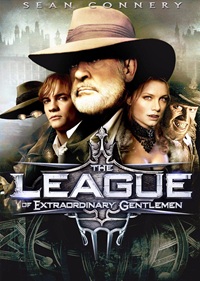
SIMON MATTHEWS watches Steven Norrington’s 2003 steampunk superhero movie The League of Extraordinary Gentlemen.
If you’ve read some books and seen some films, much of this will be familiar. It’s not every day that one goes to the cinema and watches something with characters cannibalised from such an array of sources. With Allan Quartermain (created 1885) alongside Captain Nemo (1870), Mina Harker (1897, from Dracula), Dorian Gray (1890), an invisible man (1897), Tom Sawyer (1876) and Jekyll and Hyde (1886) battling against Professor Moriarty (1893) and comparative newcomer Le Fantome (1911), and book-ended by Ishmael (1851, from Moby Dick) and ‘M’ (1953) this is drama – of a sort – pillaged from various works of popular fiction, most happily out of copyright, written by others over a period of a hundred years.
Perpetrated by strip-cartoonist Alan Moore, the obvious label for this is pastiche, with Moore’s preference for late nineteenth century ‘scientific romances’ placing it in the burgeoning ‘steam-punk’ category. (Wikipedia also describes it as ‘diesel-punk’, notionally a slightly later art-deco setting, though this seems absent on screen.)
Published in 1999 as a series of comic books, its popularity was so marked that sketching out Moore’s background is required if we are to understand its genesis. Expelled from school in 1970 for dealing LSD, he was involved with a local Arts Lab for a couple of years, got married in 1975 and held down a day job with the gas board whilst living in one of the brand-new council flats built in and around Northampton. Designated a new town in 1968, this was an area not without bohemian/counter-culture leanings, hosting post-punk band Bauhaus, with whom Moore had connections in later years. He eventually had some drawings published in New Musical Express. By 1980 Sounds were running one of his comic strips and paying him £35 a week, at which point he went freelance and never looked back.
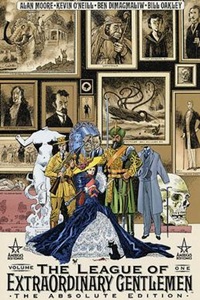
In terms of where – exactly – his work belongs on the literary spectrum, the obvious comparison would be Michael Moorcock’s The War Lord of the Air (1971, and sequels 1974 and 1981) which imitates the style of H.G. Wells, circa 1900, and peoples its narrative with real historical figures. Moore does the same and, as originally written, his strip included Sax Rohmer’s Fu Manchu (1912) and Virginia Woolf’s Orlando (1928) amongst his gallery of characters, with the ensemble battling their way through the events that occur in The War of the Worlds (1898).
Hollywood – always interested in cartoon super heroes – eventually came knocking. His 1989 strip, From Hell, clearly based on Stephen Knight’s Jack the Ripper: The Final Solution (1976) and its theories about freemasonry and the Duke of Clarence and Avondale, reached the screen in 2001. Starring Johnny Depp as a druggy (and psychic) Inspector Abberline, it did well financially. There had been talk of Sean Connery co-starring, as Sir William Gull, surgeon to the Royal Family, but the part went to Ian Holm instead.
At seventy-three though, Connery remained in the market for a major, career-peaking – and cash-generating – role, preferably in a franchise. He got a lot of money for his appearance in Indiana Jones and the Last Crusade (1989) but subsequently rejected The Matrix (1999) and The Lord of the Rings (2001, as Gandalf). Had he accepted these, his earnings would have been nudging $1billion. Moore’s ability to write a colourful adventure story, featuring recognisable characters with a plot spun across decades – or even centuries – to allow for sequels, ticked numerous boxes. Connery agreed to star as Allan Quartermain whilst also acting as executive producer.
Stephen Norrington, a UK special-effects artist who had scored a big hit with Blade (1998), came in as director with comic-book writer James Dale Robinson hired to produce a script. Assembling a cast proved difficult, however, not least because Connery’s starting fee ($17m) ate up such a significant part of the budget. As a result, the supporting actors, though perfectly competent, are not well-known names.
Issues also arose with translating Moore’s work into a big-budget film. The Wells estate vigorously defended their rights, resulting in their invisible man being replaced by an invisible man, and Fu Manchu was dropped. (Why offend Asian audiences with stereotypes?) Orlando (problematic sexuality etc) got jettisoned too, with a clean-cut Tom Sawyer, appealing to teenagers everywhere, inserted, playing a US secret-service agent.
The plot commences in 1899 with the Fantome robbing the Bank of England, amidst a lot of First World War vintage tanks and infantry, supported by a fleet of Zeppelin airships. All slightly too early in historical terms, of course, but why is this happening? To obtain Leonardo da Vinci’s blueprints of Venice’s foundations, stored in the vaults beneath Threadneedle Street. Why Venice? Because world leaders are meeting there, and the Fantome wants to attack them, causing a war between the major powers.

Enter ‘M’, who approaches Allan Quartermain so this may be averted. Quartermain assembles a team of super-heroes – the League of Extraordinary Gentlemen – to deal with the threat. They have three days to save the world and travel to Venice on board the Nautilus with Captain Nemo. Nemo and his crew wear elaborate uniforms, including turbans, making this part of the story a bit like Sinbad the Sailor.
After much skullduggery, Venice – sadly – gets demolished, and the action switches to northern Mongolia where it is revealed that the Fantome, ‘M’ and Moriarty are one and the same. They’re running an enormous evil-looking fortress, guarded by Nazi lookalikes, manufacturing massive amounts of arms that they will use in their quest for world domination. Shades here – given the remote locale and doomy imagery – of Lord of the Rings. There is a fight to the death. Eventually the Fantome/M/Moriarty stabs Quartermain but is then despatched by Sawyer. A fatally wounded Quartermain dies, wishing Sawyer luck in the challenges he will face. (And, presumably, setting the stage for Sawyer to lead the team through numerous sequels.)
There isn’t much more to it than that, and the acting is irrelevant. It’s about as believable as Raiders of the Lost Ark. As Quartermain, Connery is surprisingly youthful looking. There are lots of droll comments, including jokey Bond-style banter with ‘M’, some of the one-liners are quite funny, and everything rattles along from one noisy set piece to another.
On the bonus side, there are nicely rendered chiaroscuro scenes of late-Victorian London and some of the music – by Trevor Jones – is rather good, if slightly overblown. We should also note that the scenes of a collapsing Venice are effective, with a similar sequence used in the 2006 version of Casino Royale despite being absent from Fleming’s 1953 book.
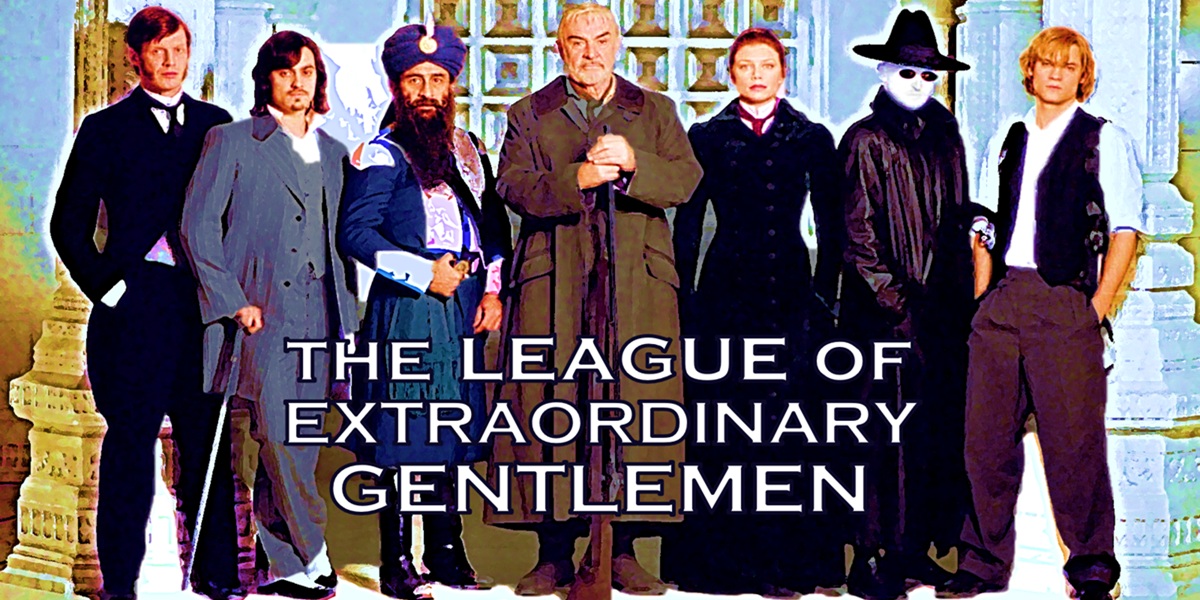
Released in July 2003, reviews were poor. Which seems a bit harsh given the proliferation of material like this. (Aren’t they all junk, really?) It seems to have made a profit of $100 million, not that remarkable by the standards of the genre. Connery found it a wearisome experience, and it caused his retirement after fifty-five starring roles in a forty-six-year career that brought him an Academy Award for The Untouchables and a BAFTA for The Name of the Rose. Neither the director nor the screenwriter have worked on a live-action feature film since.
Despite this, plans for a sequel rumble on. As of 2022 this was being written by Justin Haythe with funding from a Walt Disney subsidiary. They might care to study Moore’s own proposal, which features a struggle by the League across the twentieth century against efforts by evil magicians to create a ‘Moonchild’. Moore, it seems, is a disciple of the occult and performs ‘workings’, much in the manner of Aleister Crowley, several of which are available as full-length CD albums. Seeing the Beast in action – who would play him? [Alfred Molina? Ed.] – might actually be quite entertaining. Perhaps Moore should use his powers to ensure Disney and Haythe have the imagination to do this.
from the maker of:

see also:


Discover more from Lion & Unicorn
Subscribe to get the latest posts sent to your email.
