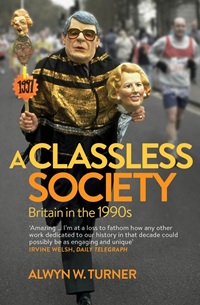
To mark the death of Ann Widdecombe, here’s an extract from ALWYN TURNER’s A Classless Society: Britain in the 1990s.
Then there was the government’s simple insensitivity to issues that required at least the lip-service of concern. Chief amongst the culprits here was Ann Widdecombe, who had made her name in the Commons as a doughty campaigner against abortion, having been elected in 1987 as the MP for Maidstone, where the local Tories had once turned down Margaret Thatcher as their candidate.
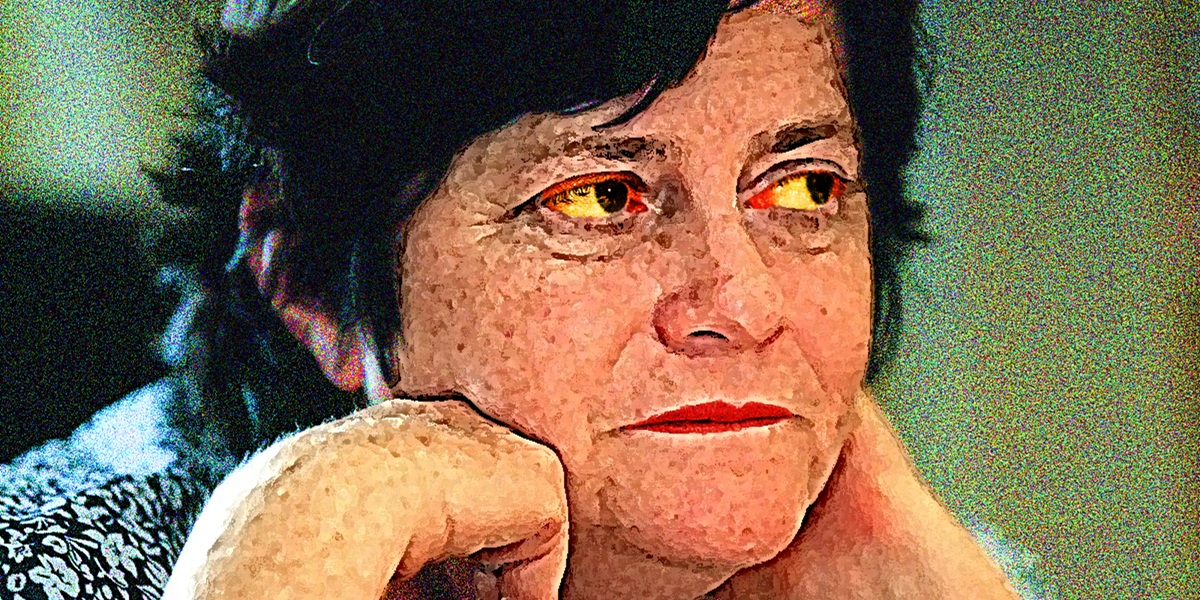
In John Major’s government there were so few women – none at all in his first cabinet – that she was bound to be noticed when she became a minister, but in all likelihood she would have stood out in almost any era. She displayed such a fierce refusal to care about her look (‘I am short and fat and ugly,’ was her own assessment) that it became the most readily identifiable image in the House; with her dumpy stature and jet-black pudding-bowl hairdo, she resembled, thought Gyles Brandreth, ‘a death-watch beetle’. Coupled with that was a willingness to express forthright opinions in plain-speaking language that was lapped up by a media ruing Edwina Currie’s absence from the government. ‘She is as hard as nails and as cold a politician as you would fear to meet,’ one anonymous colleague told the press, feeding the myth of the most heartless Tory of them all.
She first made public waves as a social security minister in 1991 when a study published by National Children’s Homes concluded that the welfare state was failing the poorest; in the families of those receiving benefits, it was claimed, 10 per cent of children under five were missing meals because of poverty, and one parent in five regularly went hungry. Widdecombe retorted that this meant the vast majority of those on benefits were eating sufficiently, and that the research should therefore have concentrated instead on the differences between those who did eat properly and those who did not, in order that the latter might be pointed in the right direction.
Her comments displayed logic but little compassion, and much of the media turned against her, particularly the Daily Mirror, for whom she became a hate figure to rival the position of Labour’s Clare Short at the Sun; the paper missed few opportunities to point out that she was unmarried – a virgin, even – and apparently was thus, by definition, a woman out of touch with the mass of the people.
The biggest storm came in January 1996 with the broadcast of a Channel 4 documentary that showed a pregnant prisoner being shackled to warders as she was taken from Holloway Prison to the Whittington Hospital in North London to give birth. This was standard policy, following a disproportionate number of escapes by women prisoners on their way to hospital in recent years, and a practice with which Widdecombe, now the prisons minister, professed herself content: ‘I was perfectly happy for women to be secured between prison and hospital. I was perfectly happy with the procedure that you removed the restraints as soon as medical treatment started, that was, when labour started.’
Again it was a logical position, but not one likely to attract much public support, and the Mirror’s abuse became ever more personal. The ‘mums-in-chains minister’, she was called in what should have been a muck-raking article (except that there was no muck to rake) headlined ‘Loveless life of the woman they call Doris Karloff’. The policy was swiftly changed so that restraints would be removed from pregnant prisoners on their arrival at hospital, but the whole story followed a pattern that had become characteristic of John Major’s government: an unpopular policy was allowed to fester and to attract opprobrium before being abandoned in a humiliating retreat.

Discover more from Lion & Unicorn
Subscribe to get the latest posts sent to your email.
