Compton Miller
Who’s Really Who
Sphere Books, 1984
Nostalgia ain’t what it used to be. This book from the day before yesterday purports to identify the 450 people in Britain who really matter. If you were expecting lists of top civil servants, diplomats, key industrialists and big-wigs in the intelligence and security services, you may be, partly at least, disappointed.
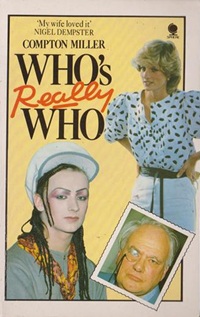
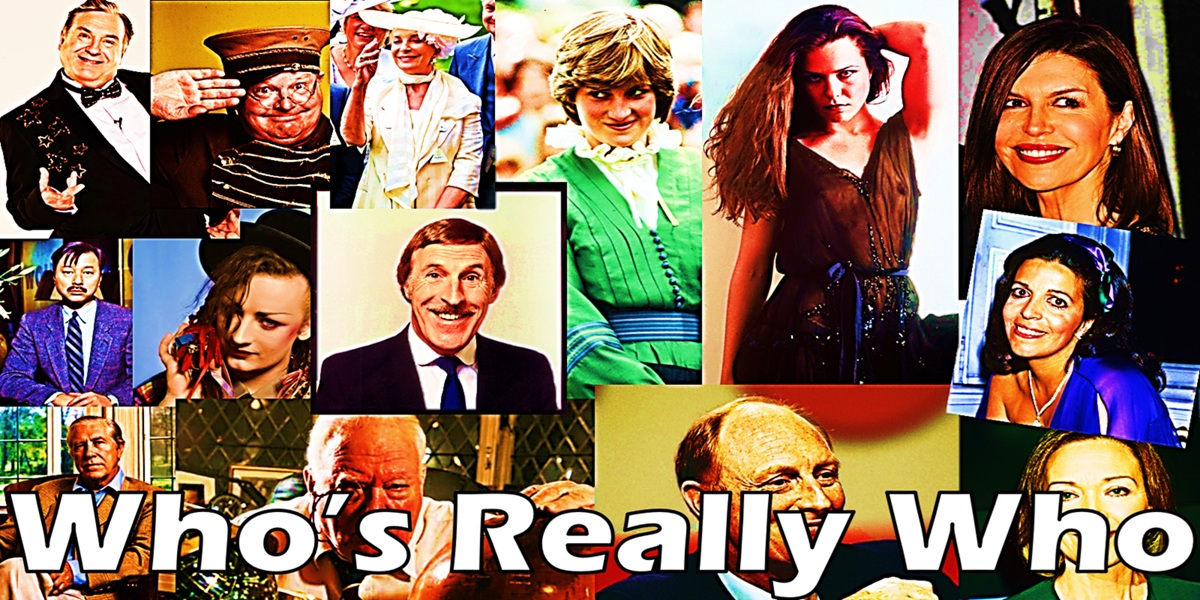
The front cover sets the tone, with pictures of Princess Diana, Boy George and the astronomer Patrick Moore. Inside, a random flick through the pages will disclose the following people who ‘really matter’: Benny Hill, Finola Hughes (who?), Guy Munthe (ditto), TV astrologer Russell Grant (famous for fifteen minutes), Jose Fonseca (a model who sounds like a type of Mediterranean wine), Koo Stark and Venetia Spicer, described as a ‘Knightsbridge gadabout’.
Margaret Thatcher does not make the cut but children Carol and Mark are here. The list of non-entities, has-beens and never-weres is long: publicist Tony Brainsbury; Liz Brewer, ‘brightest of the new breed of café society PRs’; Michael Chow, restaurateur; ‘aesthete’ Christopher Gibbs; Mayfair shop-owner Lady Rendlesham ‘Whippet-thin…You would never guess that she was married to an Irish eighth baron’ (presumably Irish peeresses are supposed to be fat); John Reid, not the future cabinet minister but a ‘pop manager, known as Beryl’. Of course he is.
Even when dealing with what were still household names, it is hard to see in what way they ‘really matter’. Lady Sarah Spencer-Churchill ‘really matters’ to Britain from homes in Los Angeles and Montego Bay. Bruce Forsyth, Anna Ford and Princess Michael of Kent were all well-known – it is the ‘mattering’ that is the problem.
There are at least two books in this volume. One is tightly focused on decision-makers in commerce, law and government. The other is a series of light sketches of people famous in Britain in the mid-Eighties.
Aside from the selection problems there is the constant attempt to be ‘waspish’, perhaps in the hope of emerging as the next Dororthy Parker or Lytton Strachey. So hotelier Rocco Forte ‘behaves like the Vatican nobleman his father Lord Forte wants him to become’ (wouldn’t he need to take holy orders?); Christina Onassis ‘plain-Jane daughter of Aristotle Onassis’ is nicknamed Thunderthighs (very gallant, I don’t think); Lady Silvy Thynne ‘dubbed the Loins of Longleat’ has a photo in the book in which she sits imperiously in a chair in full riding kit holding a whip and looking like a model in an S&M magazine, and there is industrialist Tiny Rowland, ‘Cheapside Attila the Hun’.
Two questions arise. How was this book ever published, and why on earth did I buy it all those years ago? Regarding the first, I suspect it caught the emerging mood of the second half of the 80s, one of an obsession with trivia and in which it was de rigueur for educated professionals to declare their addiction to Corrie, their love of the Sunday Sport and their passionate devotion to ‘Saint and Greavsie’ (nor I).
Re the second question, I’d like to say it was because my then girlfriend and I liked a good laugh. But the fact is that, in a pre-internet age, a journalist was well-advised to corner as many sources of biographical info as possible.
Flicking through the lists of inclusions and the categories in which they are placed induces a sense of melancholy: ‘Politicos with frisky dispositions’ (what on earth is devoted husband Neil Kinnock doing there?’), ‘The Nearly-Royals’, ‘Grown-up starlets’ and so on. In most of these cases, the caravan moved on long ago.
O quam cito transit gloria mundi.
see also:

Discover more from Lion & Unicorn
Subscribe to get the latest posts sent to your email.
