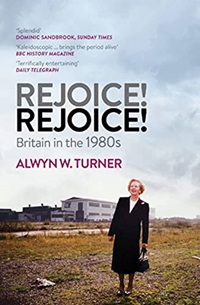
As England prepare to play Argentina in football’s World Cup, this extract from ALWYN TURNER’s Rejoice! Rejoice! revisits the post-Falklands context of the most celebrated encounter…
Perhaps the Falklands War really was Margaret Thatcher’s finest hour. What had previously been seen as terrible political faults – her stubbornness in following her own course, her refusal to listen to other points of view – were now magically transformed into the greatest of her virtues: rigidity had become resolution, pig-headedness had become perseverance.
The Falklands defined Thatcher, in the eyes of supporters and her detractors alike, both for the three hundred thousand people who turned out for the victory parade in London and for the anarcho-punk band Crass, whose single asked: ‘How Does It Feel to Be the Mother of a Thousand Dead?’ Just as the Falklands without Thatcher came to be unthinkable, so too did Thatcher without the Falklands.
The other reason why the successful outcome of the war so demoralized the left was that the campaign had exposed an uncomfortable truth. In the Labour Party, wrote John O’Farrell, the war ‘split activists directly along class lines: working-class members in favour and middle-class members against. On reflection the same split happened in my family: Dad who put HP sauce on his chops was in favour, Mum who put mint sauce on hers was against.’ Or, as Julie Burchill pointed out rather more provocatively in The Face at the time: ‘the left will have to learn that craven pacifism does not appeal at all to the proletariat.’
The internal problems of Labour – its arguments over party democracy, the departure of the SDP, the deputy leadership contest – had already served to alienate many of the party’s natural voters; now Thatcher’s unashamed populism seemed likely to draw off yet more support. Despite Foot’s enthusiastic support for the government’s actions, Labour benefited not at all, for Foot was still seen as the man from CND, leading a party that was openly split on the correct response to the Argentine actions.

Even after the surrender, the continuing controversy over the way the government had lied about the position and course of the General Belgrano when it was sunk (which Tam Dalyell in particular turned into a long-running crusade) did more to harm Labour than the Conservatives, since any mention merely gave the Tories the opportunity to talk yet again about the Falklands victory. And anyway, as Alan Clark pointed out: ‘What does it matter where it was when it was hit? We could have sunk it if it’d been tied up on the quayside in a neutral port and everyone would still have been delighted.’ His assessment was undoubtedly correct: for most people, the facts that the country was at war and that an enemy cruiser had been torpedoed were sufficient.
In the more rarefied circles of the left, the explosion of public patriotism and flag-waving was also considered to be so vulgar as to be unacceptable in polite society. ‘Now they are singing “Britannia Rules the Waves” outside Downing Street,’ shuddered Alan Bennett in his diary on the day of the Argentine surrender. ‘It’s the Last Night of the Proms erected into a policy.’ The novelist Salman Rushdie, meanwhile, could not help returning to the imagery of the governess: ‘Hers are the politics of the Victorian nursery: if somebody pinches you, you take their trousers down and thrash them.’
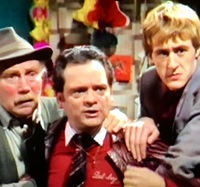
But elsewhere the Falklands entered British mythology with little difficulty. In a 1986 episode of Only Fools and Horses an expatriate South Londoner arrives in the Nag’s Head and begins running down the country: ‘The stench of defeat’s everywhere,’ he says. ‘The old place has got no guts anymore.’ And finally Del Boy loses his patience and his temper: ‘Somebody else said that a little while ago. A little jumped-up general from Buenos Aires, and if you’re not careful, you’ll get what the Argies got.’
One other consequence of the war was, inevitably, a legacy of suspicion between the two nations involved. In popular terms, this was symbolized by the meeting of England and Argentina in the quarter-final of the football World Cup in 1986. Footballing relations had been poor for twenty years, since a controversial encounter in the 1966 tournament, but the Falklands had given an added edge, as seen in the Sun’s front page headline on the day of the match: ‘It’s War Senor!’, an angle that was mirrored in the Argentine media. The fact that Argentina went on to win with two contrasting goals by Diego Maradona in the space of five minutes – the first a blatant and deliberate handball, the second a sublime piece of dribbling that was later to be voted the Goal of the Century – did nothing to restore harmony between the rival supporters, though the Sun did have the wit to echo its earlier headline: ‘Outcha!’
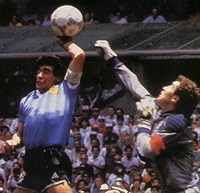
Maradona became the great pantomime villain for England supporters (and something of a hero to Scotland fans), particularly since he offered no apology for cheating on the first goal, explaining that it was scored ‘a little with the hand of Maradona and a little with the hand of God’, but his attitude was not unprecedented. As a player with Barcelona, he had faced Manchester United in the 1984 Cup-Winners’ Cup and made it perfectly clear where he stood: ‘I would want to beat the English, even if we were playing marbles,’ he declared. ‘I am very much Argentinian.’ (His relationship with English fans might have been different had Sheffield United been successful in their attempt to lure him to Bramall Lane in 1978.)

The tense relationship also surfaced, more unexpectedly, in Alan Hollinghurst’s novel The Swimming Pool Library, in which the central character, William Beckwith, cruises a young Latin-American in a bar and only discovers back in the man’s hotel room that he’s Argentinian.
‘But what about the war?’ he asks, and his pick-up, Gabriel, hastens to reassure him. ‘That’s all right,’ he says. ‘You can suck my big cock.’ Even so the subject can’t be entirely avoided, and later on Gabriel suggests, ‘I could whip you for what you did to my country in the war’. But Beckwith demurs: ‘I think that might be to take the sex and politics metaphor a bit too seriously, old chap,’ he replies.
from the maker of…

Discover more from Lion & Unicorn
Subscribe to get the latest posts sent to your email.
