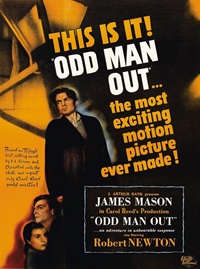
SIMON MATTHEWS on Carol Reed’s 1947 classic Odd Man Out.
The novels of F. L. Green are not much read these days. English, but living in Belfast, he was quite popular, publishing thirteen crime dramas in as many years between 1939 and 1952. The first of these, On the Night of the Fire, was adapted into a film with Ralph Richardson whilst a later effort, Mist on the Waters (1948) was twice made on US TV. Between these he wrote Odd Man Out (1945) easily his best-known work.
Set in Belfast, and drawing from his experience of living in the city, like all quality crime fiction, it is also a study of a place. Alleyways, cobble stones, buses, trams, old ruined houses, terraces of tiny, overcrowded properties, ornate Victorian gin palaces, and the weather – constant rain – are all presented as the narrative traces the final forty-eight hours (or so) in the life an Irish nationalist, on the run after a botched robbery.
Green’s plot was based on actions taken locally by the IRA during the war, specifically the case of Tom Williams, hanged in September 1942, at nineteen, for killing an RUC officer. His book, though, avoids any of the complications caused by Irish politics, and the on-going nationalist-unionist struggle. The central character, Johnny McQueen, is part of ‘the organisation’ (the IRA are not named as such, possibly to secure a release certificate for the film) and conducts himself much as a bank robber would, albeit one with an educated and articulate approach.
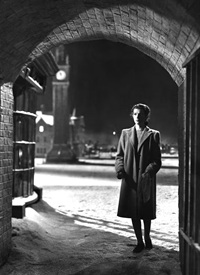
The film opens with him ordered to secure funds for ‘the struggle’ by robbing a mill. He has been on the run for six months and lacks fitness, but decides to carry out the job anyway, with three colleagues. They get the money, but have to shoot their way out. A guard is killed and McQueen, severely wounded, left behind. Thus begins his nocturnal odyssey through the city.
This – for contemporary viewers – is the interesting part of the film. Green takes McQueen through a dowdy, polluted, large provincial city in mid-century. The trappings of Edwardian and Victorian grandeur remain but are now battered and run down. This is an age of austerity and rationing. People go about their lives as rain pours down, trams rattle through the streets and ships hoot in the docks.
Some of the detail is curious. There is a well-to-do boarding house with the atmosphere of a literary salon. In a respectable area, a middle-aged couple with a live-in spinster sister give McQueen some first aid when he collapses nearby and then wave him away into the night. A Catholic priest – with clear Republican sympathies – meets McQueen’s sweetheart as rumours of his whereabouts trickles through. The police are on the trail throughout. Led by a grimly invigilating inspector they seem an odd bunch, varying from the para-military – pistols and rifles firmly clasped – to the quaintly Victorian, with constables wrapped in immense belted gaberdines and sporting cloche style helmets. A reminder, if any were needed, that Northern Ireland was a decidedly different part of the UK. (And dated too…the city still sports horse-drawn hansom cabs. In 1946?)
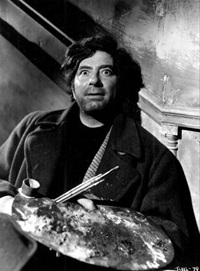
Other characters tend to the grotesque, three of whom occupy an immense semi-ruined Georgian house, with a roof open to the elements. Perhaps it is a bomb-damaged property, still occupied but abandoned by its owner. It might almost be Gormenghast. One of these figures, Shell, trades in budgerigars, with his room stacked full of cages. Another, Tober, seems to be either a failed medical student or a struck-off doctor. The third, Lukey, is an extravagantly alcoholic artist occupying a ballroom sized space, littered with his canvases. McQueen ends up in their hands and they consider the financial advantages of handing him over to the authorities.
Meanwhile, the owner of the boarding house/literary salon has betrayed McQueen’s accomplices to the police. They try to shoot their way out and are gunned down. Lukey and Tober have a memorable scene in which they argue and wreck one of the huge city pubs. Meanwhile, McQueen has been rescued by his sweetheart. They struggle toward the docks in a snow storm, where a ship awaits them. The police corner them. She pulls out a revolver – retrieved from her grandmother – and opens fire. They die together in a hail of bullets, the priest and Inspector surveying the scene.
Odd Man Out was Carol Reed’s first feature film after five years spent making wartime documentaries. Prior to that, his work from the moment he stepped behind the camera showed a predilection for observations of day-to-day British life: Laburnum Grove (1936, from a J. B. Priestley play), Bank Holiday (1938), The Stars Look Down (1939, from the A. J. Cronin novel) and Kipps (1940, from H. G. Wells). It amongst these that Odd Man Out should be placed, even if its grim drama, and unusual setting sets it slightly to one side. R. C. Sheriff provides an intelligent script with many rounded characters.
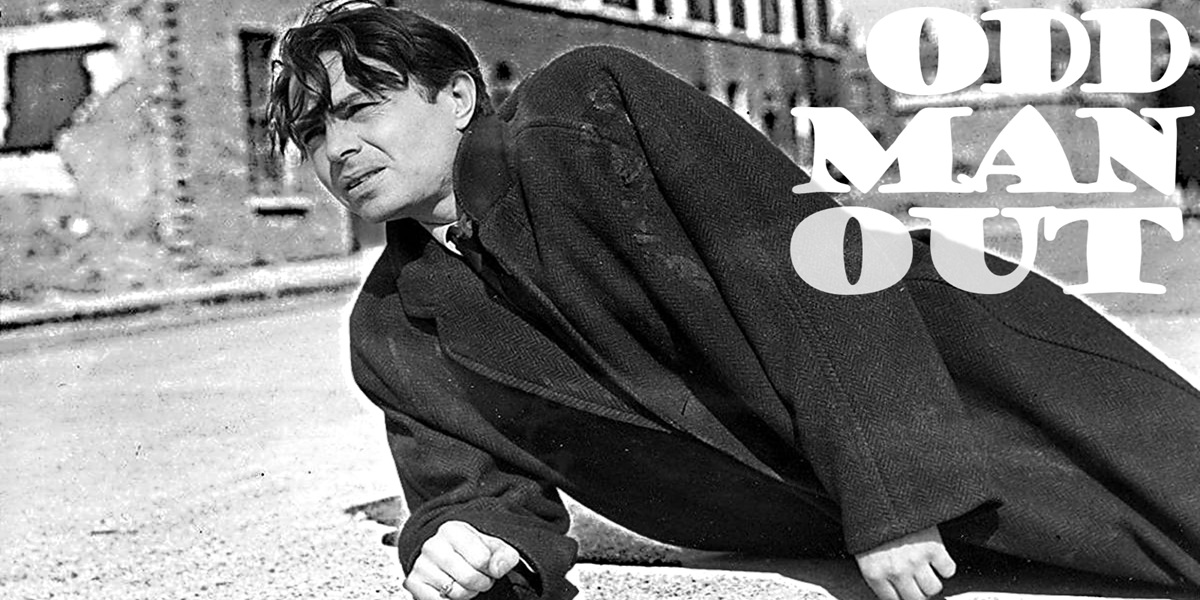
James Mason gives a career best performance as McQueen, and, whilst Ulster accents are in short supply, authenticity is assured by most of the supporting cast being regulars from Dublin’s Abbey Theatre, notably Kathleen Ryan as McQueen’s sweetheart and Cyril Cusack as a fellow gang member.
Robert Newton appears as the drunk artist Lukey, and has only been on the screen a few seconds when it becomes clear how similar – identical, even – his character is to those played twenty to thirty years later by Oliver Reed. The gestures and accent are a perfect match. And, of course, he does a drunken rampage through one of the city bars. Oliver Reed was Carol Reed’s nephew, and eight years old when this was shot in the summer of 1946. One wonders if this was where his on-screen persona started. Given that when not in west Belfast, some of the exterior scenes were filmed in London’s Broadway Market (now hipster central E8), it doesn’t seem unlikely.
This amount of location shooting was unusual then and Rank duly moaned when there were delays and it went slightly over budget. Released in January 1947 it received good reviews, was popular, and duly won the BAFTA for best British film a year later. But if it was liked in the UK, critics elsewhere were ecstatic. In Time James Agee considered it ‘Dostoevskyian in conception and design’ and it was nominated for the Golden Lion at the 1947 Venice Film Festival. (Which went, instead, to The Strike, an adaptation of a novel about striking miners, written by a member of the Czechoslovakian Communist Party).
Inevitably, comparisons with Reed’s next film, The Third Man, come to mind. Both are set in battered post-war cities. Both have a doomed central character, whose actions (robbery with McQueen, drug-dealing with Lime) raise moral issues. Both have a hefty dollop of Catholicism. Both end in shoot-outs, and both feature the atmospheric cinematography of Robert Krasker, replete with peculiar camera angles and unusual lighting. Some – Roman Polanski, Gore Vidal, Sam Peckinpah – consider Odd Man Out the better film, Reed’s masterpiece. This is an interesting view, but not one widely held.
Irrespective of these ruminations, Odd Man Out provides us with a fascinating portrait of post-war provincial city, still trading on its Victorian grandeur but facing an uncertain future. Its dramatic strength was sufficient to produce a 1969, US-based remake, The Lost Man, with Sidney Poitier, a Quincy Jones score, and black power militants replacing the IRA. The original is freely available on You Tube, the remake can by watched on one of the curious Russian based channels that have sprung up in recent years.
from the maker of:

see also:


Discover more from Lion & Unicorn
Subscribe to get the latest posts sent to your email.
