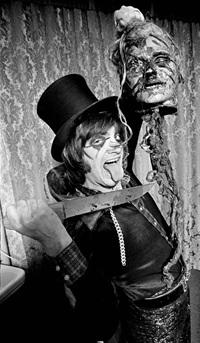
ALWYN TURNER remembers his first – and only – political book.
I’ve only ever been asked to ghost-write a book for three people. Of those, neither the Norman Tebbit nor the Michael Portillo project worked out, which means that my solitary ghosting experience was for that other giant of modern British politics, Screaming Lord Sutch.
This was back in 1996, when I was writing content for a games company. Old-fashioned games, you understand – cardboard and plastic, not bits and bytes – things like the board games for Big Break and The Price Is Right. The company was owned by a man named Richard Pain, who had also published some novelty books, the kind you’d find in a giftshop rather than a bookstore: Farquhar McNaughty’s The McNaughty Book of Limericks was one, Norman ffamily-Value’s The McTory Book of Bonks another.
Those were his own work, written before I met him, and his imprint – McNaughty Books – hadn’t put anything out for a couple of years, but with a general election coming due, he thought there might be some mileage in a joke book for the occasion. So he signed up Lord Sutch to lend his name to the thing.
It seemed to make commercial sense. Sutch had stood in more than forty elections, and was well known for mixing comedy and politics. This public profile was a little odd, since he had nothing political to say and wasn’t particularly funny, but then he had a lot of experience at making a little go a long way – his night-job was as a rock ’n’ roll singer, and he’d never been much good at that either. ‘I can’t sing,’ he admitted cheerfully, way back in 1960. ‘I just scream. That’s the way to put rock ‘n’ roll over. Scream, man.’
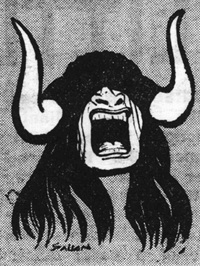
David Sutch – he wasn’t actually a member of the peerage – was born in 1940 and made his name as the most gimmicky performer on the dancehall circuit in the years between rock ’n’ roll and the beat boom. His hair was two-foot-long, he wore a set of buffalo horns on his head, and his stage act exploited the contemporary fashion for horror movies. ‘We keep the sex out and the horror in,’ he explained.
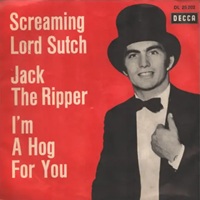
He released his first single, ‘Til the Following Night’ in 1961. It wasn’t a hit, and nothing further was released for two years until ‘Jack the Ripper’, which became his most famous song. Actually, it wasn’t his song at all, it was a cover of an American novelty single by Clarence Stacy, but his version was an improvement on the original, even if that was thanks more to the Joe Meek production than to His Lordship. ‘A sick intro and bang-bang rhythm will probably lift sales into chart heights,’ wrote fantasy novelist Jane Gaskell, who was then slumming it as a record reviewer for the Daily Express. She was wrong – it got nowhere near the charts – but the song did become the centrepiece of his live show, gradually extended to incorporate him acting out the title role: here’s footage of a six-minute version from 1966.
What he lacked in musical talent, he made up with stagecraft and with a backing band that featured genuinely good musicians in their early days. Future stars – including Jeff Beck, Ritchie Blackmore, John Bonham, Keith Moon, Jimmy Page and Charlie Watts – played with him, as did Paul Nicholas and Freddie Starr, though none of them stayed around for very long. There was a parallel, said Ian Hunter of Mott the Hoople, with John Mayall, whose band the Bluesbreakers nurtured new talent, and Sutch deserved more credit than he got: ‘So he wasn’t all that as a singer, but his timing was amazing.’ He also displayed a relentless pursuit of publicity. Which is where the political ‘career’ came in.
When John Profumo left Parliament in disgrace in 1963, Sutch stood in the resulting by-election for the National Teenage Party, calling for votes at eighteen, and attracting more press attention than he ever had for his music. There had been plenty of fringe candidates before, most notably the road-safety campaigner Commander Bill Boaks, who first stood as an independent in 1951, and would later achieve a record low of just five votes in the 1982 Glasgow Hillhead by-election (some 383 behind the Protestant Crusade Against the Papal Visit candidate). But Sutch was the first to see the publicity potential of standing as a means of promoting himself, rather than a cause.
It required a £150 deposit to stand, and you needed 12.5 per cent of the vote to get the money back – which was never going to happen – but that was a decent rate for the advertising it generated. And it was not beyond Sutch’s budget. He claimed that taking a fortnight off work for the election had cost him £1,500, and – unusually for him – that was probably not an exaggeration: at a time when the average wage was just under £12 a week, a top-drawing act could get up to £300 for a big dancehall gig.
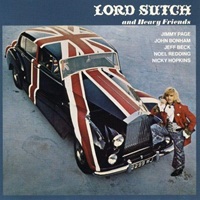
He stood again in the general elections of 1966, 1970 and October 1974. But mostly in these years, he was still concentrating on music. He reunited with some of his old backing musicians-turned-superstars for a brace of albums, Lord Sutch and Heavy Friends (1970) and Hands of the Ripper (1972) – both were dreadful – and he appeared at the big rock ’n’ roll revival shows in Toronto in 1969 and Wembley Stadium in 1972. (It was at the former that, as I’ve written elsewhere, his image, derived from music-hall legend George Chirgwin, was passed on to Alice Cooper.) He was also an early customer of Vivienne Westwood, buying his first leopard-print suit from her when she was still an unknown designer of teddy-boy outfits.
I saw him a few times, starting in Germany in 1979, and he always gave value for money, even if his act hadn’t really changed since 1963. That was when he’d caused some controversy for wearing a toilet-seat round his neck while singing ‘I’m a Hog for You, Baby’ – he was still wearing it. Most of the set was comprised of ‘enthusiastic’ covers of classic songs by the likes of Little Richard and Chuck Berry, before ‘Jack the Ripper’, which could by now run up to fifteen minutes.
The most notable gig I saw was in June 1981, when he supported the Cramps at the Hammersmith Palais. The date was significant, just a month after Peter Sutcliffe had been given twenty life-sentences for the Yorkshire Ripper murders. I speculated on the way to the gig that this wasn’t really the time to be doing a comedy-horror routine about a serial killer, but Sutch hadn’t registered this and went ahead with his normal show. When he got to ‘Jack the Ripper’, he was met with a deluge of booing and bottling and the performance came to an ignominious end. Times had changed, and what had once been a jokey bit of bad taste was now seen as simply offensive. Even to a crowd of psychobillies.
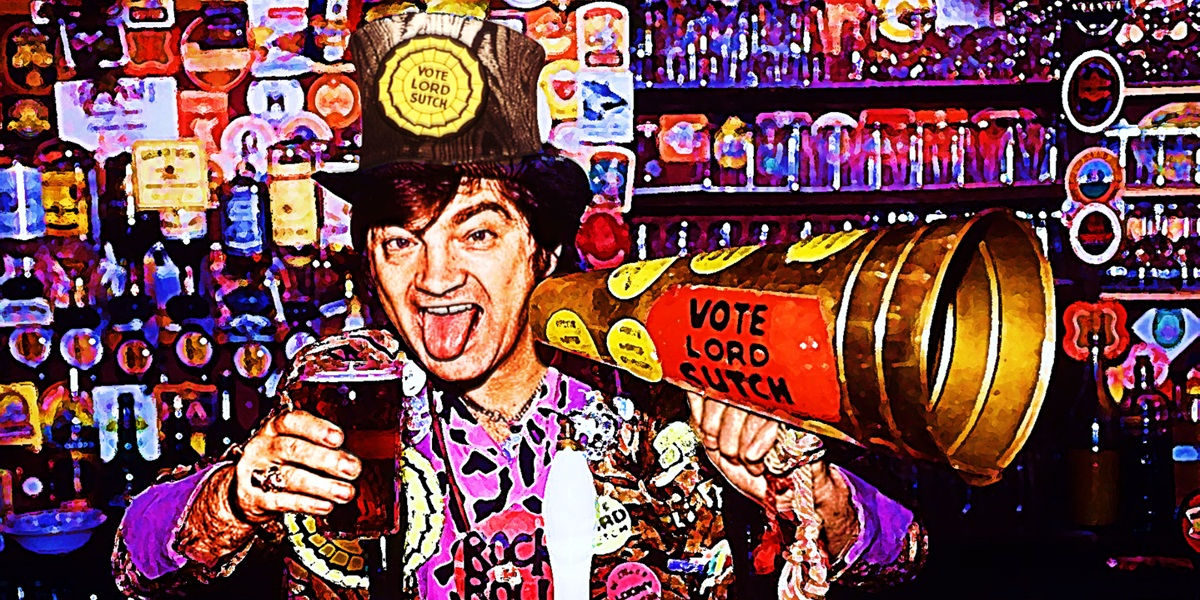
Adjusting to the new times, Sutch fell back on his other option. He stood in the Bermondsey by-election in February 1983 under the banner of the Official Monster Raving Loony Party, and from then on he and his party have seldom been absent from ballot papers. His ubiquitous presence at by-elections was partly responsible for getting the deposit for candidates increased from £150 to £500 in 1985, while the threshold for getting it back came down to 5 per cent. (If the deposit had kept pace with inflation, it’d now be nearly £1,600, but it hasn’t gone up again.)
The new regulations did nothing to deter him. In the 1992 general election, he stood simultaneously in three constituencies, Huntingdon, Islwyn and Yeovil – the seats held by the three main party leaders, John Major, Neil Kinnock and Paddy Ashdown. In terms of numbers, he peaked in the 1994 Rotherham by-election, where he reached four-figures for the only time, getting 1,114 votes, a 4.2 per cent share. His finest moment, though, came in the Bootle by-election of May 1990, when he polled higher than the SDP candidate – a result so humiliating for David Owen that he and the national executive closed the party down.
Incidentally, if the name of Sutch’s party seems appallingly naff (to use a 1980s term), it should be borne in mind that the word ‘loony’ had political significance when he adopted it. These were the days of tabloids thundering against ‘the loony left’ – the ‘woke’ of its time – and Bermondsey in 1983 was the very epitome of that. This was the election that saw Labour lose an ultra-safe seat on a record 44 per cent swing, as gay rights campaigner Peter Tatchell was defeated by the Liberal Democrat Simon Hughes (‘the straight choice’). Sutch got more votes than the Dowager Lady Birdwood (a veteran racist), and the candidates from the Communist and Ecology Parties.
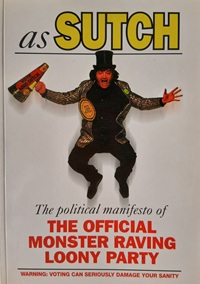
So this was how things stood when I was asked to ghost a novelty book for Screaming Lord Sutch, titled As Sutch: The Political Manifesto of the Official Monster Raving Loony Party (McNaughty Books, 1996), published to cash-in on the coming election.
It was – and this hardly needs saying – complete rubbish. It’s hard to believe that it took four days to write it. Sutch’s contribution was to send over some scrappy old press releases, and we padded out the meagre eighty pages with lots of photographs, but it still needed some work. And it definitely needed some vague indication that we were in the mid-1990s: Sutch hadn’t really changed his jokes in fifteen years, so he was still on about the EEC wine lake and butter mountain. (Though his demand that there be more than one Monopolies Commission remained sound.)
What I seem to have done, as I look at the book for the first time in decades, is to have put in a lot of references to then-current news stories, rumours and minor celebrities, some of which now look very odd. Was Tony Blair really that worried about losing his hair? Would Ken Dodd have made a good chancellor of the exchequer? Was it right to call for making illegal all Christmas singles by Cliff Richard? Certainly our suggestion that Mystic Meg be entrusted with economic forecasting couldn’t have been any worse than leaving it to the Treasury.
For some reason – presumably because Richard Pain had bumped into him in a disreputable drinking establishment – William Donaldson contributed a couple of pages about religion. Meanwhile, there was a good deal of stuff about mad cow disease, and Michael Portillo was said to be making a decent fist of being defence secretary.
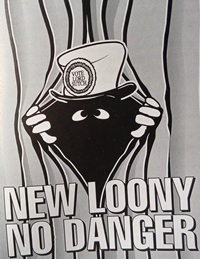
Much of the rest is a series of panel-game jokes: mention of film titles such as A Returning Officer and a Gentleman and Michael Howard’s End – that kind of thing. I did, though, manage to put a positive spin on Sutch’s unsuccessful pop career: ‘He has never sold out to the forces of commercialism and sought the easy path of popularity.’ And I did break with political tradition by giving at least one straight answer. ‘Is a Loony vote a wasted vote?’ ‘Yes.’
Sutch didn’t have any control over the contents of the book, except that he insisted we cut all the jokes about the police, most of which – this being pre-Macpherson – were about racism and brutality. Sutch said the police had always been very good to him in his publicity stunts and he didn’t want to alienate them. Fair enough.
The book was – deservedly – a sales disaster. It probably would have been anyway, but it certainly wasn’t helped by the fact that Sutch didn’t contest the 1997 general election, because he was depressed by the death of his mother. Although the party fielded twenty-four candidates, it got very little publicity in the absence of His Lordship.
The depression continued, and in 1999 David Sutch hanged himself. He was fifty-eight years old.
Discover more from Lion & Unicorn
Subscribe to get the latest posts sent to your email.

Such a great character. I saw him live once, in a club in Stoke called The InSet, in the summer or autumn of 1978. The height of punk in my backwater city. And what a dive that place was. Local punk band The Verdict mentioned the club in a song of their’s, sampled in 2005 (see links below).
We punk types were attracted by the late bar, loose women, and noisy guitar music. He was supported by local record shop owner Legendary Lonnie. I believe Lonnie may also have played in Sutch’s band that night, but that memory has long gone, and recalling the amount of beer I used to drink back then, it may have gone by the next day.
Echoes of Jimmy Clitheroe’s death in Sutch’s demise?
https://theredandwhiteattack.bandcamp.com/track/the-inset
LikeLike
Pingback: ‘A silent majority behind their lace curtains’ – Lion & Unicorn