JONATHAN CALDER reads Jonathan Meades’s first book and learns who and what really mattered in 1970s television.
In a television interview with Mark Lawson, Jonathan Meades describes meeting the principal of RADA, Hugh Cruttwell, some twenty years after he had been a student there alongside Michael Kitchen and Robert Lindsay. ‘I always knew you’d do well as a character actor,’ said Crutwell, ‘but I never realised that the character would be called Jonathan Meades.’
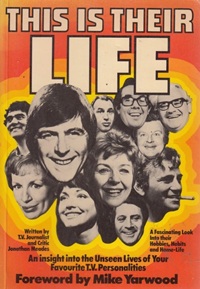
But before he became Jonathan Meades, Jonathan Meades was many things, the television critic of the Observer among them. I have in front of me of a book, his first, that he published in 1979. The cover of This is Their Life promises ‘an insight into the unseen lives of your favourite TV personalities’ and ‘a fascinating look into their hobbies, habits and home life’. It also boasts that the book has a foreword by Mike Yarwood, whose name appears in much larger type than that of the author.
This is Their Life is a collection of potted portraits of television personalities of its day, from Joss Ackland to Susannah York, and those wanting no more than that were well served. They learnt that Cheryl Ladd from Charley’s Angels was married to Alan Ladd’s son David, and that it was Oliver Hardy who advised Harry Worth to give up ventriloquism and concentrate on comedy; that Derek Nimmo was running a dance hall in Penny Lane (that Penny Lane) at the age of seventeen, and that Frank Finlay had a City and Guilds diploma in butchery.
It was all a long time ago – the entry for Violet Carson (Ena Sharples from Coronation Street) reveals she was born in the nineteenth century – but it’s still tempting to look for omissions. Only two Goodies are here (Graeme Garden misses out), and I was surprised that Trevor Eve wasn’t, until I realised that Shoestring, which made him a star, didn’t begin its first series until late in 1979.
Other non-appearances are explained by the ups and downs of acting careers. When This Is Their Life appeared, Derek Fowlds was no longer ‘Mr Derek’ – the only man to come close to keeping Basil Brush in order – but had not yet become Bernard Woolley of the Department of Administrative Affairs. Similarly, Norman Bowler was a few years into the long gap between Detective Chief Inspector Harry Hawkins from Softly Softly: Task Force and Frank Tate, the character around whom the revitalised soap opera Emmerdale was built. James Fox is luckier: he hadn’t acted for years, but Meades thinks so much of him that he is still praised as ‘arguably the world’s best actor (at least in certain roles)’ in his brother Edward’s entry.
This is Their Life is not, as you might fear, dominated by those who were later of interest to Operation Yewtree. There is a long profile of Jimmy Savile during which Meades circles his subject in bemusement. Savile has become a folk devil who was able to walk into any institution at will, but then that was pretty much the premise of his radio programme Savile’s Travels. Rolf Harris’s short entry makes his grandfather, ‘a Cardiff bohemian who made a good life from portraits’, sound more interesting than he does.
When it comes to food, another aspect of Seventies life that gets a bad press, the terrifying Fanny Cradock has gone, replaced by the helpful older-sister figure of Delia Smith. The book came too late for Graham Kerr, who has been unfairly written out of the history of television cookery, and too early for Keith Floyd.
A happier memory of 1970s television is the way you could rely on finding every major sporting event on the BBC. The book is full of names – Dan Maskell, Bill McLaren, Peter Allis – who were identified with their sport to a degree that cannot occur today. Perhaps the greatest of them was John Arlott, though by 1979 his only regular television appearances were to cover Sunday afternoon cricket (alongside Jim Laker, who also gets an entry) in the days when the game still had something of the village green or beer match about it.
In his An Encyclopaedia of Myself, Meades records that his mother

once mentioned (parenthetically, forgetfully) that when she was a probationary teacher at Basingstoke in the early Thirties and he was a policeman, she had known John Arlott ‘quite well’. This might have meant anything. It probably meant no more than her having gone to a couple of dances with the young Hugh Casson, whom she had met through his father, University College Southampton’s rowing coach.
Casson could have had an entry too, but didn’t make the cut.
There’s also a reminder of how sports can rise and fall in popularity on the small screen. Show jumping had been huge in the early Seventies, but lost its popularity when the horses stopped being called things like Penwood Forge Mill and started being given names like Sanyo Music Centre. It had been such a classy affair. Meades tells us that Dorian Williams, one of the BBC’s commentators, was used as a boy to having his parents entertain the Dukes of Windsor and Gloucester; he later inherited a prep school from an aunt.
What Meades has always offered his admirers is not so much a collection of beliefs as an attitude. He’s an opponent of cant in all its manifestations and sceptical of high theory. Buildings, and life, are above all to be enjoyed.
In This is Their Life we see that attitude deployed against some of television’s stars. Here’s his take on Jimmy Tarbuck, who was still not yet forty in 1979:
A milkman before he started entertaining at Butlin’s in North Wales, his teenage ambition was to be a footballer, and he had two trials at Anfield. He still follows Liverpool, still gambles on them frequently (which must make him richer still) and strongly believes that football hooligans deserve the birch.
While he says of Ted Rogers, host of the impenetrable quiz show 3-2-1:
Most of his material is written in conjunction with Wally Malston, who is apparently known as ‘King of the One-Liners’ and says that Rogers is ‘a barometer of what the public is thinking’.
So be it, but he is hardly a barometer of what the public is doing. His passion is polo – he has four ponies and plays at Cowdray Park, which is also a regular haunt of Prince Charles.
Meades is at his best when hunting big game, and there is no game bigger in television than the BBC’s hereditary aristocracy. David and Jonathan, sons of the revered wartime reporter and commentator on royal events Richard Dimbleby, were dubbed ‘the Dimbleboys’ by Bernard Levin, and Meades is not slow to take up the baton and hit them round the head with it.
First he takes aim at David:
Even before he became a professional journalist, he had to learn to live with accusations of privilege. At Oxford, where he took a third in PPE, his appointment as editor of Isis was opposed by the outgoing editor Kenith Trodd, who is now a noted drama producer, and his staff. Dimbleby countered with a swingeing attack on ‘the left-wing clique’.
A couple of years later, some journalists took it upon themselves to advise him publicly not to attempt to follow in his father’s footsteps at the BBC.
It might appear that he has done just that, but, of course, his route and approach have been very different from Richard Dimbleby’s. Whereas the father was ever reverential, the son – despite his looks and his smooth cap of hair – is rather an abrasive fellow.
Then he sights Jonathan, who had ‘wanted to be a farmer, and his father succeeded in getting him a job on the Royal farm at Windsor, where he trained to be a show jumper’.
Still being a Dimbleby isn’t what it was. David was twelve when he introduced his first radio programme, but his son Henry had to wait until he was thirteen to be invited to appear on the BBC, in television adaptations of Arthur Ransome stories. He later re-emerged as an expert on food policy for Conservative governments, somehow never getting round to acknowledging the effects of the Brexit he had championed. There are disquieting rumours of further generations of Dimbleby behind him.
Two names, at least, in This is Their Life make you nostalgic for 1970s television, but they are names that would not be there if it had been edited by anyone but Meades. They are W.G. Hoskins, who invented the discipline of local history while at the University of Leicester, and Ian Nairn. If Meades’s excursions around Britain were once described as ‘Down Your Way with the Mafia’, then Nairn’s were heartfelt, even tearful.
We don’t get people like Hoskins and Nairn on television today, but then we don’t get Jonathan Meades either.
Visit Jonathan Calder’s excellent blog Liberal England.
see also:

Discover more from Lion & Unicorn
Subscribe to get the latest posts sent to your email.
