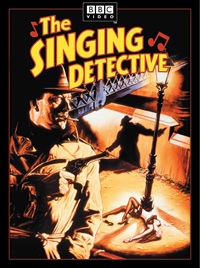
In our series celebrating the best of British television, FINLAY McLAREN finds himself laid up in bed and transported back to 1986.
First broadcast forty years ago this week, Dennis Potter’s The Singing Detective remains television’s strongest contender for entry into the Western canon. It is the medium’s Hamlet; its Citizen Kane and Sgt Pepper’s. A towering work that remains unrivalled and unparalleled.
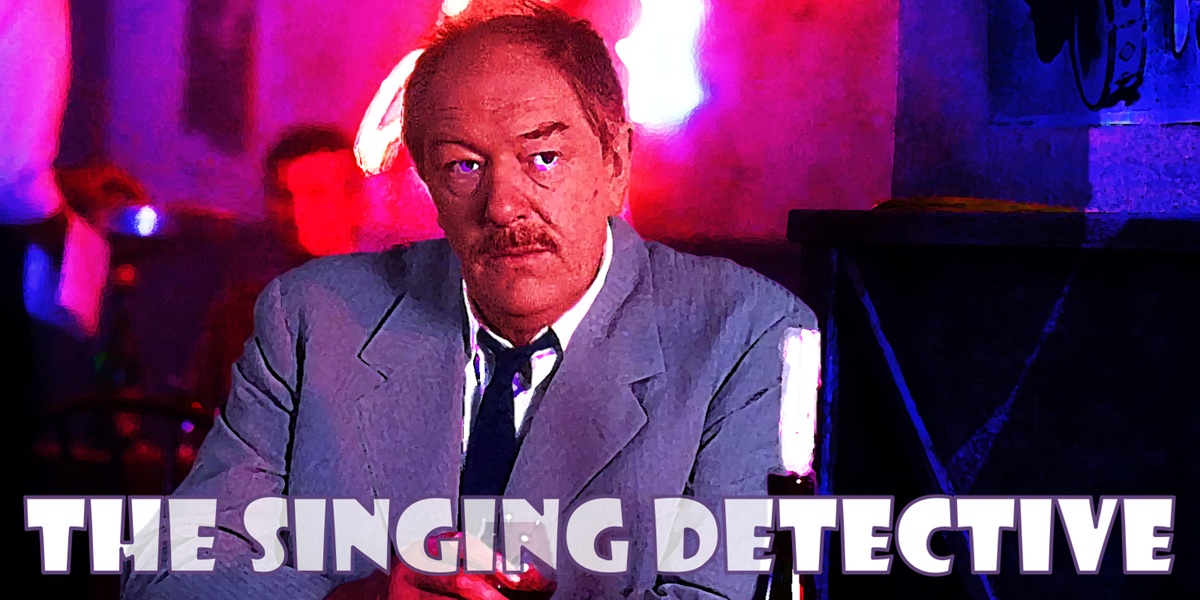
Across six episodes, The Singing Detective follows three separate, though interconnected, narrative strands. The first centres on Philip E. Marlow (Michael Gambon), a crime writer hospitalised with a debilitating case of psoriasis. The severe skin condition has left Marlow bedridden and barely able to move. Bitter, bad-tempered and spectacularly ill-disposed towards the world, he spends much of his time railing against his fellow patients and resisting the well-meaning hospital staff in their attempts to help him.

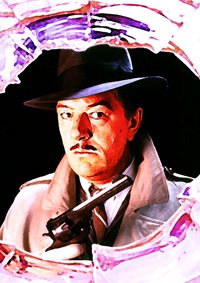
Trapped inside his own body, Marlow’s mind begins to wander back to the events of his noir novel, The Singing Detective, a pulp-fiction fever dream set in a shadowy world of spies, femme fatales, double-crosses and murder, involving a wisecracking bandleader who moonlights as a private detective (Gambon again). The third strand takes us back to Marlow’s childhood, growing up as the son of a miner in the Forest of Dean during the Second World War. Tensions between his parents (Alison Steadman and Jim Carter) eventually lead to the break-up of the family, prompting Philip (played here by Lyndon Davies) and his increasingly unstable mother to leave for London.
Battered by illness and medication, Marlow’s fractured psyche becomes a kaleidoscopic dreamscape in which reality, memory, fantasy and perception mingle and merge. The three narratives begin to collide, producing a succession of extraordinary ‘and you were there’ moments as characters slip between worlds and identities. The glamorous Nurse Mills (Joanna Whalley), from Marlow’s hospital reality, reappears as a nightclub singer in his film-noir fantasy. His estranged wife (Janet Suzman) assumes the role of his mother in an Orphic switch-up, while across all three strands the malign figure of Binney (Patrick Malahide) looms large.
These narratives weave together to construct their own detective story. The case to be solved is not one of murder, but the mystery of how Philip E. Marlow came to be so profoundly ill. And the clues? They lie scattered throughout his life. Buried in memories, relationships, fantasies and unresolved traumas. Marlow must investigate his own personal history in the hope that, by solving the mystery of himself, he might find a way back to health.
There’s more to The Singing Detective than its narrative flourishes however. It is profoundly moving and, it should be stressed, wickedly funny.
This is career-best work from everyone involved. Gambon as the main character – protagonist feels like the wrong word for Marlow – is a detailed and perfectly judged depiction of a soul in agony. His performance as the eponymous singing detective, a side-of-the-mouth, Chandler-esque type, stays just the right side of parody.
Director Jon Amiel transforms Potter’s script into a piece of cinematic art, weaving drama and imagery together to wonderful effect. The presentation of many scenes is deliberately non-linear, with flashbacks within flashbacks, repetitions from the recent past, and associative cuts to other parts of the story creating the effect of a visual stream of consciousness.
For all the brilliance of the cast and crew, The Singing Detective belongs to Dennis Potter. Here, the themes and techniques of his life’s work reach their apex. The use of musical interludes, in which characters lip-sync and dance to popular songs of the past, returns here, last used in Potter’s other great mini-series Pennies from Heaven. The non-naturalistic conceit of Blue Remembered Hills, where adults played children, is also repeated, while the ‘return of the repressed’ plot has echoes of the infamous Brimstone and Treacle. Even the cynical, knowing narrator of Vote, Vote, Vote for Nigel Barton, Jack Hay, seems to have a spiritual descendant in Marlow.
In many respects, The Singing Detective is Potter’s most autobiographical work. Like Marlow, he was a writer raised in the Forest of Dean, and he too suffered from excruciating bouts of psoriasis. Reviewing the series for the Financial Times, Christopher Dunkley recognised as much, observing: ‘It is impossible to avoid the feeling that the writer is at last portraying himself directly in his work.’
That said, we should resist the temptation to regard Marlow and Potter as one and the same. Lest we end up like Mary Whitehouse, who in 1990 claimed that Potter had drawn on personal experience in depicting Marlow’s childhood discovery of his mother’s adultery. The allegation led to a libel action and payout for Potter’s mother. Nevertheless, the parallels between creator and creation are difficult to ignore.
Potter himself frequently, and often irritably, denied that Marlow was a fictional version of himself. Yet his own reactions to the work suggest a more complicated relationship. At the first read-through of the script, he was visibly moved, admitting: ‘I hadn’t realised it was so close to the bloody bone.’ After a screening of the series in New York in 1992, Potter was left ‘publicly catatonic with tears’. Whatever his protests, The Singing Detective had clearly touched something profoundly personal. As W. Stephen Gilbert puts it in his biography of Potter, ‘in his work he stands before us naked… more than naked: bleeding, his flesh flayed, his guts spilled’.

Unlike a great deal of archive telly, The Singing Detective is exceptional in the sense that it has hardly aged at all. In fact, save for the many, many instances of characters happily smoking away in the central hospital ward, it seems utterly of the now.
Although divided into six episodes, the series is anything but episodic. Decades before the rise of box sets and binge-watching, The Singing Detective works as one continuous piece of work. In 1988, Joseph Papp’s Public Theater in New York hosted a run of six seven-hour screenings of the series. Every show sold out. Similarly, its focus on psychology – most evident in the scenes involving Marlow and hospital psychologist Dr Gibbon (Bill Paterson) – anticipated the prominence of psychotherapy in television drama, years before Tony Soprano’s sessions with Dr Melfi, or the behavioural profiling of that other TV detective, Cracker.
Perhaps the most dated aspect about The Singing Detective is how easily it was commissioned. ‘I was having a pee in the gents’ loos on the sixth floor of the BBC,’ then director-general Michael Grade later recalled. ‘Jonathan Powell came in. He said he’d just seen Dennis and explained the outline of the programme. I said I’d take it right away.’ (Grade was always a great supporter of Potter and, during his tenure as head of Channel 4, was responsible for organising Potter’s incredible last-stand interview with Melvyn Bragg.)
It is remarkable that a series so unconventional was broadcast on Sunday nights on BBC One, running from 16 November to 21 December 1986. Nevertheless, it was a hit, with its audience growing to nearly ten million viewers by the final episode. The series also generated one of the Radio Times’s biggest-ever postbags, with 652 letters reported in January 1987. As Alan Rusbridger put it: ‘No television writer ever demonstrated more powerfully that you don’t need to be populist to be popular.’
No doubt, some of these viewers were drawn in by the tabloid storm that followed the third episode, ‘Lonely Days’, with its explicit scenes depicting Marlow’s mother’s infidelity. Whatever the reason, the series went on to receive eleven BAFTA nominations, winning three, including Best Actor for Gambon. It missed out on Best Drama Serial though, which went to the BBC’s The Life and Loves of a She-Devil, adapted from Fay Weldon’s novel.
There is, of course, a great deal more to discuss when it comes to The Singing Detective. The hospital Greek chorus of Mr Hall and Reginald (David Ryall and Gerald Horan); the unnamed schoolteacher (Janet Henfrey), who remains one of television’s most terrifying villains; the parallels between Marlow’s relationship with his father and Potter’s own paternal experiences; the idea of sex as something inherently ‘dirty’ and ‘unclean’; Potter’s complicated relationship with women and his original intention to use videotape – then the standard means of recording television drama – as a Brechtian distancing device.
Each of these subjects could sustain an essay in its own right. Indeed, if ever a television programme cried out for a Folio Society treatment, it is The Singing Detective. This is a work that demands to be engaged with, and rewards that engagement. The more you return to it, the more you discover.
Forty years on, The Singing Detective remains an extraordinary achievement: formally audacious, emotionally devastating, intellectually playful and frequently hilarious. If the medium has ever produced a masterpiece, then this is it.
‘Am I right, or am I right?’
The Singing Detective is available on BBC iPlayer
Finlay McLaren writes about modern British politics and pop culture. He has been featured in The Times, Spectator, UnHerd and the Critic. His Substack is called Notes from Behind the Sofa.
see also:



Discover more from Lion & Unicorn
Subscribe to get the latest posts sent to your email.
