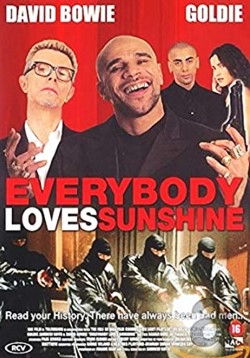
SIMON MATTHEWS on Andrew Goth’s 1999 film Everybody Loves Sunshine
It was the time of the last re-invention. The final shape-shift by the great chameleon on his odyssey from bequiffed saxophonist to long-haired Stones acolyte to mod to swinging London songwriter to folk to glam to blue eyed soul to euro-rock to nonchalant post-punk to clean American boy to guitar band sideman. By the mid-1990s David Bowie had cast off Tin Machine and was treading water with okay album releases and diminishing film roles, his turn as Andy Warhol in Basquiat (1996) being the most notable.
What next? Definitely not nostalgia: trying to stay relevant he blocked the use of his music in Velvet Goldmine (1998) a project much loved by the Brit Pop boys, who had grown up worshipping Ziggy, Marc and Lou.
Instead of raiding his back catalogue, he accepted an offer from Goldie to co-star in Everybody Loves Sunshine. It must have seemed heaven-sent. Goldie’s 1995 debut album, Timeless, had been proclaimed a masterpiece – even today it is reckoned one of the best releases of all time – with Melody Maker calling it ‘Massive and jaw-droppingly ambitious’. Goldie himself was treated like the new messiah, a charismatic character who had successfully welded together electronica and rock with drum and bass.
Via his sound engineer, he met Andrew Goth, whose script for Everybody Loves Sunshine had been floating around for years, winning prizes, but no financial backing. Goldie agreed to star, and then brought in Bowie. One suspects both saw it as a mutually beneficial project. The former starting out and climbing, the latter rebooting.
Mostly filmed on the Isle of Man, with Liverpool standing in for the Manchester locales featured in the script, it was shot in early 1998. However, despite Goldie’s fame, funding remained barely adequate. At one point Bowie had to put in £30,000 of his own cash to keep it afloat. Goth both directed and co-starred.

The plot has Goth and Goldie as cousins emerging from a spell in prison. Bowie, a laconic ‘senior’ gangster with notions of honour, collects them. Goth returns to his home on a Manchester council estate with his deeply religious mother. He wants out, and develops a love interest (Rachel Shelley). Goldie is violent, misogynistic and a psychopath. He wants to continue. There are drive-by shootings, rival gangs and drugs. The wider public don’t feature very much, there is no context for anything and the police are invisible. It all seems a bit random until one remembers that was how things often felt on ‘the street’ in dubious areas in the first flush of New Labour, when Brown and Blair kept to the same spending levels as those proposed by the departed Major–Heseltine–Clarke government.
The photography is good and there are lots of short scenes. Some of the dialogue and characters verge on the comic, and there is a sub-plot involving rap music. A showdown with a Chinese gang on the moors outside Manchester is effectively done, almost Shakespearian in its quality. Rather like a Scorsese film there is a continuous soundtrack throughout, and it ends with a break-dancing competition.
What does Bowie actually do? In the seven or eight scenes we see him, his acting has about the same range he displayed in The Man Who Fell to Earth. Unshaven, deadpan and menacing, he looks much older than 51. We assume his character has been around since the 1960s. A key point, as this was made when lad mags like Loaded were all the rage and busy endorsing The Italian Job, Performance and Get Carter as cultural icons. On paper, then, there was a lot to suggest this was a clever move.
Bowie went further too, singing on Goldie’s second album, Saturnz Return, a vastly ambitious work with an opening track an hour long. Despite that, and an appearance by Noel Gallagher on a different song, opinion was divided and Goldie would not release a third solo album until 2017. On the evidence of his performance in Everybody Loves Sunshine he was by no means a bad actor, but film roles proved scarce and for many people, having seen him as a contestant on Strictly Come Dancing, he remains more associated with celebrity culture. Looked at today, Everybody Loves Sunshine was a perfectly fair debut for him when it appeared in December 1998.
As it was too for Andrew Goth. Rather like Goldie, Goth filmed infrequently thereafter with three other releases and a fourth in the works over 25 years. The reviews of these suggest similarities with his debut, with remarks about implausible or simplistic plots compensated for by visually striking set-pieces. Which is not to suggest any fault on his part: making feature films in the UK is not easy, and indeed has become harder in recent years as international ‘blockbusters’ have swept all before them and the domestic production industry has shrivelled.
For Bowie, this was the point he gave up trying to climb on new trends. From 1999 his film career, when not appearing as himself, amounted to two small-scale guest star roles, the last in 2008. Musically he stopped touring in 2006 and eventually found his own voice again with The Next Day (2013) and Black Star (2016). With their unaffected, melancholy ruminations, these were classics of a type he had produced years earlier. Cinematically Everybody Loves Sunshine belongs firmly to that long interregnum, between Scary Monsters and The Next Day, when he was commercially successful, often astute, but creatively less than he might have been.
from the maker of:


see also:




Discover more from Lion & Unicorn
Subscribe to get the latest posts sent to your email.
