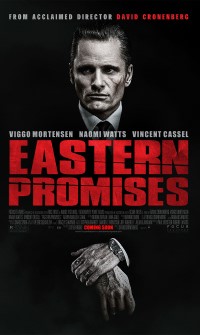
SIMON MATTHEWS watches David Cronenberg’s 2007 film Eastern Promises.
London, autumn 2006. Tony Blair has been Prime Minister for nine years, after leading Labour to a third consecutive general election victory in May 2005. This brought a drop in the Labour majority as support drifts away to Charles Kennedy’s Liberal Democrats, who now have 62 MPs. The occupations of Iraq and Afghanistan remain ongoing and are not without their consequences. After the July 2005 London bombings that left 52 dead, comes a 2006 plot to take liquid bombs on board passenger aircraft.
But, despite it all the city remains determinedly open for business. Finance, property, private security companies, sex work, newspaper and media outlet ownership, political lobbying companies, niche art galleries, Premier League football clubs and upmarket restaurants all thrive. It is a heady time, and if you work in certain sectors of the UK economy in London in the early twenty-first century it is hard to avoid Russian businessmen.
The atmosphere of menace that pervaded through these years is captured in David Cronenberg’s brilliant film Eastern Promises.
The plot has it all: Russian mafia gangs, trafficked under-age prostitutes, Chechen hitmen, bodies dumped in the Thames, excruciating violence, and lots of money. We begin with Anna, an Anglo-Russian midwife, living with her mother and uncle (a retired KGB functionary) in a council flat in Southwark. She attends a fourteen-year-old girl who dies in childbirth. The baby survives and the girl’s diary leads her to the Trans-Siberian Restaurant. Its owner Semyon runs it as a front for his violent criminal organization. His son, Kirill is drunk and unreliable. Semyon prefers Nikolai, an effective henchman, and advances him. Stupidly, Kirill encourages a local Kurdish mafioso to murder a Chechen leader. Chechen hitmen come for Kirill. To save him Semyon sacrifices Nikolai, who survives their attack and is hospitalised. It turns out Nikolai is an undercover FSB agent working under license from the British government. He tells his Scotland Yard handler how to deal with Semyon and takes over the gang.
It provides a lot of fun location-spotting. The Trans-Siberian Restaurant is in St John Street, Farringdon, an excellent choice. Murders happen in a hairdresser in Hackney and Brompton Cemetery, after a Chelsea home game. (In real life, the hairdresser, in Broadway Market was Turkish and noted for vigorous towel massages. In the film the Chechen leader is despatched whilst awaiting one). The hospital scenes were shot in the old Middlesex Hospital in Cleveland Street W1, shortly after its closure and purchase by luxury developers Candy and Candy … whose scheme failed. Today the new buildings on the site house the Estée Lauder HQ. Who needs a hospital when the land it sits on has a sky-high land value?
In keeping with much of the UK economy, though listed as a UK production, it was only nominally so, with a British co-producer (Paul Webster), co-star (Naomi Watts) and script-writer (Stephen Knight). Otherwise, it was an international affair. The director, David Cronenberg, was Canadian. The leading actors were Viggo Mortensen (American-Danish), Armin Mueller-Stahl (German) and Vincent Cassel (French). Supporting roles were played by Jerzy Skolimowski (Polish), Sinead Cusack (Irish) and, four decades on from ‘Come Outside’ and Myra Breckenridge, Mike Sarne (born London, family from Czechoslovakia).
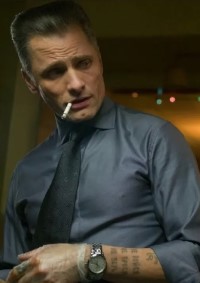
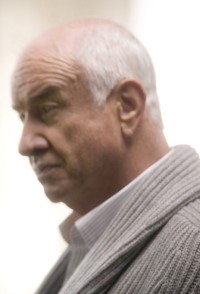
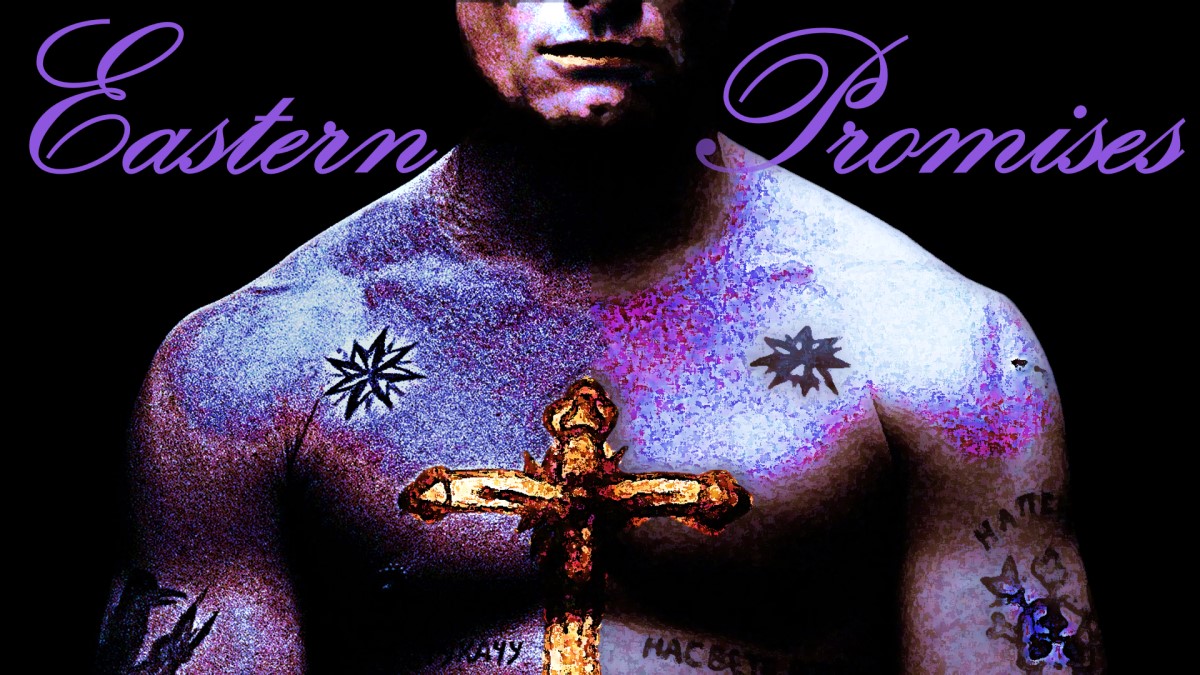
The acting is magnificent, with Mortensen particularly brilliant. Physically imposing, enigmatic, his body covered with tattoos and yet morally compelling. For Armin Mueller-Stahl, this was another great performance in a career that began in the GDR and proceeded via Fassbinder to playing Archduke Franz Ferdinand in Colonel Redl (1985).
Eastern Promises premiered in September 2007, at the Toronto International Film Festival and after a limited release in Russia, appeared in London a month later. Critics were effusive in their praise, with comments that it represented as big an advance in gangster films as The French Connection had 35 years earlier, even if it was a ‘highly entertaining but sometimes revolting look at a particularly venal branch of the Russian mob’. Mortensen was nominated for an Academy Award, though he didn’t win, and had to be content with collecting Best Performance by an Actor in a British Independent Film at the British Independent Film Awards instead.
Commercially, it got its money back after a decade of screenings and on-line sales. Artistically, the interplay between the characters was so well done, and the relevance to contemporary events so striking, that a sequel, or even a mini-series, seemed the natural next step. Talks started in 2010 with the intention of filming in Russia. It almost happened in 2013, but for reasons that aren’t clear, was pulled by producer James Schamus. By late 2020 it had been rewritten as Small Dark Room starring Jason Statham, known to many as one of The Expendables and Fast and Furious team.
The outbreak of war between Ukraine and Russia, the massive sanctions imposed on Russian oligarchs, and the disappearance of most from the west, have left it in limbo and one suspects it may never be made. A similar fate attended McMafia, the drama series culled from Misha Glenny’s 2008 non-fiction work about organised crime in eastern Europe; the second series was cancelled in 2022. Perhaps we will never see their like again.
As a compelling cinematic study of the forces at work, just beneath the surface, in UK society, Eastern Promises is a brilliant example of how others see us. Who would have thought it would be David Cronenberg providing this? If you were an attendee at independent cinemas back in the day you might have seen his early efforts, The Brood (1979) or Scanners (1981). A bit later there were enjoyable literary adaptations such as The Naked Lunch (1991) or Crash (1996), the latter managing to get banned 23 years after JG Ballard’s novel appeared.
Before Eastern Promises he had never made an entire film outside Canada and there was nothing to suggest that he could carry off a drama that accurately captured the day-to-day experience of living in London. Perhaps he was able to do so because the UK had become progressively more visceral.
Or perhaps it came down to the script. This was written by Stephen Knight, four years after he was nominated for an Academy Award for Dirty Pretty Things, a not dissimilar study of London, and its immigrant population during the Blair years. His crowning achievement at the time of writing is the 2013 TV series Peaky Blinders, exploring how another, different, gang of men made their way to the top of British society 70-odd years earlier. It ran for nine years, which is not something we’re likely to see any time soon about Russian mafia characters.
see also:


Discover more from Lion & Unicorn
Subscribe to get the latest posts sent to your email.
