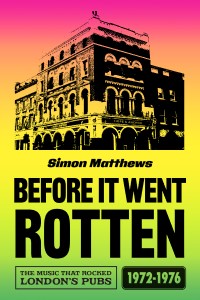
Simon Matthews
Before It Went Rotten: The Music that Rocked London’s Pubs 1972–1976
(Oldcastle Books, 2023)
There’s always been music played in pubs, of course, and it’s been a hugely influential strand in British culture. Music Hall emerged out of public houses in the 1850s, became the most popular form of entertainment for seventy years, and was still shaping British music half-a-century after its decline.
But ‘pub rock’ as a thing – the subject of Simon Matthews’s new book, Before It Went Rotten – is not just any old music that’s played in pubs. It’s not even any old rock music played in pubs. It’s very specifically the music played in an identifiable network of pubs in London and the suburbs in the early and mid-1970s: the Tally-Ho, the Kensington, the Nashville, the Fulham Greyhound, the Hope & Anchor, the Half Moon in Putney and dozens more. Sometimes they had a short-lived existence as venues – coming and going as sympathetic landlords moved on – but collectively they could sustain the kind of band not big enough for the college circuit.
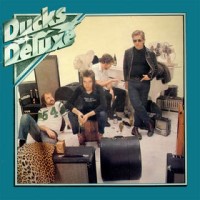
If you read the music press at the time, these were the acts whose names you’d see in semi-display ads on the gig pages, the likes of Ace, Blue Goose, Brinsley Schwarz, Chilli Willie & the Red Hot Peppers, Clancy, Ducks Deluxe, Eggs Over Easy, Kokomo, Legend, Scarecrow, Shucks, Starry Eyed and Laughing, Uncle Dog, the Wild Angels…
If you weren’t around then, or didn’t subscribe to the Melody Maker, then you’ll be forgiven for not having heard of many of these. Apart from Ace, who made the top 20 with ‘How Long’, they didn’t really have hits, and apart from sessions for John Peel, they didn’t get played much on national radio. (Charlie Gillett on Radio London was also supportive.) The genuine stars who came out of this world – including Nick Lowe, Elvis Costello and Shakin’ Stevens – only broke big after the scene had faded.
They covered a lot of musical ground, these bands, from blues and soul to country and rock ‘n’ roll. There was even room for G. T. Moore and the Reggae Guitars, whose version of ‘Knockin’ on Heaven’s Door’ predates – and is superior to – that of Eric Clapton. What they had in common was a back-to-roots sensibility, devoid of showbiz glamour and of rock-god posing. It was good-time, drinking music, played in a world that – in Matthews’s words – was ‘all beards, long hair, Afros, baggy overcoats, flares and an abundance of denim’, an atmosphere of ‘easy informality and optimism’. The shadow of the Band is all over these pages.
It’s not a world that has attracted much attention from historians, which makes this book a happy alternative to the shelves and shelves of volumes on punk, a movement which came out of, and devoured, pub rock. It’s best read with YouTube next to you – you’ll find some very decent music that you probably don’t know.
In addition to the main narrative, which draws on the music press of the time (beautifully dated stuff about how ‘band and audience share the buzz of merrymaking’), there are also written contributions from twenty or so of the musicians and promoters, many of whom I’ve never seen interviewed before. There’s some splendid trivia: I love the idea of the Joe Loss Orchestra covering ‘Seaside Shuffle’ by Terry Dactyl & the Dinosaurs, the first hit for Jona Lewie (and the first hit for Jonathan King’s UK label). There are terrific stories as well, including Rocky Sharp & the Razors getting bottled offstage at a gig in Fivemiletown, County Tyrone – though they were thanked for coming to Northern Ireland by Martin McGuiness; oh, and don’t worry about the troublemakers, he reassured the band ominously: ‘They’ve been dealt with.’
And you can’t really love rock ‘n’ roll if you don’t get misty-eyed at the thought that, had you been around, you could have seen the MC5 at the Greyhound, Croydon. Let alone at the idea of Funkadelic playing at the same venue.
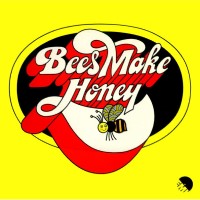
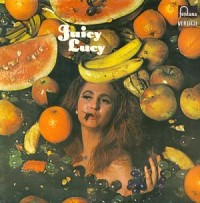
There are a couple of unexpected themes. One is the cheerfully juvenile level of humour, as seen in the song ‘Knee Trembler’ by Bees Make Honey, or the album title 12 Inches of Brett Marvin and the Thunderbolts, or the names of bands like Fumble, Juicy Lucy, Brewers Droop. (The latter perhaps a foretaste of punk’s celebration of impotence: see ATV’s ‘Love Lies Limp’ and ‘I Can’t Come’ by the Snivelling Shits.)
Another is how educated many of the musicians were. There’s the art school element, obviously, continuing on from the 1960s – there’s always the art school somewhere in the background when it comes to British pop – but there are also a large number of former university students and teachers: Wilko Johnson of Dr Feelgood (and, even better, of the Solid Senders), Sean Tyla of the Tyla Gang, members of the Fabulous Poodles, Brewers Droop, Brett Marvin & the Thunderbolts, Rocky Sharpe & the Razors. This was not then normal.
Towards the end, Matthews spins a fascinating counterfactual: ‘Suppose Malcolm McLaren had been hit by a bus crossing the King’s Road one day in 1973…’ His answer is that punk would not have happened. Or rather, not the version of punk that did actually happen in 1976–77, because that was entirely shaped by the extraordinary, unique figure of Johnny Rotten. And without McLaren, it’s extremely unlikely that Rotten would have emerged. (Who else was going to give him a chance? It wasn’t like he was a Joe Strummer or a Tom Robinson who’d been working the pubs, serving his apprenticeship; he was just a misfit with no stage experience at all.)
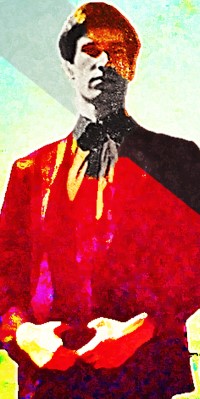
There would have been something akin to punk, though. There would still have been a drive towards a sharper, stripped-down rock, a back-to-basics reaction to the stadium rock of the time. By 1976 a new, punchier wave of acts was breaking out of the pubs, with the frontrunners being Dr Feelgood, the Kursaal Flyers, Eddie & the Hot Rods, Graham Parker & the Rumour. And behind them, the Stranglers, the Jam, Squeeze were already gigging in a world that existed outside McLaren’s influence. This surely would have been the direction of travel. It might still have been called punk rock. It might still have found room for the other three Sex Pistols. But it wouldn’t have been anything like the same thing, not without Johnny Rotten.
The closest parallel with him, I think, is perhaps Peter Cook, an artist so original and charismatic that his worth is measured not just by his own work, but by the people he inspired to take up performance. All those Oxbridge comedians of the 1960s and ’70s would have found other careers had Cook not existed. Similarly, Rotten inspired people who would otherwise not have believed they had a place in the music industry.
There’s one crucial difference between the real punk story and the McLaren-less alternate history: the presence of women. Pub rock was, as Matthews notes, a very male thing (hence the schoolboy humour). There were a few exceptions – Carol Grimes, Sandra Berry of Slack Alice – but they were vanishingly rare. And the new generation of the Feelgoods et al continued in the same blokey way. Punk, on the other hand, brought us Siouxsie Sioux, Poly Styrene, Gaye Advert, Fay Fife of the Rezillos, Pauline Murray of Penetration, Ghislaine Weston of the Killjoys, Shanne Bradley of the Nipple Erectors, Vi Subversa of the Poison Girls, Alison Statton of the Young Marble Giants, the Raincoats, the Slits, the Au Pairs.
It’s hard to imagine this being the same without actually-existing-punk having happened. The continuing growth of feminism would surely have had an impact on music, but not like this; it would’ve been Kate Bush as far as the eye could see. Somehow Johnny Rotten made all the difference. Perhaps it was because he was restating, at precisely the right moment, the central premise of rock ‘n’ roll: that attitude and imagination matter far more than proficiency and musicianship. And perhaps too because he was the least macho rock star there had been. He sang about abortions, not sex. And as he famously observed: ‘Love is two minutes fifty-two seconds of squelching noises.’ It was a long way from cock rock.
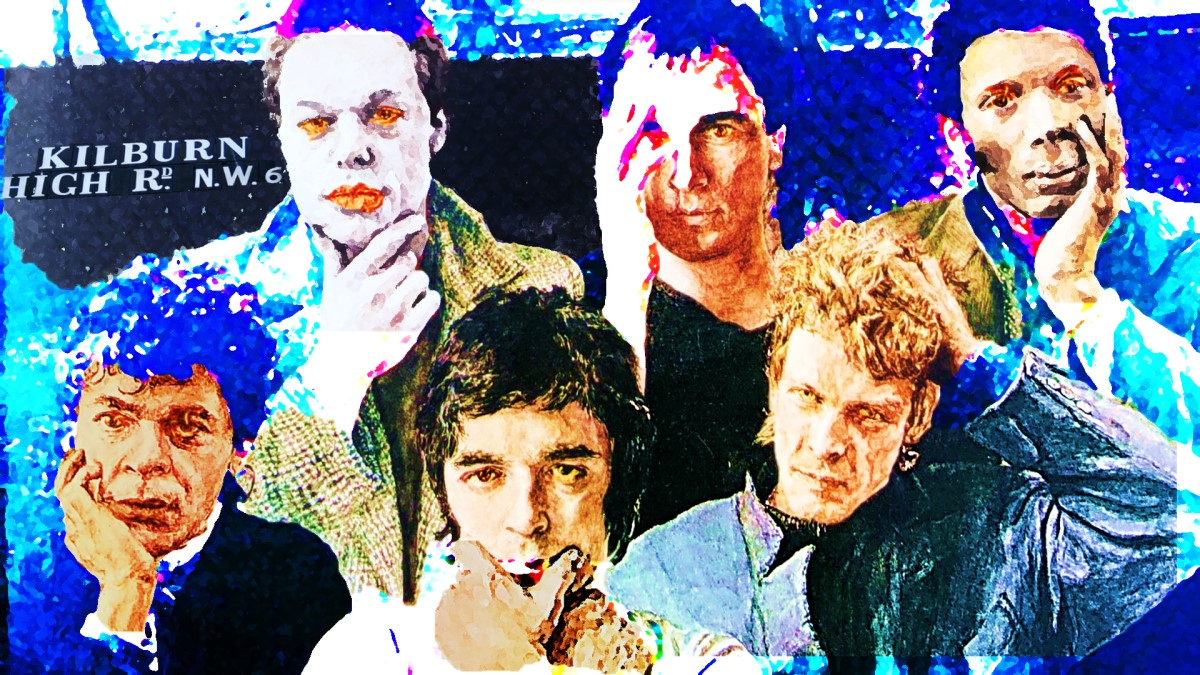
But however significant Johnny Rotten has been, it’s worth remembering that he nicked much of his shtick from the greatest of all the pub rockers. In the pre-punk days, Ian Dury sang with Kilburn & the High Roads, later he became a national treasure with the Blockheads, and in between, there was a brief incarnation as Ian Dury & the Kilburns, whose ‘England’s Glory’ is probably my favourite-ever TV performance by a British act. The song, celebrated by Matthews as ‘a kind of oral equivalent of Blake’s Sgt Pepper sleeve’, was later recorded by Max Wall – which, quite properly, takes us right back to the Music Hall.
from the maker of:
Discover more from Lion & Unicorn
Subscribe to get the latest posts sent to your email.

The first review of this book that I have seen that isn’t just the press release regurgitated. Thanks for that Alwyn, a good read and nicely illustrated. Much appreciated.
LikeLike