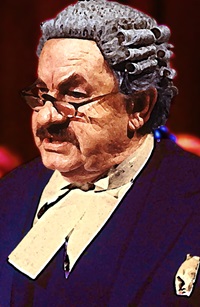
In a new feature celebrating individual episodes of British television, FINLAY McLAREN lauds ‘Rumpole and the Alternative Society’ (1978).
In this ever changing world in which we live in, there are few things that you can truly depend upon. Obviously there’s the new Bond film taking a ‘back-to-basics’ approach inspired by Fleming’s original novels, or Doctor Who’s latest assistant being less of a screamer, more of an equal. And you can be sure that the new arrival in Walford is a tart with a heart of gold who will ensure that ‘Albert Square is never the same again’. But there’s not much else.
Save, that is, for the biannual British press reports of some half-forgotten 1970s TV programme being revived, rebooted and remade.
Nearly all such stories come to nothing, of course. Did anybody catch Neil Cross’s Sapphire & Steel? Or John and Camilla Cleese’s Fawlty Towers revival? How about Russell T. Davies’s Doctor Who relaunch?
No, I didn’t think so.
My favourite example of the genre – and the basis of the prosecution’s argument, ladies and gentlemen of the jury – is the proposed Rumpole of the Bailey reboot, as reported in 2019.
This would have seen the most famous character in British legal fiction, Horace Rumpole – the ageing and dishevelled defence barrister created by John Mortimer and chronicled in book, radio and TV form – reimagined for the modern world as a woman (cue Roger Moore eyebrow-raise) and written by Mortimer’s daughters, Emily and Rosie.
Of course, anybody who has watched Rumpole of the Bailey knows full well that the cigar-smoking, wife-fearing, Old Bailey hack of 25B Froxbury Mansions, would never be accepted on TV today, woman or not.
His entire character – that of a cynical and world-weary, anti-establishment eccentric who stands as a fervent champion of privacy, individualism and personal freedoms, always holding that ‘an Englishman’s home is his castle’ – is antithetical to British television as it exists now. Fifty years on from Rumpole’s first appearance, in the BBC’s Play For Today, our national broadcasters typically serve either as cruise ship entertainment for OAPs, or as state-funded agitprop designed to pummel the viewer into total civil obedience and acceptance of whatever improving ‘message’ the media classes want to impart that week. This is not the world to which Rumpole belongs.
Take in evidence episode two of the first series, made by Thames Television and broadcast on 10 April 1978. Titled ‘Rumpole and the Alternative Society’, it sees Leo ‘Number Two’ McKern’s barrage balloon-shaped barrister travelling to the West Coast town of Coldsands to defend the free-spirited, flower-power drop-out and ‘lotus eater of Nirvana’ Katherine ‘Kathy’ Trelawney, as played by Jane ‘Here, There and Everywhere’ Asher.
Kathy has been charged with the possession of cannabis and Rumpole intends to defend her on the basis that the evidence against her was produced via entrapment; specifically, the sending of an officer from the local drug squad, dressed in beads and afghans, to the hippie commune of Nirvana, aka 34 Balaclava Road, to trick Kathy into committing a crime she would not have otherwise perpetrated.
Disgusting behaviour, your honour. The police are there to detect crime, not to manufacture it. What is this country coming to? Constables tricked out in beads singing to a small guitar, conning an innocent girl into making huge collections of cannabis resin from some pusher she met at a dance at the local tech. She would never have done it if the policeman hadn’t asked her.
This proves to be a winning argument. The case looks sure to be dismissed and Rumpole’s holiday on the Western circuit can begin in earnest. He and Kathy spend time together outside the court. They get along well, quoting Wordsworth to each other, and the Old Bailey hack even joins the Nirvana commune for dinner.
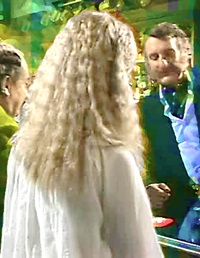
At one point Rumpole flirts with the idea of ‘dropping out’ himself, getting away from his life of legal chambers, Froxbury Mansions and his domineering wife Hilda, the dreaded ‘She Who Must Be Obeyed’. But these fantasies come to an end when Kathy reveals to Rumpole that she had bought the cannabis before the constabulary’s agent provocateur made contact. Worse still, she planned to sell it to raise money to help her brother Peter, who is serving a twelve year prison sentence in Turkey. This confession leaves Rumpole with no choice but to change her plea to guilty. Kathy will go to jail.
She begs him to forget she said anything, even offering to ‘visit’ him in London if it means he will just for once forget his legal scruples. Although tempted, Rumpole can’t bring himself to lie. Nothing matters to him more than being a barrister and the duties that entails. And so, despite Rumpole’s efforts to convince the judge to let Miss Trelawney off lightly, she is sentenced to three years in prison, and Rumpole’s dream of dropping out is over.
I would rather live at 34 Balaclava Road than flat 38 Froxbury Mansions with She Who Must Be Obeyed. That’s Mrs Rumpole.
During his time on the West Coast, old, rounded Rumpole stays in the Crooked Billet, a seaside hotel run by his old RAF friends Bobby and Sam Dogherty, played by Liz ‘Carry On’ Fraser and Peter ‘next time, Doctor, I will not be so lenient’ Jeffrey respectively. The Doghertys are deliberately presented in contrast to the drop-outs of Nirvana. Rather than being radical, free-thinking, hippie types with a love of wine and flute music, they are solid and dependable, conservative sorts; Bobby, the slightly put-upon wife, and Sam, an old soak with a handlebar moustache, stuck in the past and always to be found holding court behind the bar.
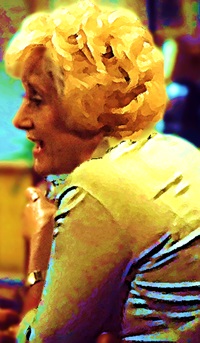
But for all their cultural differences, the two households both act as alternative societies for people out of step with the modern world of 1970s England: the Crooked Billet for the nostalgic veterans of the Second World War; Nirvana for the idealistic young people who have embraced the flower-power values of peace, love and individuality.
A typical night in the Billet sees Bobby take her place behind the piano to play old drinking songs, such as ‘Oh Johnny, Oh Johnny, Oh!’, while her husband, former flyboy Sam Dogherty tells dirty dancehall stories to punters his same age. Meanwhile, in Nirvana, a small community gathers around the table to drink homemade wine, sit on Indian scatter cushions and read poetry; think the Nut Hutch from Doctor Who serial ‘The Green Death’ (1973).
Rumpole’s stay at the Billet also stirs dreams of a different life, but here the mood is one of regret over the road not taken. For while Kathy Trelawney may be Rumpole’s current crush, once upon a time he held a candle for Bobby. Admitting to her that he wishes he had confessed his love all those years ago, he laments having been press-ganged by his head of chambers into marrying ‘She Who Must Be Obeyed’.
Like Kathy, Bobby holds her own sad secret. She has been warned that if her husband doesn’t get out of the licensing trade he’ll be dead within a year. But Bobby can’t bring herself to tell Sam, knowing that he wouldn’t be happy living out the rest of his days supping lime juice and soda in a bungalow. So, in the end, she decides not to tell him. Her husband will go on, living out his days stood behind the bar, telling old war stories, surrounded by friends and good cheer. Ruminating on Kathy’s conviction, Rumpole agrees: sometimes it is better not to tell the truth.
People not telling people things. People not scattering information like bombs. Oh yes.
We finish with a jolly sing-along of ‘Roll Out the Barrel’, and as the credits roll we know that a young girl is spending her first night in prison, that former Flight Lieutenant Sam Dogherty will never learn the truth, and that in the morning Horace Rumpole will make the long journey back to London, to chambers and to ‘She Who Must Be Obeyed’.
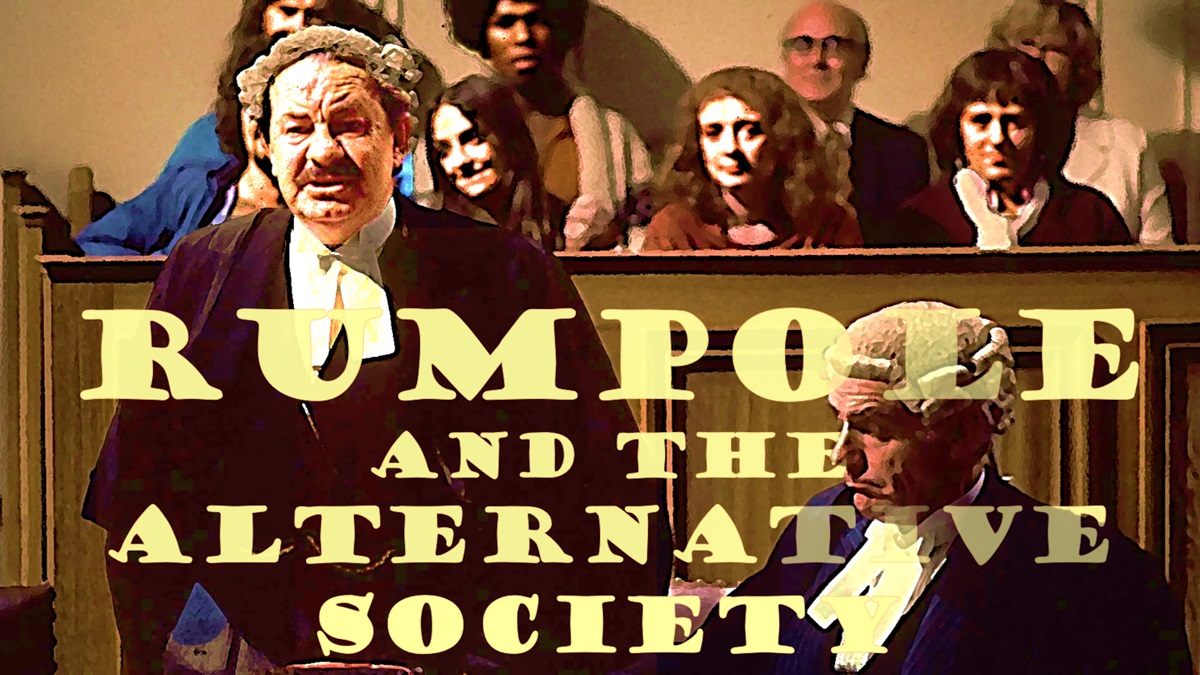
In the end there is no great lesson, no grander point. This isn’t a polemic on personal liberty or a glorified public information film on the evils of drugs, nor some kind of holy moral lesson so characteristic of dramas today. Instead, there are just people and places and decisions. Mortimer gives us no answers to the moral questions he poses.
Should Rumpole have lied? Is it right that Kathy goes to prison for what many would see as a minor offence committed for a just cause? Should Bobby have told the truth? Is there really any difference between the vices of alcohol and cannabis? What makes Sam so different from Kathy? Would Rumpole, the compassionate, free-thinking liberal, who seems more at home in Nirvana than with the legal professionals of the Western circuit – or with his old friends at The Crooked Billet – have been happier had he ‘dropped out’? Is it sometimes better not to tell the truth?
That’s up to you. You, the jury.
It is impossible to imagine this being the case today. In the world of Auntie’s Sherwood (2022, 2024) and Netflix hit Adolescence (2025), the idea that a television programme might trust its viewers enough simply to present a story and allow them to make up their own minds is unthinkable. There is no explicit condemnation of John Lennon hippie types for perverting the youth, nor a denunciation of the system, man, not even a realistic depiction of a panic attack.
Episodes of a rebooted Rumpole, would likely be followed by a cool but compassionate female voice intoning to viewers: ‘If you’ve been affected by any of the issues raised in Rumpole…’. Instead of such mollycoddling, we are presented with a view into another world, into the world of late post-war era Britain, where the foreign countries of seaside hotels run by gin-sozzled ex-RAF types and hippie communes rubbed shoulders, and where viewers were still treated with respect.
I first watched ‘Rumpole and the Alternative Society’ in 2017. In the year of Horace’s fiftieth anniversary, not only do I keep coming back to it, but in between viewings it lives on in my mind. Kathy giving Rumpole a tender kiss good night at the bus stop, the tragedy of former Flight Lieutenant Sam ‘three fingers’ Dogherty, Leo McKern’s reading of ‘It was a beauteous evening calm and free’, the final sing-along, all the questions it raises and refuses to resolve. It is a masterpiece of writing. Television has rarely felt so alive and so lived in.
Please seek it out. Let it wash over you. Then, let it sit with you.
And so, during the long, cold nights in Froxbury Mansions, they flash upon that inward eye, Coldsands and the lotus eaters of Nirvana.
‘Rumpole and the Alternative Society’ is available on YouTube, and the first three series of Rumpole of the Bailey are available to stream for free on itvX.
see also:



Discover more from Lion & Unicorn
Subscribe to get the latest posts sent to your email.

Great episode. In Rumpole’s shoes I’d have kept my mouth shut. I don’t think she did anything wrong.
LikeLike