
It’s Spring! And here’s BEN FINLAY with the soundtrack to the season.
Spring was moving in the air above and in the earth below and around him… Something up above was calling him imperiously… Hither and thither through the meadows he rambled busily, along the hedgerows, across the copses, finding everywhere birds building, flowers budding, leaves thrusting – everything happy, and progressive, and occupied.
Kenneth Grahame, The Wind in the Willows, 1908
With Winter’s icy, dark days behind us, we look forward to longer, sunnier times, the rebirth of nature, and of course a new Lion & Unicorn top ten and playlist. Luckily, I’ve spent the sunnier days of March working on such a piece, a collection of albums to soundtrack the Spring in all its glory.
As with my Autumn piece, the music featured here is rich in mood, and to my mind (and ears) suits the change to springtime. There is a lineage here from the Autumn article, last year’s folk rock top ten and the ‘getting it together in the country’ piece. Again, with one exception, we are situated firmly in the 1970s, for which I make no apology whatsoever. And while not all the titles were recorded or released in the spring months, several were, and all are of a mood conducive to the temperate season.
So, with the yakkin’ and shameless self-promotion done, get ready to walk out one morning, listen for the birdsong in the valleys ring, and enjoy the L&U top ten of the lovely spring.
Warning: Several Fairport alumni are included. It seems that you just couldn’t keep the buggers out of recording sessions in the 1970s. I didn’t realise when I put together the list how they would keep popping up, but it makes for good continuity, I s’pose.
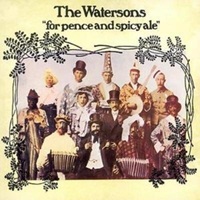
10. The Watersons, For Pence and Spicy Ale (1975)
In spring we sow, at the harvest mow,
And that is how the seasons, round they go;
But of all the times, if choose I may,
‘Twould be rambling through the new-mown hay.
Released by Topic in 1975, For Pence and Spicy Ale (great title) saw Mike, Lal and Norma Waterson reform with Martin Carthy (Norma had been a radio DJ on the – wait for it – Caribbean island of Montserrat) and saw the band in fine fettle. The record was greeted with considerable acclaim from critics and audiences alike and is considered by many to have been the group’s finest recording. Wonderfully produced by Tony Engle, the sound is so warm it sounds like you have stumbled into a sing-around in a rural pub sometime in the 1930s. The thirteen traditional tunes and one original are as fresh as newly mown grass and have a lovely spring-like rebirth feel to them. One of the best records of the traditional British folk scene.
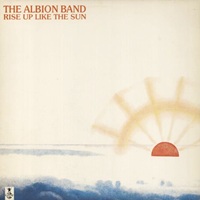
9. The Albion Band, Rise Up Like the Sun (1978)
While we are in a traditional mood, this record from is a whomping bit of late 70s British folk-rock, so very nearly included on my previous folk-rock top ten. Now it has its chance to shine, and rightly so. Made with Fairport Convention stalwarts past (Richard Thompson, Simon Nicol, Dave Mattacks) and future (Ric Sanders) Rise Up is a fan favourite, including the glorious, massed voices at the peak of ‘Poor Old Horse’ and the deep rural groove of the opening ‘Ragged Heroes’.
Trivia note: ‘Poor Old Horse’ (a traditional sea shanty) was released as a single and named Record of the Week by Radio 1’s Simon Bates, but it sank without trace. Now, either old Batesy was seriously out of touch with the late-70s zeitgeist, or it is one of the bravest left-field choices ever. Answers on a postcard please…
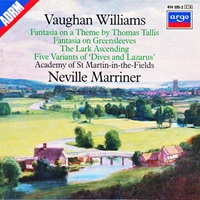
8. Vaughan Williams, Neville Mariner, Academy of Saint Martin in the Fields, The Lark Ascending et al (1972)
‘The Lark Ascending showed serene disregard of the fashions of today or of yesterday. It dreams its way along in “many links without a break” … the music is that of the clean countryside, not of the sophisticated concert-room.’ – The Times, 1921
Classical music doesn’t make lists such as this nearly as much as it should, so I’m redressing that here with one of the finest ever pieces of music.
Ralph Vaughan Williams composed The Lark Ascending in 1914, just before the outbreak of World War One. A haunting ‘pastoral romance’ for solo violin and orchestra, it has become a symbol of the calm before the storm, and a metaphor for peace before The Great War. Because of the war, its premiere was delayed until 15 December 1920. The first version to be heard was for violin and piano; the orchestral premiere followed on 14 June 1921. On both occasions, the violinist was Marie Hall, for whom Vaughan Williams composed it.
A simple construction, the violin soars like a bird above the orchestral landscape, and a contrasting section evokes a rural idyll through folksong-like melody. At its conclusion, the solo line soars up into the stratospheres, as if merging with the sky, and then vanishes.
There are, of course, many recorded versions of the piece, but I opt for Neville Marriner’s superb 1972 recording of favourite shorter works by Vaughan Williams. The record has both excellent performances and a warm sound, and was recorded at the Kingsway Hall, Holborn in May 1971, with Iona Brown playing the violin part on The Lark Ascending. I have an original vinyl copy, and it is one of my most treasured records.
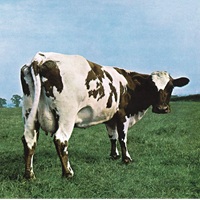
7. Pink Floyd, Atom Heart Mother (1970)
‘A load of rubbish. We were at a real down point … I think we were scraping the barrel a bit at that period.’ – David Gilmour, 2002
‘If somebody said to me now – right – here’s a million pounds, go out and play Atom Heart Mother, I’d say you must be fucking joking.’ – Roger Waters, 1984
Perma-bickering Floyd principals Gilmour and Waters are in rare agreement about this record, particularly the 23-minute, side-long title track. Both state their dissatisfaction with its recording, but I see the boys as overdoing the negativity somewhat, as this as an important, transitional album for the group. The ‘Atom Heart Mother’ suite for band and orchestra contains several musical motifs they would hone later (for example, the ‘Funky Dung’ section forms the basis of the strict-time groovy passage of ‘Echoes and later ‘Time’) while also being the most ‘prog’ thing they recorded.
But it is side two where we can identify where the two leaders would go in their later musical and lyrical stylings. Waters’ acoustic ‘If’ sees the start of his preoccupation with the human condition(‘If I were a good man, I’d understand the spaces between friends’)and Gilmour’s ‘Fat Old Sun’ is a pastoral, melodic ode to sunny days, replete with church bells and birdsong. He resurrected it to great effect on his solo tours, and it is a Floyd fan favourite.
AHM marks the high point of the band’s English, rural sound, but also points the way to the future. It’s also a great Spring record, with the cover photo (the cow was named Lulubelle, and the picture taken just outside Potters Bar) evoking the music within.
Trivia note: Stanley Kubrick wanted to use the album’s title track in A Clockwork Orange. The group refused permission, with Waters later saying, ‘maybe it’s just as well it wasn’t used after all’. However, the album is visible behind the counter in the record store scene of the film.
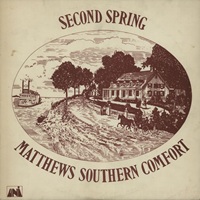
6. Matthews Southern Comfort, Second Spring (1971)
Formed in 1970 by former Fairport Convention Ian Matthews (who confusingly recorded a solo album named Matthews’ Southern Comfort in 1969), this was a group heavily influenced by the laidback, West coast sound of the era. Their first album, Second Spring is a lovely, relaxed offering, with ‘Moses in the Sunshine’ a particularly fine track.
Although best known for their version of ‘Woodstock’, their lush three-part harmonies and pedal steel didn’t last long, as in late 1971 Matthews quit to form the more folk-rock based Plainsong.
coming soon:
see also:
Discover more from Lion & Unicorn
Subscribe to get the latest posts sent to your email.
