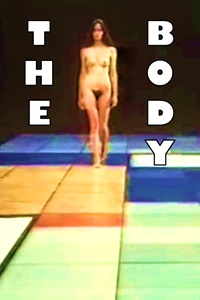
SIMON MATTHEWS watches Roy Battersby’s 1970 movie The Body.
It is hard to know where to start with a film like The Body. The obvious information to impart is that it was made by Kestrel Films, between their successes with Kes (1969) and Family Life (1971). It was produced by Tony Garnett and directed by Roy Battersby, who had never made a feature film before but whose 1969 TV documentary Some Women gives an indication of what might be expected.
Both Kes and Family Life are dramas, of course, and The Body is not, being based on a 1968 book by Anthony Smith, at that point narrator and presenter of the BBC Two series The World About Us. According to Wikipedia, he was also an explorer, a David Attenborough-type figure roaming the post-colonial world in a safari suit, providing audiences with an overview of third world societies. This anthropological approach, describing homo sapiens and their environment in microscopic detail, is replicated in his best-seller, which incidentally sold 800,000 copies. Hence the film version.
The job of distilling this into a commentary fell to Adrian Mitchell, one of the great all-rounders of the period with a CV that included anti-war stage productions, albums combining poetry and jazz (as well as something called A Laugh, A Song, and a Hand-Grenade) and the 1968 LWT special Georgia Brown Sings Kurt Weill. He also had a fondness for William Blake, incorporating some of his verse into his script for the film. Narrators were needed, and who better than Vanessa Redgrave and Frank Finlay, the latter appearing as Jesus in Son of Man at the Roundhouse when approached.
To accompany their panoply of arresting visual images Garnett and Battersby wanted intelligent, experimental music. They sought advice from John Peel. He recommended Ron Geesin to whom he had given three sessions on the strength of his 1967 album A Raise of the Eyebrows. Never a household name, Geesin had been piano player in the Original Downtown Syncopators. One of many early 1960s trad-jazz ensembles, these occupied the same terrain as the Temperance Seven, providing deliberately antique replications of long-forgotten ragtime hits. Another comparison would be the Alberts, the ensemble led by Bruce Lacey whose music shaded into absurd performance art and kinetic sculptures.
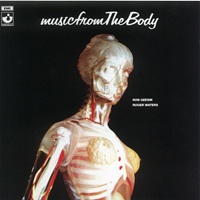
As Geesin later said, he could do the ‘tunes, textures and atmospheres’ but not the songs. However, he knew Pink Floyd’s Nick Mason, who shared his interest in gadgets and sound effects, and via this connection, Roger Waters arrived to provide the remainder of the music. Between them they produced twenty-two tracks, eighteen of them solo pieces (fourteen by Geesin, four by Waters) and four featuring them both.
The film starts with footage of heavy industry, pollution and crowded cities, accompanied by gentle folk music. Not long after it dives into a sex scene – chastely shown through a translucent screen – acted out by Richard Neville, editor of Oz magazine, and his girlfriend Louise Ferrier. A lot of time is given to human biology and reproduction, with significant amounts of nudity (both sexes, all ages). A human embryo grows in the womb, alongside music from a string quartet. A big ecological, anti-war message is conveyed, followed by images of the homeless, the unemployed and finally birth.
As shown here, life isn’t a happy experience. Society – and those who control it – cause many problems, notably through obliging the population to submit to employment in dehumanising factory conditions, leading to injuries, blindness and even learning difficulties. The narrators do a lot of talking and explaining, whilst the camerawork deploys extreme close-ups and slow motion. Everyone explores their bodies and there is much footage of nude children. Waters’ bass riffs bumble away in the background, accompanied by Geesin’s piano rolls.
After which, we see the effects of ageing (more nice music) and explore sleep, dreams, eating and the digestive system, including an interior exploration by miniature cameras of the urinary tract and lower bowel. There are voices, tape loops, and an affecting scene where a terminally ill woman discusses her death. All of this is illustrated by images that make the point that the world we live in is being degraded.
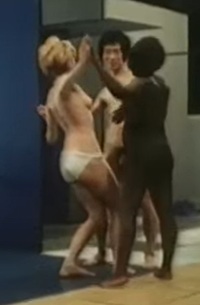
Towards the end of the film there is an extended group conversation, a sort of informal ‘democratic’ discussion by an ad-hoc collection of participants. Garnett and Battersby are clearly keen to present this as a working-class community event, but among those credited with appearing (here, and in the film generally) are Professor Richard Gregory (Head of the Bionics Research Laboratory at the University of Edinburgh), Kim Howells (late of Hornsey School of Art, and at that point a member of the Communist Party of Great Britain), Danny Lynch, aka ‘The Great Stromboli’ a fire eater, often seen on TV (including on The Black and White Minstrel Show) and various actors: Sadie Corre, Danny Daniels, Peter Kerrigan, Diane Patton, Joan Perkins and Beryl Riggs.
Things reach a rousing, and rather noisy conclusion with a gynecologically explicit childbirth scene during which Waters, and his Pink Floyd colleagues rock out with ‘Give Birth to a Smile’. The net effect is fearless, like watching a completely ‘out there’ instructional film mixed up with one of Yoko Ono’s shorts and Godard’s fiercely political excursions into current affairs.
At 112 minutes, and given an X certificate on its release in October 1970, what was the intended audience for this? Given the age restrictions insisted on by the British Board of Film Censors, school human biology classes were out of the question. The university and college film societies and art-house circuit were a possibility, of course. Interpreting this from the standpoint of 2026, where it seems inconceivable that the Odeon, Granada and ABC chains could have screened such an oddity, is to ignore the huge sales figures for a book like The Joy of Sex around the same time. Indeed, in August 1971 the film’s distributors (which included EMI in the UK and MGM in the US) confirmed it had recouped its costs in the Far East alone. So, not such a leftfield artefact after all.
But if The Body captured the zeitgeist of a now-vanished era, repeating its success with a string of similar productions proved difficult. Geesin continued his working relationship with Pink Floyd, notably on Atom Heart Mother where some of the tracks – with titles like ‘Breast Milky’, ‘Funky Dung’ and ‘Mind Your Throats Please’ – suggested a connection to the film, after which he helped score Sunday, Bloody Sunday (1970). Battersby went back to television where his work on Play for Today remains highly regarded, but by the end of the decade was not welcome at the BBC, having been blacklisted by MI5 due to his close connection to the Workers Revolutionary Party.
Kestrel Films found life difficult too. When the political atmosphere in the UK changed radically in 1979, they relocated to the US, where attempts at making more mainstream features gradually petered out. Looking at Earth Girls are Easy (1988) – their Julien Temple-directed LA-based comedy, starring Jeff Goldblum and Geena Davis, with music by Nile Rodgers – makes one aware of the uniqueness of The Body.
from the maker of:

see also:


Discover more from Lion & Unicorn
Subscribe to get the latest posts sent to your email.
