He was the future once . . . SIMON MATTHEWS revisits Rocky Morton and Annabel Jankel’s 1985 movie Max Headroom: 20 Minutes into the Future.
There was a lot of interest in the early 1980s in the dramatic, and cinematic, potential of computers and digital technology. Its sinister, manipulative side was touched on in Time Bandits (1981); Tron (1982) deliberately resembled a video game with immense amounts of computer-generated imagery; and Electric Dreams (1984) was a rom-com in which a personal computer — a piece of domestic kit many people could now afford — played a significant role. The first two made a lot of money. Electric Dreams, a Virgin production, didn’t, but came with a score which provided Phil Oakey and Giorgio Moroder with the international hit single ‘Together in Electric Dreams’. It was directed by Steve Barron who had made over a hundred music videos in the preceding five years.
In the UK, Channel 4 took note, and asked Peter Wagg, a producer at Chrysalis Records, if he could devise a pop video show, complete with presenter. Wagg, whose credits included the Ultravox promo-film ‘Vienna’ (clearly nicked from The Third Man), consulted his colleagues and came up with the idea of using a computer-generated figure to front the programme. This was quickly seen as having the potential to become a stand-alone film; to develop the idea further, they went down to Cornwall to seek advice from Colin Wilson.
It might seem odd that the 1950s angry-young-man wunderkind (to some; pretentious nihilist to others) might be approached. But in the years that had passed since his 1956 debut The Outsider, Wilson had re-invented himself as a polymath and science-fiction writer, with a considerable interest in the workings of human consciousness. He was also at a commercial high: by late 1983 one of his books, The Space Vampires, was in production as Lifeforce with a commendably large budget and the mooted involvement of Billy Idol at one point.
Wilson’s suggestions ended up being uncredited, but he did make one very prescient observation: that in the near future the most knowledgeable people about computers would be adolescents, and that one of the key characters in Wagg’s proposed film should be no more than fifteen years old.
With funding from Chrysalis in place, and with Rocky Morton and Annabel Jankel directing (they too had made an awful lot of music videos), a script was put together by Steve Roberts, noted for the rather quirky Sir Henry at Rawlinson End (1980).

The plot starts at Network 23, a TV station somewhere in south-west London, possibly riot-ravaged Brixton given that the streets outside look like a cross between Mad Max and Blade Runner. Network 23 is broadcasting a reality TV show, punctuated by ‘blipverts’, an early and pernicious form of subliminal advertising. This comes to the attention of Edison Carter, an investigative journalist, who is accidentally killed whilst pursuing the story: he collides with a sign reading ‘Max Headroom’ in a car park. As suggested by Wilson, the TV station have a fourteen-year-old computer genius to hand — Bryce, played by the teenage actor Paul Spurrier — who downloads his brain and clones a digital replacement.
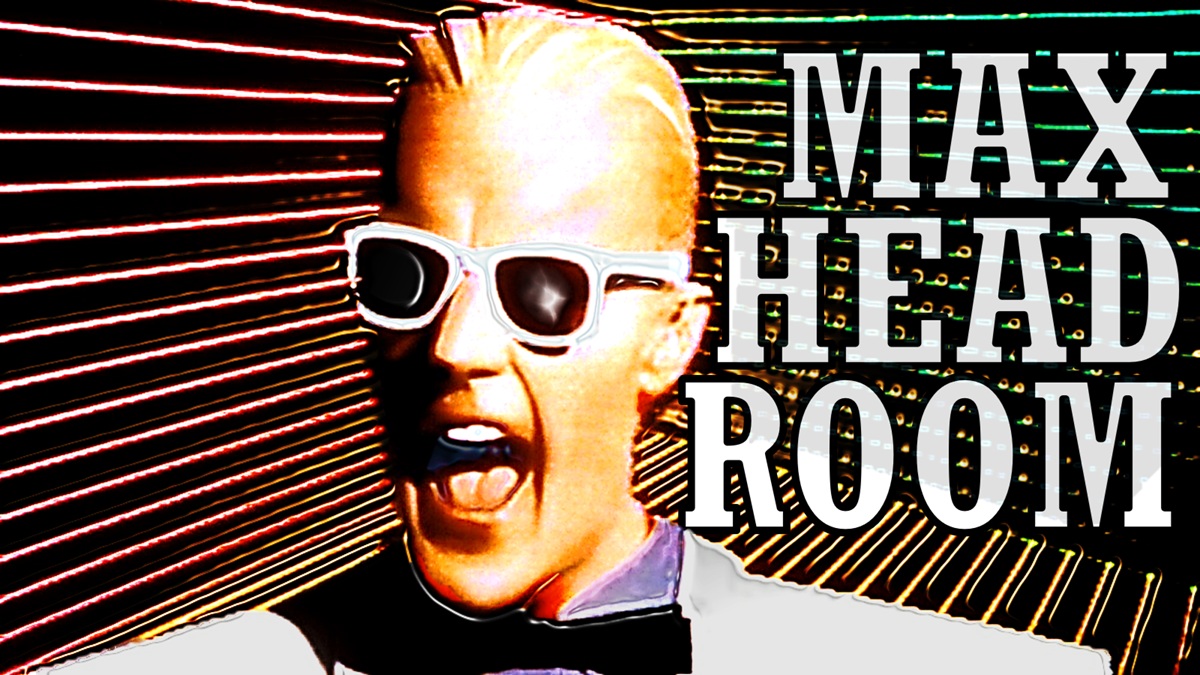
Much fun is had with this and, allowing for the technology of the time, it’s very well done. Both Carter and his cloned alter-ego — quickly christened Max Headroom because it is the only thing he keeps saying — are played by the American actor Matt Frewer, who proves adept at stuttering and twitching in a transatlantic accent, rather like someone with Tourette’s Syndrome. He really inhabits the character. Too early for computer-generated graphics, a lot of prosthetics were applied to Frewer’s head and shoulders to emphasise Headroom’s angular, robotic features, which were then shot against a neon-striped background, punctuated by blipverts, as he presents the show.
He has a female colleague, Theora, decked out like Princess Di and as posh as Jenny Agutter, played by Amanda Pays. There are also a couple of characters called Breugal and Mahler who operate like Burke and Hare. It seems the budget didn’t run to having any Grade A stars — this was a TV film, after all — but the cast do a great job, led by Nickolas Grace, Roger Sloman and Hilton MacRae, all of whom were Royal Shakespeare Company thespians. It’s a very enjoyable and inventive work and the mixture of the dystopian and a geeky fascination with computers is very 1980s.
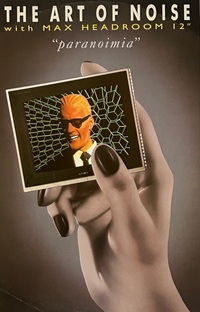
Broadcast on Thursday 4 April 1985, it had — as befitted something connected to music videos — a synthesizer-driven score by Midge Ure and Chris Cross, done whilst they were taking a break from Ultravox. Oddly, despite their commercial heft at this point, it remains unreleased in any format. That Headroom — as a character — could sell records was proven a year later when The Art of Noise featured him on their single ‘Paranoimia’, which reached #12 in UK charts, #34 in the US, and sold heavily across Europe.
By this point ABC had asked Chrysalis to make a US TV series. This involved shortening each episode by eleven minutes, dropping the cyber-punk trappings and giving it an overall Americanization. Frewer remained in situ as Headroom, but apart from Amanda Pays’s Princess Di lookalike, most of the UK cast were dropped. Between March 1987 and May 1988 fourteen episodes were made. It won awards, but despite this was cancelled — due to ‘poor ratings’ — halfway through the second series. It was too sophisticated for audiences used to Dallas and Miami Vice. A proposed film, Max Headroom for President, which would have been released during the 1988 United States presidential election, was never made.
The ABC series reached the UK in March 1989 and proved astonishingly popular, with some cable channels screening it down to 2002. The inability of the UK media, whether analogue or digital, to seize the opportunities presented by the programme is striking. An obvious comparison would be Robocop. Despite claims that this owed much to Blade Runner, it has many similarities with Max Headroom. Both have plots where an investigator is killed and cloned into part man-part computer. Both have plots where a critical scene is staged in the toilets within a corporate HQ, it being taken for granted that this is where the deals are done.
As of 2026, the Robocop franchise has produced four films (with a fifth on its way), four TV series, one of which is animated, six video games, a pinball machine, a paperback novel, ninety-six comic books, a theme-park ride and a walk-on role for its main character in a TV commercial for Kentucky Fried Chicken, extended in 2021 to the UK insurance company, Direct Line. It has made its creators a great deal of money.
The same is clearly not true for Max Headroom: 20 Minutes into the Future. Clearly ahead of its time, its audience was niche: you either loved it, or just didn’t get it.
see also:


Discover more from Lion & Unicorn
Subscribe to get the latest posts sent to your email.
