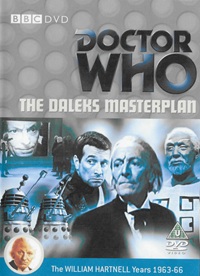
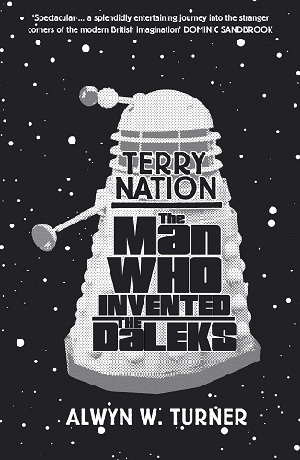
It being sixty years since ‘The Daleks’ Master Plan’ was first broadcast, here’s an extract from ALWYN TURNER’s Terry Nation: The Man Who Invented the Daleks.
Among the many fans of the Daleks was Huw Wheldon, the man who had recently become controller of programmes for BBC One. Wheldon expressed his disappointment at the brevity of their appearance in the first episode of ‘The Chase’ (1965), and although he was assured that they would appear more substantially in the subsequent episodes, and that they were pencilled in for a fourth story later in the year, he was keen that there should be still more of the creatures, asking if the forthcoming series couldn’t perhaps be extended. Others in the BBC hierarchy agreed and, against the wishes of the production team, ‘The Daleks’ Master Plan’ — intended as a six-part serial — was extended to twelve episodes.
Now fully engaged as script editor on ITC’s The Baron, Terry Nation simply didn’t have time to complete such a major project. David Whitaker, who would have been the obvious next choice, was already handling much of the expansion of the Daleks’ mythology in TV Century 21, so Nation turned to his other colleague, Dennis Spooner, to share the burden of ‘Master Plan’. Nation was responsible for the basic storyline but wrote only six of the episodes; the remainder were contributed by Spooner, who had in the meantime handed over the duties of script editor on Doctor Who to Donald Tosh in order that he too could work on The Baron.
Other changes in the programme’s personnel had seen the departure of the characters Ian and Barbara at the end of ‘The Chase’, and shortly thereafter that of producer Verity Lambert, to be replaced by John Wiles, who inherited ‘Master Plan’ despite his distaste for its unwieldy length. Even Nation was far from convinced by the scale of the undertaking. ‘If I was a producer on a show like that,’ he reflected later, ‘I don’t think I would ever commit myself to a three-month Dalek story without a lot of other stuff in it as well.’
Nonetheless, there’s a great deal of fun to be had in Nation’s first five episodes of the story. The Doctor and his companions travel rapidly around the universe, starting on Kembel before moving on to a penal colony planet, Desperus, then to Earth and thereafter to Mira, inhabited by invisible beings called Visians. But there is also some rather downbeat material. Secret agent Bret Vyon is killed by Sara Kingdom, who believes him to be a traitor; he wasn’t, but it does turn out that he was her brother (returning to the fratricide seen in ‘The Dalek Invasion of Earth’). Sara too fails to survive the serial, while Katarina, a woman from ancient Troy brought along on the TARDIS from the previous story, ‘The Myth Makers’, dies in an act of heroic self-sacrifice.
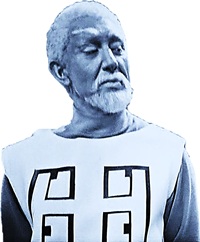
Counterpointing the Doctor’s adventures is the story of Mavic Chen (Kevin Stoney), the most powerful man on Earth and holder of the office Guardian of the Solar System.
Despite his initially dignified bearing, he turns out to be a power-crazed despot who is secretly in alliance with the Daleks, providing them with the vital component, Taranium, needed to complete the Time Destructor, with which they intend to conquer the universe. In characteristically excessive fashion, Taranium is said to be ‘the rarest mineral in the universe’, and the Time Destructor ‘the most dangerous weapon ever devised’.
If the Daleks are, as ever, derived from the Nazis, then Mavic Chen is clearly modelled on Stalin, his first appearance including a reference to a Non-Aggression Pact, which can hardly fail to bring to mind the Molotov–Ribbentrop Pact of 1939 (it was even signed in the year 3975).
After these five episodes, Nation handed over to Spooner to complete the story, returning only for the seventh episode, ‘The Feast of Steven’, which was broadcast on Christmas Day 1965 and which therefore, in accordance with BBC practice at the time, abandoned the storyline for some fun.
The TARDIS materialises in 1960s Liverpool, where the crew run into trouble with the local police (originally it was hoped to tie in with the cast of Z Cars, though this didn’t work out), then finds itself in Hollywood during the silent movie era, complete with a Keystone Kops-style slapstick chase sequence and a desert melodrama, the latter dominated by a glamorous hero who, Nation noted, should be ‘very superior and good looking in the tradition of Valentino’. It ended with the crew safely back on board and celebrating the festive season. ‘A happy Christmas to all of us,’ toasts the Doctor, before turning to the camera: ‘Incidentally, a happy Christmas to all of you at home.’
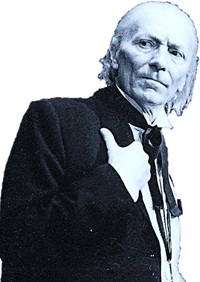
The Daleks, however, make no appearance in that interlude, and rather more chilling was Nation’s sign-off to episode five, the last of his Dalek tales to be screened for more than seven years. When the Doctor and his companions are discovered by the monsters, he goes further than ever before in admitting defeat: ‘I’m afraid, my friends, the Daleks have won.’ They hadn’t, of course, and nor had we seen the last of Sara Kingdom, although she crumbles to dust in the final episode, victim of the Time Destructor as it accelerates her ageing. She was back later in the year as the star of her own comic strip in the final spin-off book that Nation authorised for publication by Souvenir Press, The Dalek Outer Space Book (written by Brad Ashton), as well as featuring heavily in his plans for his next enterprise.
Meanwhile, Spooner’s six scripts kept the story moving along at the same pace and with the same balance of fun and terror (the materialisation of the TARDIS on a cricket pitch during a Test match is especially pleasing in its incongruity).
As script editor, Donald Tosh felt — as others were later to find — that Nation’s scripts for the Daleks needed some reworking, but it was a process with which Nation pronounced himself perfectly happy. ‘I’ve already told Donald that any changes he wants to make in the script will meet with my approval,’ he wrote to John Wiles in September 1965. ‘I’m sure we’re all aiming at the same thing.’
In the same letter he ruminated on the nature of names for fictional characters: ‘Our Victorian dramatists had a splendid system of immediate identification. For instance, a Roger could not be anything but a clean limbed, bright eyed, decent chap, whereas a Jasper had to be a moustache twirling, whip cracking hound.’ In this context, he approved of the name Bors being given to one of the characters on the penal planet: ‘Obviously any man called Bors started his day with a murder and by lunch time had worked up to really serious crimes. Splendid name.’
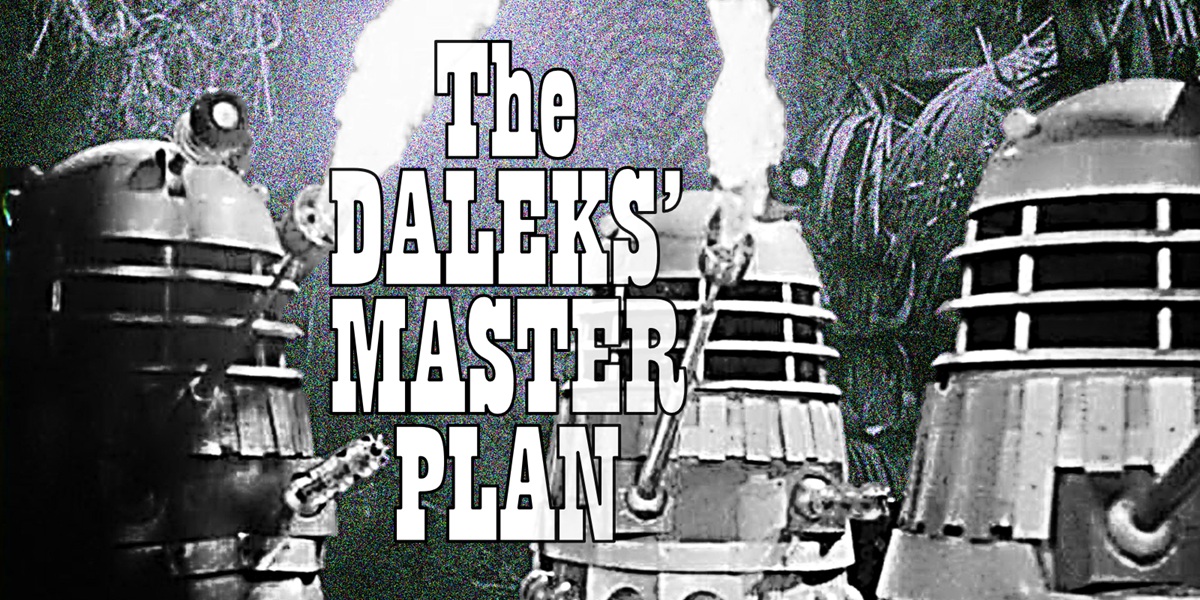
Notwithstanding the outbreak of Dalekmania the previous Christmas, 1965 was the great year of the Daleks: they appeared in a record fourteen episodes of Doctor Who that year, as well as in the cinema, on stage, in comics and in two books. And emerging from all that work was a pattern that was clearly related to Nation’s comments in August about the possibility of an American television series of the Daleks. The intention to break away from Doctor Who was self-evident.
from the maker of:
see also:
Discover more from Lion & Unicorn
Subscribe to get the latest posts sent to your email.
