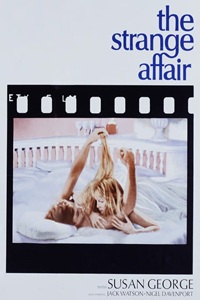
SIMON MATTHEWS watches David Greene’s 1968 movie The Strange Affair.
When did the dream fade? According to Peter Wynne-Wilson, operator of the Pink Floyd light show, ‘By the end of 1967 the zeitgeist had changed. And it wasn’t the cosy happy thing anymore.’
Others noticed it getting chilly too. When the Pretty Things signed to EMI that autumn, they got almost no advance and had so little funding that they designed the cover of their rock opera masterpiece SF Sorrow themselves. To keep themselves afloat financially they recorded library music, for use in TV commercials and feature films, under a pseudonym.
Meanwhile, Tomorrow, who were doing nicely as the next-big-thing in the summer of 1967, found they had relatively little live work booked for the opening months of 1968.
For students of cinema, plotting the route from Georgy Girl to Performance, or from Magical Mystery Tour to Get Carter is equally intriguing, and some have settled on The Strange Affair – announced in October 1967 – as an early outlier of this evaporation of optimism. It was adapted from a 1966 novel by Bernard Toms, a former Metropolitan Police officer, based on the career of Detective Sergeant Harold Challenor (‘the scourge of Soho’). Noted for his wartime exploits in the SAS, Challenor developed a line in planting evidence and beating suspects that eventually saw him discharged, classified as a paranoid schizophrenic, and sent to a mental hospital. It is said that Joe Orton based the character of the venal and corrupt Inspector Truscott in Loot on him.

An interest in how the Police really operated, and the short cuts they took to get convictions, had been explored before this, notably in The Informers (1963, ‘an unsentimental, hard-edged account of the framing of a police inspector’) and prior to that in a popular ITV series The Ghost Squad, which ran for three years from 1961. Both relied heavily on the experience of Detective Superintendent John Gosling, whose service at Scotland Yard, recounted in a 1959 memoir, had included working with informers and various underworld figures. Much of this was deniable, hence the designation of those involved as ‘the Ghost Squad.’ Not much swinging London here, then.
Having been paid £10,000 for film rights (enough to buy a house then) Toms gave way as screenwriter to Stanley Mann, whose credits included a couple of high-quality literary adaptations, A High Wind in Jamaica and The Collector. His adaptation of The Strange Affair follows the book, with a lot of internal police wrangling, drug deals and pay-offs to informers in pubs.
Much of it is shot in derelict parts of Ladbroke Grove, then being cleared for the construction of the Westway, giving everything a down-beat feel. Early on, we meet PC Peter Strange, played by a fresh-faced Michael York, who has opted for a socially useful career after failing his finals at university. One of his superiors at ‘the station’ is Detective Sergeant Pierce – Jeremy Kemp, villainous and much given to bonhomie – who prizes his ability to work hand-in-glove with Quince, a dangerous and violent criminal.
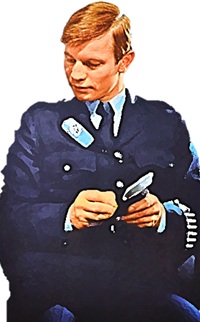
Pierce has a Victorian-type dislike for drug dealers, and taps up Charley Small, a rock musician – Barry Fantoni, driving an immense Cadillac – who fingers an Indian guru, travelling to and from the Battersea Heliport as the likely source. An unwitting and naïve Strange arrests Fantoni for something unrelated and Pierce misses his chance to pull off a major arrest. Later Strange deals with a fracas outside a night club, and meets a fifteen-year-old drugged up Frederika – Susan George, eighteen – who is helping a band carry their gear to a van. She likes the look of him. Who wouldn’t? Michael York was one of the great Peter Pans of English acting in the 1960s and 70s, perennially youthful.
They start seeing each other and she takes him to meet her aunt and uncle – there are no parents on the scene – in Hampstead. Liberated intellectuals, they live in a huge house with phenomenal pop-art interiors. Despite the clear illegality that it involves, Strange and Frederika start a relationship. There is a very risqué bath scene (in a bathroom so outré it wouldn’t disgrace Liberace) with nudity and slow-motion scenes of intimacy. The camera pans back and it turns out aunty and uncle are pornographers, filming it all and selling the material to Quince for onward transmission to private cinemas. A copy ends up with Detective Sergeant Pierce, who uses it to demand that PC Strange plants evidence on suspects. Unhappy with this, his downfall, trial and imprisonment follow.
Gloomy and pessimistic, The Strange Affair was released with an X-certificate in July 1968. It turned out it wasn’t that easy to shrug off the zeitgeist, and like both the other films made by its director David Greene – Sebastian (1968), I Start Counting (1970) – it remains poppy and modish.

There is some enjoyment to be had spotting the ‘swinging London’ credentials of those involved. Barry Fantoni, for instance, presented the BBC TV series A Whole Scene Going, released a couple of collectable singles and appeared at the 14 Hour Technicolor Dream, alongside Pink Floyd and Tomorrow. The band in the pub where Fantoni gets his pay-off from Kemp are John E. Paul and The Blue Mountain Boys, whose version of the Northern Soul classic ‘I Wanna Know’ appeared on Decca in October 1967. A close inspection of the footage where York first encounters George appears to show the Liverpool Scene doing a walk-through. Finally, the soundtrack consists of library music by Basil Kirchin, now much admired by high-brow collectors.
All of which makes it difficult to know where to place The Strange Affair. A late version of the social realist police dramas that stretched back to The Blue Lamp, it acts as a bridge to series like The Sweeney and The Professionals where those who enforce the law are as flawed and unlikeable as those they fight. It’s worth a look, now that, after a long period of obscurity – possibly because of its under-age sex sub-plot – it has finally appeared on DVD.
from the maker of:

see also:


Discover more from Lion & Unicorn
Subscribe to get the latest posts sent to your email.

I’m a fan of these late 60s/early 70s films, I like to think of them as the younger siblings of the 50s kitchen-sink dramas. This one, though, has passed me by. I’ll be looking out for it. I wonder if it was where the 70s mod-revival band ‘Secret Affair’ took their name from?
LikeLike
Secret Affair? Forget that…it’s called Strange Affair isn’t it!!
LikeLike