To inform, educate and entertain… John Reith’s remit for the BBC
BBC Four’s primary role is to reflect a range of UK and international arts, music and culture. It should provide an ambitious range of innovative, high-quality programming that is intellectually and culturally enriching, taking an expert and in-depth approach to a wide range of subjects. BBC Four remit
I have few vices left these days, but I will confess to just one that is of interest. Over the last year or so, I’ve had an increasing attachment to BBC Four. Now, it might be my age, or a growing nostalgia (though I’ve always had that), but I think this is more a realisation of an objective truth: the programming of the past was simply better. Nothing radical there, as I’ve always (rightly) argued that about music, but I think my enchantment with BBC Four runs parallel with my disillusionment with the modern world, and particularly with what’s left of television.
By way of example, I’ll start with a travel programme from 1995 that I watched on Four recently. In it, the comedian Victoria Wood travelled by train from Crewe to Thurso, and then back again. 1995 was only thirty years ago, but it looked like a lost world. However, it was the presentation of the programme that confirmed just how must has changed in a few decades: dry, observational humour, no tension music, no politics, no agenda, just a well-made, intelligent and informative travelogue. The producers didn’t feel the need to constantly recapture the viewers’ attention, and the whole thing was a joy to watch.
In my capacity as a university lecturer, I taught a course covering Britain from 1945 to 1979. I had long included a session where I covered the popular culture of the 1970s: literature, film and music. In terms of television, I looked with a vaguely humorous eye at children’s shows such as The Wombles (its early eco credentials duly noted), before playing it fairly safe with a section on the classic era of Morecambe and Wise and references to The Sweeney, The Good Life, Fawlty Towers etc. I also talked of the unifying effect of TV on social cohesion – the fact that everyone watched it in real time, had something to converse about the next day, rather than viewing in our individualistic, atomised pods like these days.
However, after increased viewing of Four, I began to develop the television stuff a lot more, launching a session I named ‘In Defence of the 70s’ and mounting a full-on celebration of the viewing of the era. Alongside the rightly lauded ‘golden oldies’, I pointed to the great series of the era – Ways of Seeing, Jacob Bronowski’s landmark The Ascent of Man, Life on Earth, Play for Today, James Burke’s Connections – all monumental series, and educational, thought-provoking television for all, accessible, informative and entertaining. I would discuss David Attenborough’s tenure as controller of BBC Two from 1964 to 1972 and the programmes he commissioned in that time. Shows such Man Alive (sociopolitical documentaries), Chronicle (popular archaeology), The Old Grey Whistle Test (underground, album-based popular music), Monty Python’s Flying Circus and The Money Programme all flourished in the 1970s.
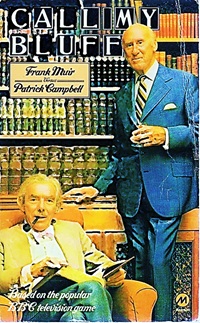
But it is Call My Bluff, the long-running panel show where two teams compete to earn points by identifying the correct definitions of obscure words – another Attenborough-commissioned show – that really excited my BBC Four obsession. I duly recounted it to students as an observation on the difference between then and the present day. But I also think that outside of the lecture room, there are lessons and observations here for all.
At nine o’clock on Monday nights, Four repeats classic episodes from the mid-1970s, occasionally wandering into the 80s. Presented by the unflappable Robert Robinson, the show is like looking through a window on to an old world inhabited by seemingly lost traits such as manners, erudition, wit and character; team captains Frank Muir (sporting a marvellous bow tie each week) and Patrick Campbell were two wonderfully humorous personalities, and the guests that appeared with them were equally funny and intelligent (recently I’ve very much appreciated appearances by the likes of Tom Baker, Jonathan Miller and Angela Rippon). All were well spoken, and no one talked or shouted over anyone else. Surely, these are qualities to aspire to? It is the anthesis of its contemporary descendent Would I Lie to You where every ‘bluff’ is predicated on a personal anecdote, with noisy ‘wacky’ interjections from other panellists. In comparison, Call My Bluff is a model of understated entertainment and, God forbid in the present day, maturity.
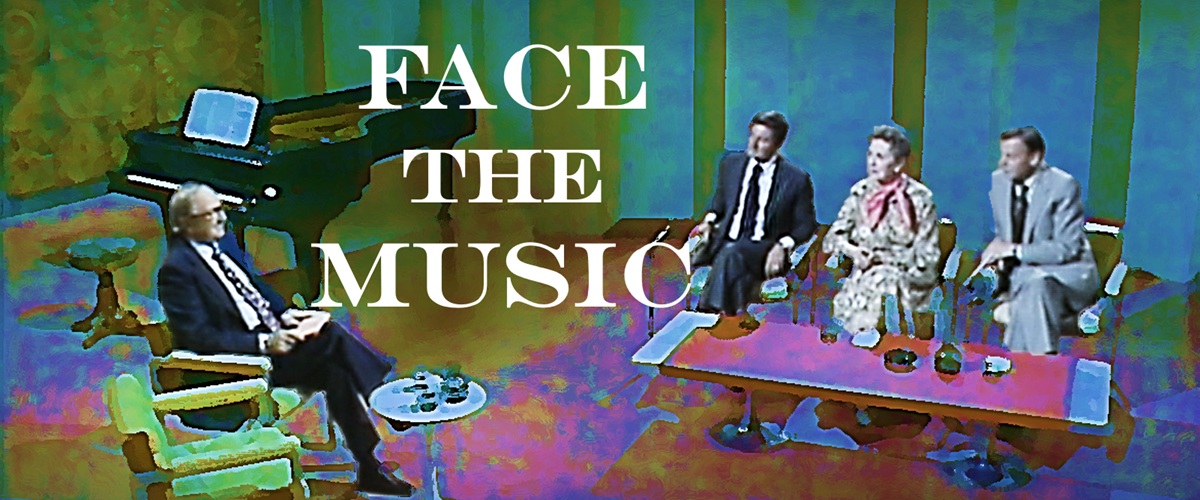
It is followed by selected episodes of the wonderful Face the Music, which ran from 1966–79 and was presented by pianist and broadcaster Joseph Cooper. A panel game show entirely devoted to classical music, it saw notable figures (rather than ‘celebrities’) set a series of challenges, all of which revolved around identifying musical extracts. In recent repeats, the likes of Attenborough, critic Bernard Levin and a young Arianna Huffington all took part.
There were several regular rounds, such as the crossword puzzle with musical extracts as clues. Another one was the video clip question where an opera was accompanied by music from a different opera and the guests were asked to name both. But my favourite is where the panellists had to identify a piece that Joseph Cooper played on a silent ‘dummy piano’, with only the sound of the clunks to work with. Could you imagine such a breadth of knowledge now? I saw a celebrity edition of The Weakest Link recently and one contestant couldn’t even answer the question ‘who was the British Prime Minister in the 1980s?’ correctly, let alone identify Chopin’s Nocturne in D flat major played on a soundless keyboard.
Such ‘highbrow’ programming would now be considered inconceivable. The learned sophistication of the show would now be seen as too self-assured. But compared to the 1970s, our cultural content is narrower, simpler and far more concerned with the individual than a broader, collective content. Classical music was in fact far more prevalent fifty years ago; consider that in 1975 the Daily Mirror chose a showing of a Monteverdi opera (composed in 1640), as its TV choice for the August bank holiday. Or on a lighter note, who could forget Andre Previn’s appearance on the Morecambe & Wise 1971 Christmas show?
What has happened since with the ‘democratisation of culture’ is that anything considered ‘too clever’ or ‘elitist’ has been discarded and replaced by bland, conforming, populist viewing. But programmes such as Face the Music didn’t assume that the audience needed talking down to; the recent reruns have seen people recall memories of the show, impressed by the intelligence and knowledge on offer, and reminding us of a time when high quality cultural programming was the norm and not the exception.
The same is true of recent BBC Four scheduling. This autumn, the channel has shown many classic episodes of the documentary strand Arena; it is still broadcasting J.K. Gailbraith’s epic series on the history of economics, The Age of Uncertainty from 1977 and the wonderful fifteen-part Great Philosophers (1987) hosted by the great Bryan Magee. Magee was a philosopher, broadcaster, author and was also elected as a Labour Party MP for Leyton in the February 1974 UK general election – just the sort of character whose ideas I thoroughly agree with; he wholeheartedly believed in bringing education, particularly philosophy, to a popular audience through the medium of television.
Most recently, the channel has been broadcasting serious high-quality drama from the vaults. On Wednesday nights it has been rerunning the Screen Two series (a 1980s/90s continuation of Play for Today) with particularly enjoyable short introductions from producer, directors or actors involved with the original series. Notable titles that are thoroughly recommended (all are still available on iPlayer) include The Blue Boy (1995) featuring Emma Thompson, and The Firm (1989) with a young Gary Oldman delivering a virtuoso performance in Alan Clarke’s gripping drama about organised football hooliganism.
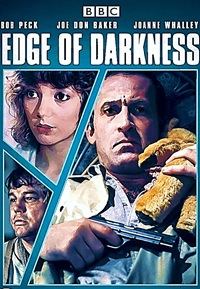
I also reserve a particular affection for Troy Kennedy Martin’s taut crime drama/political thriller Edge of Darkness (recently repeated on Four), featuring the late Bob Peck, Ian McNeice and Joe Don Baker. I remember it when it was originally screened, with its brooding score by Eric Clapton, and the esteem my parents held the series in. Over the years, I’ve rediscovered it on DVD and consider it to be one of the greatest TV series ever.
Originally broadcast on BBC Two in November–December 1985, it achieved a viewing figure of around four million (roughly equivalent to the audience that watched the BBC’s coverage of the 2024 UK election), but when it was repeated in double episodes on BBC One, over three consecutive nights later that December – the fastest time between original broadcast and repeat in the BBC’s history – it doubled its audience to eight million viewers. And again, it’s hard to imagine such an involved drama being so popular in the present day. Viewers’ expectations have changed; it would also be considered too slow, too wordy, too un-diverse for a contemporary audience. Luckily, we still have Four to challenge these assumptions.
So, are these the ramblings of an old nostalgist, a paean to BBC Four itself, or a robust defence of education and good culture for all, à la Richard Hoggart or some such well-intentioned figure of yesteryear? The answer is yes to all. There has been (for many reasons) a change in viewing quality over the years; the internet and ever-increasing competition has seen programmers place ratings above anything else, and we have gone from four channels to an infinite number in a relatively short space of time. The adherence to ‘diversity’ etc hasn’t helped, but nor has a cultural shift that promotes the individual, placing emotion and sensation over the erudite and cerebral.
But we are lucky to have BBC Four. If we find ourselves confounded by the present day, if contemporary programming is vapid and dull, there is an oasis that runs from 7pm to around 4am every night, a window to the old world, and a quite treasure trove of glories, even if they are just former ones. I’ll meet you there later and bask in yesterday’s triumphs.
I wholeheartedly agree with everything you have written. What a marvellous channel it is, but also what a sad indictment of modern society. When you watch children’s programmes from the 1970s, the level of vocabulary and concentration required is way above pretty much all adult oriented programming now. I will escape there whenever I can.


I wholeheartedly agree with everything you have written. What a marvellous channel it is, but also what a sad indictment of modern society. When you watch children’s programmes from the 1970s, the level of vocabulary and concentration required is way above pretty much all adult oriented programming now. I will escape there whenever I can.
LikeLike