It is thirty years since James Goldsmith officially launched the Referendum Party and PAUL SAFFER says it did have a long-term impact on British politics, but not the one you think.
Almost exactly thirty years ago, a French MEP paid for a full-page advertisement in The Times of London. See, already got your attention!
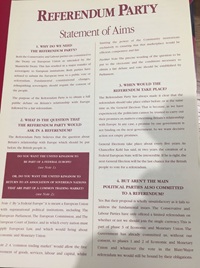
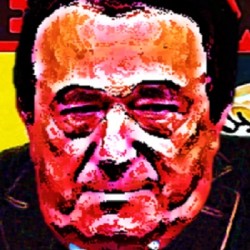
Anyway, this representative of the Movement for France and chair of the European Parliament’s Delegation for Relations with Canada happened to be a man called Sir James Goldsmith, born in Paris to a French mother but a British businessman of huge wealth and notoriety. And his advert was the modestly-titled Statement of Aims, officially launching his Referendum Party.
This was not the first flowering of a Eurosceptic movement independent of the traditional parties (UKIP, from the start explicit about advocating withdrawal from the European Union, had been going a few years). But Goldsmith was a far higher-profile figure than UKIP’s founder, the A.J.P. Taylor-mentored historian Alan Sked, and just a tad more wealthy (reports at the time suggested Sir James was worth between £750m and £1.5bn).
The actual Statement of Aims posed (and answered) four questions. Firstly, ‘Why do we need the Referendum Party?’ The explanation was that both major parties were ‘committed to the Treaty on European Union as amended by the Maastricht Treaty. This has resulted in a major transfer to European institutions … Fundamental constitutional changes, relinquishing sovereignty, should require the consent of the people. The purpose of the Referendum Party is to obtain a full public debate on Britain’s relationship with Europe followed by a fair referendum’.
Secondly, ‘What is the question that the Referendum Party would ask in a referendum’, which was: ‘Do you want the United Kingdom to be part of a federal Europe or do you want the United Kingdom to return to an association of sovereign nations that are part of a common trading market?’ Both options are given copious footnotes and a further clarification that the exact wording of the question would be established by Parliament.
Thirdly, ‘When would the referendum take place?’, which would be ‘either before, or at the same time, as the General Election’. It was seemingly urgent because ‘Chancellor [Helmut] Kohl has said, in two years the creation of a Federal European State will be irreversible. If he is right, the next General Election will be the last chance for the British people to vote in a referendum.’
Fourthly and finally, ‘But aren’t the main political parties also committed to a referendum?’ ‘Yes. But their proposal [on potential membership of a single currency, the eventual Euro] is wholly unsatisfactory as it fails to address the fundamental issues’.
The idea of a referendum on the issue of Europe was of course not novel. There had been one in 1975 obviously, and after the Maastricht Treaty was signed in 1992 Conservative rebels – with the support of Margaret Thatcher – had called for another public vote (as there had been in Denmark, France and the Republic of Ireland). But that proposal was unlikely to be taken up the government of John Major, nor by Labour under John Smith or later Tony Blair.
Then came Goldsmith, a long-time presence in public life. His ancestors, of German Jewish descent, had been partners and rivals to the Rothschilds, and James’s had family escaped Paris in 1940 just before the Nazis arrived. He ended up, via the Bahamas and Canada, at Eton, which he left after winning a small fortune on a horse racing accumulator, before becoming a financier. He was involved in a wide range of industries from pharmaceuticals to food (his 1971 purchase of Bovril was a key success), usually spotting vulnerable targets for takeover, rationalising the firms into profitability, and then selling them on. Anticipating both the financial downturn of the early 1970s and the 1987 stock market crash helped make him a billionaire.
His energies were not restricted to business as he made his way through a succession of wives and mistresses, and he was part of the Clermont Set (members of the eponymous Mayfair casino), along with the likes of owner and zookeeper John Aspinall, fellow financier Jim Slater, ‘the unpleasant and unacceptable face of capitalism’ (© Edward Heath) Tiny Rowland and others. Those others included Lord Lucan,* and when the errant Earl disappeared in 1974 following the death of his children’s nanny, Goldsmith was accused by Private Eye of being part of a Clermont-based conspiracy to help the accused peer.
Goldsmith launched a barrage of writs that even Robert Maxwell might have thought rather aggressive. It earned him an apology, and allegedly the sympathy of Harold Wilson – Sir James’s knighthood was part of the ‘Lavender List’ (speculation about the exact reason for the honour has continued through the decades). His clash with the Eye also shot Goldsmith to notoriety, something he attempted to counter with his ambitious but short-lived weekly magazine NOW!. The stance was right-wing and anti-Communist, but Goldsmith had been far from anti-EEC; later in the 1980s, and even more so after the Maastricht Treaty, that changed.
In 1993 Goldsmith used an edition of the Channel 4 programme Opinions to call for a referendum on the treaty, the transcript published under the title Creating a Superstate is the Way to Destroy Europe. Suspicious of German domination and the benefits of free trade, the son of a former Conservative MP decided to set up a rival party, announcing the Referendum Party and pledging to spend £20m on the cause, including £10m at the forthcoming general election.
By this stage Goldsmith had been elected an MEP for a party led by Eurosceptic French politician Philippe de Villiers and had published his book The Trap. The volume collected Sir James’s various speeches and essays of political philosophy, criticising global free trade, mass immigration, intensive farming and nuclear energy, all of which he saw as spreading misery, unemployment and instability.
Naturally what was now known as the European Union comes up, Goldsmith comparing ‘elected national heads of state or their representatives’, with the ‘technocrats of the Commission’. And then, at the end of October 1995, as the Referendum Party took form, came his Statement of Aims, with the advance assurance that if it was successful, and secured the desired vote, the party would immediately dissolve. This was not an attempt to gain office.
But despite that, the party’s ambition was far from modest. Prior to 1997, only twice had a party outside the Conservatives, Labour or Liberals (or their predecessors/successors/allies) put up more than a hundred candidates in a British general election – the National Front’s 303 in 1979 and Natural Law’s 309 in 1992. With Goldsmith’s wealth, however, the Referendum Party stood in 547 constituencies, the £273,500-worth of deposits probably not more of a gamble than what might be wagered in an average night playing backgammon at the Clermont Club.
In a December 1996 interview with John Humphrys for the BBC’s On The Record, Goldsmith explained: ‘We will put up candidates wherever the leading candidate, in our view, is not committed to a referendum on the fundamental issues.’ (Those spared an intervention were not just Conservative Eurosceptics: there was no candidate against Jeremy Corbyn in Islington North, nor against Ken Livingstone who, despite his support for a Federal Europe, backed a referendum.)
For their own candidates, the Referendum Party did not lack for celebrity. John Major’s rival in Huntington was to be TV botanist David Bellamy, and among others selected were One Man and His Dog host Robin Page (a former Conservative candidate), Rowan Atkinson’s brother, Peter de Savary, John Aspinall, Southampton FC chairman Rupert Lowe, and George Gardiner, the former Tory MP for Reigate who, after deselection, defected just ahead of the election to give the Referendum Party its first parliamentary member. Goldsmith himself challenged a man with a similarly colourful private life: David Mellor in Putney, a high-profile target not far from Goldsmith’s Richmond home (‘Putney was seen as a seat where there would be lively debate,’ an aide told the Independent).

The party spent around £7.2m on press advertising in the year running up to the election and once it was called for 1 May 1997, Goldsmith – frustrated at only being allowed one Party Election Broadcast – funded the nationwide distribution of five million promotional VHS cassettes, demurely titled: ‘The most important video you’ll ever watch’. Fronted by former That’s Life presenter Gavin Campbell, it spelled out the party’s now familiar theme that unelected Eurocrats were up to German-favouring no good; featured a Goldsmith speech; and ended with an appeal over some Elgar by Lord Tonypandy, aka former Commons Speaker George Thomas.
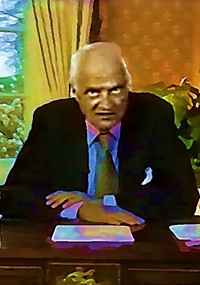
The eventual election broadcast was Goldsmith alone, sat at a desk (with a window to a garden so we knew it was not a sinister underground lair), staring unblinking into the camera for a full five-minute address, his intense demeanour and ominous message in no way resembling a Bond villain explaining an apocalyptic plan to a terrified world.
Goldsmith’s campaign, however, remained very much on the fringes. With John Major having enough trouble with Eurosceptics within the Conservative Party, not to mention the more potent electoral threats from Labour and the Liberal Democrats, the Referendum Party itself was barely a distraction, although a pre-disgrace Jeffrey Archer spent much of the year arguing differently – according to Gyles Brandreth, in a diary entry two weeks before polling day, the noble Lord was ‘wandering the corridors of Westminster urging us to take Sir James Goldsmith and his ludicrous Referendum Party seriously’.
In the end, the millions of pounds spent produced a modest result: 810,860 votes (averaging 3.1 per cent in the 547 seats in which they stood), including a record-breaking 505 lost deposits, among them that of Goldsmith at Putney. Their only real impact on election night was Goldsmith taunting the defeated David Mellor during his concession speech, and the now former MP responding: ‘We have seen tonight that the Referendum Party is dead in the water. You can get off the platform and go back to Mexico knowing your attempt to buy off the British political system has failed.’
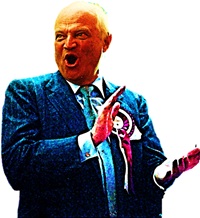
In fact, Goldsmith (who indeed owned a resort in Mexico) died, aged 64, in Spain a couple of months after the election, suffering a heart attack brought on by the pancreatic cancer he had been diagnosed with in 1993, but which was only revealed just before his death. The Referendum Party soon disbanded, but had Goldsmith’s scheme, in Mellor’s words, ‘failed’?
Lest we forget, there was eventually a referendum on the subject of Europe, more blunt than that proposed by Goldsmith. The Referendum Party was no doubt a factor in how we got from there to here, but far from the top of the list, compared to the emergence of Nigel Farage, the ructions in the Conservative Party that pre-dated Goldsmith’s initiative, the late 2000s economic crash, and much else.
However, the Referendum Party’s 1997 results did give a clue as to what would happen two decades later, almost unnoticed. Losing 505 deposits meant they retained forty-two, for the most part in the East of England in places like Suffolk, Norfolk, Lincolnshire, Essex and Kent, while their worst results were in Scotland, London and Liverpool. Although not an exact reflection of the areas that voted most strongly for Brexit – the Referendum Party’s support was more concentrated in wealthier locales – but not so far away, and certainly highlighting how the regions that most supported or opposed membership of the EEC/EU had flipped since the 1975 plebiscite.
And at the very top of the list was the 9.2 per cent (4,932 votes) secured by undertaker Jeffrey Titford in Harwich, a seat narrowly won by Labour for the first time just ahead of outgoing sports minister Iain Sproat. Titford was later to lead UKIP and spend a decade as an MEP. Harwich itself, after Sproat’s attempt to win it back failed in 2001, was won in 2005 by Conservative Douglas Carswell, later to defect to UKIP. With his new party, he twice held the successor seat of Clacton, which was then in 2024 gained by the Reform Party candidate Nigel Farage.
What was to be the Brexit heartland was, it seems, already clear in 1997, if anyone had noticed.
Titford was not the only Referendum Party candidate later to be elected for a Farage-led organisation: John Bufton was another future UKIP MEP, Damian Hockney was to gain a seat on the London Assembly, and Rupert Lowe was elected as a Reform MP last year. It was not a coincidence. UKIP was already moving away from what the high-minded Alan Sked had intended; he left after his own celebrity recruit in 1997 of Leo ‘Rumpole’ McKern only helped them to around 100,000 votes for their 200-odd candidates. And when the Referendum Party dissolved, UKIP’s new leader Michael Holmes directed their chairman, one Nigel Farage, to recruit Goldsmith’s former candidates – around 160 did join.
Moreover, Goldsmith putting up an unprecedented number of candidates from outside the major established parties set a trend. In 2001 UKIP stood in 428 seats, and by 2010 was up to 558, with the number of Green and BNP hopefuls both over 300. In 2024 it was 609 for Reform and 574 for the Greens – even George Galloway’s Workers Party and the post-1990 Social Democratic Party topped a hundred.
Whether the Referendum Party’s presence cost the Conservatives seats in 1997 is still unclear. The majority view seems to be that the impact was marginal; that, although most of Goldsmith’s supporters had voted Tory in 1992, they had already decided to abandon them regardless. But even if the Referendum Party helping Labour unseat extra Conservatives in 1997 is a myth, it is one that has haunted the Tories with the rise of UKIP and Reform, and that very fear might have been the reason why David Cameron opted for what became the 2016 Referendum, especially as the very right-leaning media that kept their distance from Goldsmith just under thirty years ago showed no such reluctance in promoting Farage.
Farage himself, while echoing much of Sir James’s messaging (except notably on green issues), has a public image and appeal rather different from the cosmopolitan polyglot – although his penchant for raising huge sums of money at a Mayfair club owned by Goldsmith’s step-son suggests a slightly closer resemblance underneath the carefully crafted persona.
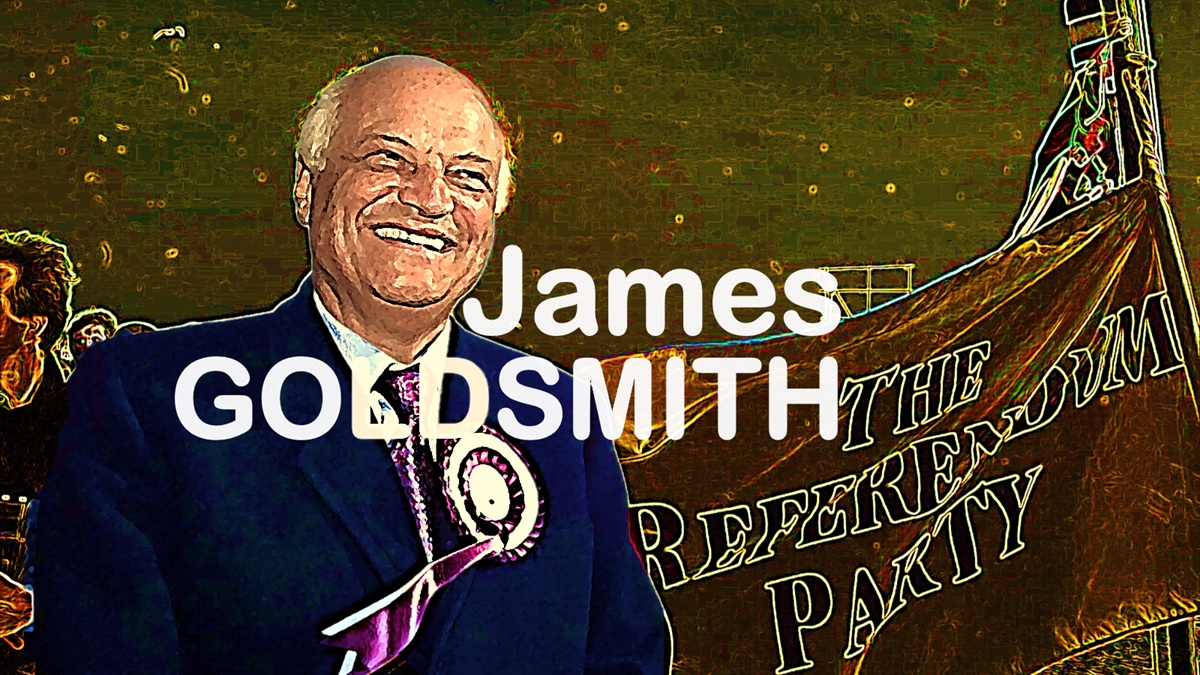
Farage isn’t a precise fit for Goldsmith’s political son. Instead, that role was taken by one who rose to ministerial status, Sir James’s actual son Zac, whose mix of Euroscepticism and environmentalism (plus an early exit from Eton, love of gambling and succession of wives) is more than a little familiar.
America has recently elected a controversial businessman as president, but although the casino-owning Donald Trump knew Goldsmith, it is unlikely that the Referendum Party particularly inspired the current White House occupier, not least considering Ross Perot was already running a strikingly familiar campaign to Sir James in the 1990s. But Goldsmith (and indeed Perot) certainly pointed the way to a right-wing opposition to global free trade that has driven Trump.
But maybe it was not so much the message as the medium where the Referendum Party really prefigured twenty-first-century politics. Attempts to cut out the mainstream media (as we didn’t then say) did not begin with the mailing out of millions of video cassettes – the street-selling of newspapers by factions of the far left and extreme right was exactly that – but Goldsmith’s 1997 initiative was on a new scale (the purchase of TV airtime that propelled Perot not being an option in the UK).
Judging by the eventual number of votes, the video at best might have been the most important video people didn’t watch. But technology had not quite caught up with Sir James’s vision. There are many factors that have made Farage’s various parties successful on a scale Goldsmith only dreamed of, but exploiting the reach of social media, from Facebook to TikTok, has certainly allowed them to reach voters in a less labour-intensive way than putting tapes through their postboxes, and is considerably better value for money too.
* This is nothing to do with anything, but has Lord Lucan now expired as a metaphor for something disappearing? Shergar too? Are they officially removed as metaphors in the same way that at a certain point they are legally confirmed dead? Once upon a time everyone was either on their way to comparing something disappearing to Lord Lucan, or had just come from comparing something disappearing to Lord Lucan. But not so much these days. Is there a new standard metaphor now?
see also:
Discover more from Lion & Unicorn
Subscribe to get the latest posts sent to your email.
