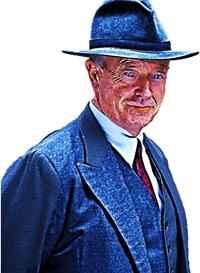
‘My name’s Foyle. I’m a police officer.’
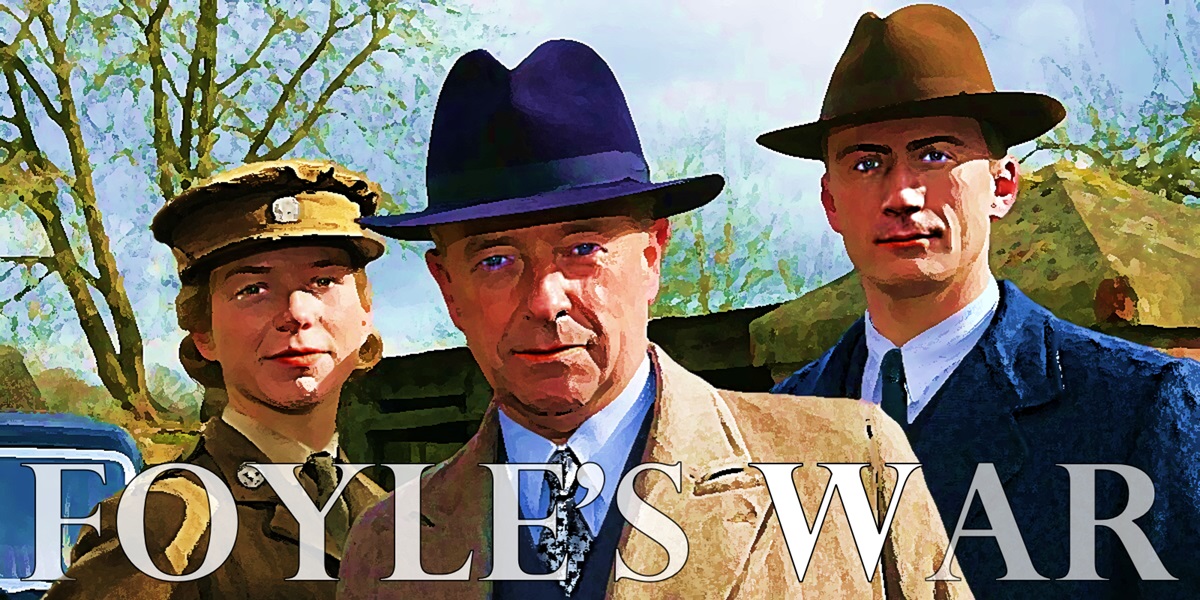
The period detective series Foyle’s War, created and written by Anthony Horowitz, was broadcast on ITV between 2002 and 2015.
Set in the 1940s, it sees Detective Chief Superintendent Christopher Foyle trying to keep the enemies of society at bay in lawless East Sussex. Not easy at the best of times, let alone when the country is engaged in a war of national survival. ‘Maintaining the law in a time of war is all but impossible,’ he writes in his resignation letter. (Not that he stays resigned.)
Like Endeavour, the show provided a potted history of the period it’s depicting, and – even more – the preoccupations of its own time. So here’s a summary of what we learned in each of the twenty-eight episodes.
But just before we get started… A cup of tea, Mr Foyle? ‘I won’t, thank you.’
Spring–Summer 1940
‘The German Woman’
There’s barbed wire on the beaches of Sussex, the first bomb falls on Hastings, and Britain is already abandoning its traditional freedoms. A harmless German professor of music and his wife are interned as enemy aliens. ‘You’ve done nothing wrong,’ exclaims their nephew, a lance corporal. ‘It makes me wonder which side I’m fighting for.’
There’s a national crime wave, and there’s corruption everywhere. For £150, a dodgy civil servant will see that your call-up papers go missing. If you’re rich and influential enough, you can even get your German wife exemption from the alien regulations. ‘One law for the rich, and one for the poor,’ says the lance corporal. ‘Nothing ever changes, does it?’ Foyle doesn’t approve of the treatment of aliens or the corruption. Or, as it happens, the Daily Mail, though this is just an aside.
Foyle’s been assigned a new driver, Sam Stewart, who turns out to be a woman, because women are going to be just as important as men in this war. Well, not quite as important – after all, she’s just a driver, and he’s a chief superintendent – but the point stands. She’s the daughter of a country vicar and this is the most exciting thing that’s ever happened to her. ‘I couldn’t wait for the war to come along,’ she says. ‘A chance to get out.’
‘The White Feather’
Britain may be in a life-and-death struggle with the Nazis, but we’ve got plenty of wrong ’uns of our own. ‘Who is the real enemy?’ asks Guy Spencer, leader of right-wing group the Friday Club. ‘The Bolshevik and the Jew. They were the enemies of Germany, and they’re our enemies now.’ He says he’s not a fascist. ‘I think of myself as a patriot.’ He has important friends and associates in Westminster, Whitehall, the aristocracy – even, he hints, in the Palace. And also at the White Feather hotel in Eastbourne, a place that doesn’t take Jewish guests.
DSgt Paul Milner, struggling to come to terms with having lost a leg at Trondheim, temporarily has his head turned, and Spencer lends him a copy of The Protocols of the Learned Elders of Zion. But Foyle isn’t fooled. Spencer is ‘one of those Mosleyites – pro-Nazi, anti-war, antisemitic.’ He’s right: the Friday Club is full of thugs, blackmailers and traitors.*
* Not to be confused with the Monday Club, a right-wing group that wasn’t founded until 1961.
‘A Lesson in Murder’
A young poet is refused conscientious objector status, despite being a pacifist, and is mistreated by the police. ‘A conchie, eh? We have a special welcome for people like you.’ He hangs himself in his cell.
Mind you, if you come from a suitably rich and influential family, it’s much easier to claim conscientious objection, and to get a cushy billet with the Forestry Commission in Dorset – it’ll cost you a £2,000 bribe to a corrupt judge. (You remember that bit about ‘One law for the rich…’)
This dodgy judge, incidentally, has taken in an eleven-year-old boy, evacuated from London. He doesn’t like the boy at all. ‘A guttersnipe, a little vermin, shouldn’t have come here in the first place.’ Even so, that’s no reason to kill him, surely. But it seems that a lot of people are behaving very badly.
Take, for example, the angry mob who greet the news of Italy declaring war by burning down an Italian restaurant. The lovable old proprietor is killed, to the distress of his son, a young man born in Bermondsey who’s never even been out of the country and who’s just joined the army. ‘What sort of a world is this, Mr Foyle?’ he despairs.
‘Eagle Day’
The morality of young women is a worry, says a police officer. ‘Illegitimate births are up, and arrests of teenage girls this year have shot up.’ The men are worse. There’s a senior RAF officer who pinches Sam Stewart’s bottom – unacceptably boorish behaviour that outrages Foyle’s sense of liberal decency. But then this man’s notorious for abusing his position with young women from the WAAF. ‘He made her have relations with him up against the wall,’ says the father of one of his victims, who later committed suicide after finding out she was pregnant. The scandal was covered up by his fellow officers, using the Official Secrets Act. Foyle concludes that his behaviour was ‘immoral, improper and downright disgusting.’
Paintings and artefacts from London museums are being moved to safety in North Wales, which gives a corrupt curator the chance to steal a priceless sculpture. There are rotters everywhere.
Special Branch are keeping an eye on communists, including Foyle’s son Andrew, who was briefly a member of the CPGB at Oxford. ‘It was after Spain,’ he explains apologetically, though actually he wasn’t in it for the politics – he was trying to impress a girl.
Autumn 1940
‘Fifty Ships’
German bombs are one thing. ‘We’re at war, it’s to be expected,’ says a woman whose house has been destroyed. ‘But this…’ She’s had her jewellery, and her late husband’s coin collection, stolen from the wreckage. Members of the Auxiliary Fire Service – the very men sent to the bomb sites – are engaged in widescale looting. Foyle is quietly furious. ‘We are living in such evil times, and the whole world seems to be sinking into some sort of mire,’ he tells the ringleader. ‘And as if Hitler wasn’t enough, we got the likes of you.’ This man’s no better than the Nazis. ‘It’s with the likes of you that this mire begins.’
It’s not just the British working classes who are letting the side down. There’s also a multi-millionaire American car-maker who’s not a very nice man. In fact, he’s a murderer. But he’s also a vital conduit to the American government, and so he evades justice. ‘We need the Americans, Mr Foyle,’ an officer from military intelligence says. ‘They’re the best friends we have.’
Maybe the local doctor is right to dislike the Americans as much as he does. ‘They were late arrivals in the last war, and it’s looking increasingly likely they won’t show up for this one at all.’ He’s not a very nice man, either, though. He hits his wife.
‘Among the Few’
‘There’s a lot of bad feeling about the Irish,’ says Rex, a fighter pilot, and indeed the IRA have been busily helping the Nazis by planting bombs. ‘Everyone knows whose side the Irish are really on,’ confirms his friend Andrew Foyle, another pilot. As it turns out, though, the bomb at the Cuckfield fuel depot isn’t political, even if it was planted by an Irishman. It’s actually to do with profiteers stealing petrol – yet more bad men exploiting the conflict and undermining the war effort.
Not that it’s all plain sailing (as it were) for the RAF, the glory boys whose hobbies are ‘anything that involves alcohol, loose women or dancing’. Rex’s girlfriend has had enough: ‘Pilots! They’re all liars. They don’t care about anybody except themselves.’ But she’s wrong: Rex cares about Andrew – he cares a great deal, with a love that dare not speak its name. ‘I disgust you,’ he says, when Andrew’s father discovers the truth, but he’s not reckoning on the liberal decency of the modern copper. ‘Not at all,’ murmurs Chief Inspector Foyle. Others are less tolerant, of course.
Before the war, DSgt Paul Milner used to like dancing to Harry Roy’s big band. These days, even the Flamingo Club can only run to a piano-led three-piece.
‘War Games’
Talking of profiteers, here’s a businessman returning from secret (and illegal) negotiations with the Germans. ‘The agreement I’ve reached will make Empire & European Foods the largest processor of non-mineral fats and oils in Europe, both during the war and after it,’ he gloats to the board of his father’s company. ‘It doesn’t even matter who wins. We can’t lose.’
Beyond business, the man’s a fascist, with a fine collection of Nazi memorabilia. ‘We’re the strong ones. We’re the ones who’ll make the New England,’ he says. ‘When someone gets in your way, you have to act. That’s the genius of Hitler. In a way, that makes him the greatest businessman of all.’ A German exile describes him as ‘even more fanatical and antisemitic than the Nazis’.
Ironically, this German is much more in touch with the spirit of Britain. ‘A pint, the fishing, the evening light – there are things about this country I would always miss if I had to leave.’

‘The Funk Hole’
There’s been a break-in at the food depot – a couple of young criminals, together with the bloke who runs the village shop, and can therefore sell it on easily enough, what ‘with everyone buying under the counter these days’. Yet another profiteer, then. Shopkeepers are almost as bad as businessmen.
A veteran of Ypres, who was blinded by mustard gas, isn’t impressed by modern youth. ‘That’s the generation we fought the war for? It was a waste of time. Don’t know why we bothered.’ Not that he’s on the moral high ground himself. He and his wife have turned their agreeable country home into a guest house, taking in genteel types who want to get out of London and can afford to do so in some comfort. They’re known as ‘funk holes’, these places, and they’re all over the country. Everyone agrees that the residents are cowards, but there’s nothing illegal about it.
‘What kind of a world are we coming to?’ wonders a London police officer. Foyle’s son Andrew has much the same feeling. ‘It’s a bloody awful world,’ he reflects. But he finds some comfort in writing poetry:
How could I ever leave here
With the English sky so blue?
Could I turn from the trees,
As they bend in the breeze,
or forsake the evening dew?
1941
‘The French Drop’
‘You can’t believe anything you read in the papers these days,’ says Sam Stewart. ‘If it’s not the Ministry of Information cutting everything out, it’s propaganda.’ Later, Sam is revealed as having been an Edgar Wallace fan in her childhood, which speaks well of her.
There’s a lot of cloak-and-dagger stuff going on, all to do with the Special Operations Executive and a woman named Hilda Pierce. ‘There are hundreds of ways to kill a man, and we know them all,’ says an agent. Which is all very well, but blowing a man up in a bookshop is wanton vandalism – particularly at a time of paper rationing. We can only hope that there wasn’t too much Edgar Wallace lost in the explosion.
‘Enemy Fire’
Digby Manor has been requisitioned for use by a medical team, working on new techniques in reconstructive surgery for the wounded. Vital work, of course, but you’ve got to feel for Sir Michael Waterford. ‘His family have owned this place since the Magna Carta.’ Now he’s been moved to a cottage on the estate, where he nurses the shame of his cowardice in the last war.
A 19-year-old pilot is trapped in the cockpit when it crashes, and suffers serious burns. It seems that the RAF can’t even trust their ground crew. The escape mechanism in the cockpit jammed because of a mechanic’s slipshod work. He’s a bad man, this mechanic, a philanderer who beats his wife.
Bad news on the shopping front. Apples cost a shilling a pound these days. ‘The whole world’s going mad.’
‘They Fought in the Fields’
‘Spring – and the smell of cordite in the air.’ The air raids continue, the war is still being fought, but the bluebells are out in the woods. Down on the farm, things aren’t what they were; there are women working the fields these days. Land girls, they’re called, and very fetching they look too, with their side-buttoned brown breeches tucked into their boots. Very good workers, as well – some of them even better than men. Not everyone’s happy, though. ‘Everything in the Garden of Eden was tickety-boo until the women showed up,’ points out a farmer.
There’s one of the Women’s Land Army whose son was killed at Dunkirk, leaving her with a passionate hatred of war and of men, since it’s they who start conflicts. But then she meets Foyle, who’s not like the others. ‘I didn’t think my view of men could change,’ she tells him. ‘You changed it.’

‘A War of Nerves’
This is no time for agitators and disruptors. Alan Bush and J. B. Priestley have been taken off the radio, the Daily Worker has been banned, and strikes have been outlawed. ‘The Communists are just as much our enemies as the Nazis,’ says Assistant Commissioner Rose. He’s concerned that ‘a Bolshie firebrand’ from leftwing group the People’s Convention is in Hastings, preaching his filthy creed that ‘The real war that’s being fought is a class war’. Foyle rather likes the firebrand.
A man who runs a shipyard is still unconvinced by Britain fighting. ‘Bloody waste of time. What did the Poles ever mean to us?’ Meanwhile, his brother reflects on how very different things are today. ‘We’ve got women riveters. We’ve got painters, even welders. Everything’s changed.’ If only their pay reflected their contribution. ‘I still get less than the men,’ says one of the women welders. ‘It’s not fair really. I’m just as good as them.’
Both brothers are crooks, of course – well, you know what businessmen are like. On the other hand, a pacifist who volunteered for bomb disposal is now a captain in the Royal Engineers.
1942
‘Invasion’
The Dough Boys have arrived in Hastings, and the attitude of some of the locals hasn’t changed since that doctor in autumn 1940. ‘Americans! Late for the last one, late joining this one.’ They’ve been given some requisitioned land on which to build an airfield, and the man whose family have farmed here for three generations isn’t happy. ‘120,000 cubic yards of concrete, 400,000 feet of wire,’ he says. ‘We’re worried about Hitler invading. What’s the point? The invasion’s happened.’ He’s beginning to think Lord Haw Haw might be right about the Yanks.
On the other hand, Sam Stewart is excited. ‘I’ve never actually seen an American, except in the films.’ As expected, they’re over here, over-paid and over-provisioned with just about everything: food, stockings, women, they’ve even got a six-piece band for their dance.
We know that these days there are ‘girls doing men’s jobs’, which is all well and good, but there’s one here who’s got a bit carried away: she’s running an illegal still and selling moonshine whisky under the counter of the pub where she works. It ends badly.
‘Bad Blood’
It’s not all soldiering, this war. In fact, now you come to mention it, none of it seems to be soldiering – not in any conventional sense. We’ve had the SOE, and now there are blokes testing chemical weapons and inadvertently releasing anthrax. They’re part of a project so secret that not even Winston Churchill knows what they’re up to. ‘What’s the world coming to if we allow such things?’ asks a Quaker scientist. ‘It makes us worse than the Nazis.’
A survivor of the mustard-gas attack at Ypres in 1915 is no more sanguine than the one we met in ‘The Funk Hole’. This one wonders whether we even won that war. ‘Look around you. There’s so much evil, so much bad blood. Humanity stinks.’
There’s another ‘bloody conchie’ as well. This one’s accused of murder, though it’s obvious he didn’t do it.
‘We haven’t had ice cream here since 1940,’ laments Sam Stewart. An old friend remembers DSgt Paul Milner as a schoolboy. ‘You were always playing Bulldog Drummond.’ Which speaks well of him.
‘Bleak Midwinter’
‘About 40 per cent of our workers here are women,’ says the manager of a munitions factory. ‘Couldn’t do without them.’ They’re working in specialised jobs now. ‘And they’re very good at it. Some would say better than the men.’ The women sort of agree, though they have their own perspective. ‘It’s a man’s job,’ says one. ‘But we do it just as well as them and they resent us because of it. They pay us half as much as the men too.’
It’s not all fun and empowerment, getting up at 6.30 and cycling to the factory in the freezing cold. And it’s dangerous work. ‘Grace Phillips gave her life for her country exactly as so many of our young men are doing overseas,’ says the vicar at the funeral of one of them.
Mind you, Grace was no better than she ought to have been, sleeping with her boyfriend when they weren’t married. As her landlord points out, ‘Young people nowadays, they got no sense of decency.’ They’ve got a sense of style, though. ‘All the girls want to look like Veronica Lake,’ says a hairdresser.
There’s a restauranteur who’s a racketeer.
1943
‘Casualties of War’
A boy who survived the bombing of his school in London got away ‘without a scratch’, but is so traumatised that he hasn’t spoken since. He wets the bed as well. Foyle suggests to the boy’s mother that she should approach Melanie Klein and Anna Freud, who might be able to help. She attempts suicide instead.
It’s no easier on the other side of the chalkface. A teacher lost his job when the school he was working at was requisitioned and closed. He resents his wife working as a secretary. (Women have jobs these days – have we established this?) He does a little home-schooling, but he’s not optimistic. ‘I sometimes think it won’t matter who wins. Either way, we’ll have a whole generation who won’t know a thing.’
His wife, incidentally, is actually somewhat more than a secretary. She’s a brilliant research scientist. ‘She has an astonishing mind,’ testifies a colleague. But they have to pretend she’s just doing the filing because the hidebound types at the Admiralty wouldn’t countenance a woman working on such a key project. (It’s to do with a bouncing bomb.)
The crime wave continues. There’s ‘a gang of saboteurs working their way along the coast’. There’s a couple of dodgy London types running illegal gambling sessions. And there are young burglars making hay while the sun isn’t shining. ‘I love the war. The blackout, no cars on the streets – it just makes life so easy.’
Sam Stewart is heartened by news from the Eastern front. ‘Good old Uncle Joe, that’s what I say.’ She’s blown up for the third time. DSgt Paul Milner name-checks Sexton Blake – which speaks well of him – but kids these days are more into Just William.
1944
‘Plan of Attack’
In pursuit of Germany’s ‘total and unconditional surrender’, Britain is bombing civilians. Is that morally justified? ‘Do we condone it? Can we condone it?’ The Bishop of Cirencester doesn’t think so. ‘This is not the way of a civilised society. This is nothing more than revenge, and we have to tell people it is wrong.’ He doesn’t find many takers, the general feeling being that the bombing is justified if it hastens the end of the fighting.
‘This war has tested the faith of a good many people,’ says a priest. Among them is Sgt Brooke. ‘God’s on holiday,’ he says. ‘How else do you explain Herr Hitler?’
A man who owns a haulage company has been fraudulently claiming for petrol; he has inside contacts in the army, air force, fire service and others. Businessmen, huh?
‘Broken Souls’
Sackville House has been requisitioned for use as a psychiatric hospital for traumatised servicemen. Vital work, of course, but you’ve got to feel for Sir John and Lady Muriel Sackville, who’ve been moved to a cottage on the estate. They’re making the best of it. ‘In a way, it’s enjoyable without staff. One feels one is doing one’s bit.’ A working-class man isn’t sympathetic. ‘You’re finished, you and your kind. You wait till the war’s over. You won’t be running the country no more.’
A soldier who was captured at Dunkirk returns home, having escaped from a PoW camp. He’s not best pleased to find a German PoW has been assigned to work on his farm, nor that the man seems to be getting on so very well with his wife and young son.
‘Nothing bad ever happens here,’ says a lad who was evacuated from London. There are two murders and an attempted suicide.
1945
‘All Clear’
It’s VE-Day, the end of the war in Europe, and remarkably there are still some people left in Hastings who haven’t been murdered, killed by enemy action, committed suicide or been jailed, whether for murder, fraud or profiteering. There is still profiteering, by the way: a man selling Union Jacks and bunting is charging extravagant prices.
Servicemen are starting to return home, and it’s not easy. ‘I can imagine you’ll find it hard to adapt,’ an ex-soldier is told by a businessman. The sympathy would be more convincing if the businessman hadn’t been cuckolding the soldier these past few months. This rascal is also a Tory parliamentary candidate. Oh, and a war dodger – he paid £200 to a man with angina to fail a medical in his name. (‘One law for the rich…’)
Peace isn’t easy for those at home, either. A doctor says that the silence is having a psychological impact, and people are finding it difficult to sleep ‘without bombs dropping, and the sirens’.
The doctor is of Austrian extraction, so when he’s murdered, Paul Milner wonders if it’s a racially motivated crime. ‘There’s so much anti-German feeling around, what with these pictures of Belsen and the rest of it.’ The assistant curator at the town’s museum certainly shares that feeling – he’s notoriously anti-German. ‘Forgive and forget?’ suggests Sam Stewart. ‘Not a bit of it,’ he snarls.
Foyle’s son Andrew is back. ‘Maybe the best of my life is over,’ he reflects. ‘Do you think it was worth it, dad?’ Foyle replies: ‘I have absolutely no doubt whatsoever.’
‘The Russian House’
Bad news on the shopping front. Europe may be at peace, but rationing continues. Not that there’s much food to ration. ‘Queues everywhere – but nothing to queue for,’ says Sam Stewart. Likewise, there may be no blackouts, but it’s still gloomy: the streetlights are turned off to save fuel.
Foyle meets up with his commanding officer from the last war, who’s mixed up in a ‘deeply offensive secret’. It turns out that the British are forcibly repatriating Russian prisoners-of-war – men who fought for Germany – to the Soviet Union, where they’re being summarily executed. It’s ‘a scandal that could tear your government apart if it became known,’ says a Russian.
A crusty old painter – ‘a hugely respected establishment figure’ – is horrified that his son is standing as a Labour candidate in the general election. It would betray ‘everything we fought for for the last six years’ if we elected ‘a government that will bring the country to its knees’. The family solicitor thinks it’s inevitable. ‘The whole world’s about to change. All of it. You, me, all the old values – we’re going to be swept away.’
A returning soldier who used to work for this painter wants his job back, ‘the job he promised would be waiting for me when I got home’. Unfortunately, it’s gone to someone else – Sam Stewart, as it happens.

‘Killing Time’
The Americans are still with us, and there’s trouble. ‘We’ve had a growing number of incidents between our coloured and white troops,’ says an American officer, which is why they’re asking for a colour bar to be instituted in Hastings. But they’re not reckoning on the liberal decency of the modern copper. ‘This isn’t America, this is Britain, and we don’t practice segregation,’ says Foyle. After all, what were we fighting for? ‘Freedom from oppression, wasn’t it? Pointless destroying what we’re trying to protect, wouldn’t you say?’
‘Who cares about the colour of your skin?’ asks an unmarried local girl, who’s had a baby with a black soldier. He wants to marry her and take her home. When she gets murdered, the US Army arrest him.
There’s another conchie. This one’s a boxer, oddly enough. He’s been away, doing farmwork, and on his return, his trainer advises him not to restart his ring career. ‘There’s some bad feeling about you.’ He’s a decent man, but they won’t even serve him in the pub – not until Foyle buys him a pint.
‘What kind of a world are our boys coming back to?’ wonders a woman. ‘Same old rules, same old people making all the money.’ But not everyone is pessimistic. ‘It’s going to be different now, isn’t it?’ says Sam Stewart. ‘The country, I mean.’ And Foyle replies, ‘Well, let’s hope so.’
‘The Hide’
The war with Japan is over. ‘This new bomb they’re talking about,’ says a naval officer; ‘makes me feel like we’re entering a new world.’
There’s a proposal for a new housing development and shopping centre in Hastings, but it means building on a green that’s been common land since time immemorial. Adam Wainwright, a young man whose war service was at ‘a place called Bletchley’, is outraged. ‘Isn’t this what we’ve been fighting for for these last six years?’ he says, gesturing at the green. More than that, he tells the developer, he resents their arrogance, ‘this unshakeable belief that you really know what’s best’. He’s had enough. ‘I think we’ve earned the right to run our own lives, not be pushed around by some Nazi in a pinstripe suit.’
There’s a young man from a family that came over with the Conqueror, ‘a noble family, one that has long given service to the nation’. He was captured at Dunkirk, and after three years in a PoW camp, volunteered to fight for the Germans in the British Free Corps, part of the Waffen-SS. But he’s a hero, not a Nazi sympathiser. As a child, he liked the Jack Harkaway stories – which speaks well of him. In case we start thinking too highly of the gentry, though, we should note that his father, crusty old Sir Charles Devereaux, is a rotter: an antisemite who abuses his wife.
Foyle says he likes Evelyn Waugh. And that definitely speaks well of him.
1946
‘The Eternity Ring’
‘We have a new war, a new enemy,’ says Hilda Pierce, who’s now working for MI5. ‘George Orwell calls it the Cold War.’ To add complications, there’s ‘this new bomb’ we heard about. ‘We’ve unleashed a monster,’ says a scientist. ‘The next war is going to be unimaginable. It could wipe out all humanity.’
Sam Wainright – Sam Stewart, as was – is suspected of passing on nuclear secrets to the Russians. Nonsense, of course, though the annoyances of Austerity Britain do cause her to say some funny things: ‘Sometimes I wonder if we did win the war.’
Her husband, Adam Wainwright, is a Labour candidate in an upcoming by-election. She’s very supportive, though she voted for Churchill last year, and she prefers reading Agatha Christie to the White Paper on the NHS.
A returning soldier tells his wife that can give up her job now, but she’s not sure. ‘I quite like working, I got used to it.’ Later, the soldier beats up a man leaving a ‘gentlemen’s club’, but Foyle – who knew the assailant when he was in the police force – insists it was an aberration. ‘He’s actually a decent man.’ The victim of the assault is a senior officer in the security services; he’s homosexual, but not a double agent. Foyle learns his secret and has the liberal decency to keep it to himself.
‘The Cage’
Complaints about rationing are still to be heard. ‘We seem to have won the war but lost the peace,’ says a woman.
‘Lord Beaverbrook says the English will only vote for a man who wears a hat,’ Adam Wainwright is told by his election agent. Adam will go along with that, but no funny business and no election tricks. ‘I didn’t come into politics to play games,’ he declares. ‘I want to create a society that looks after those who can’t look after themselves.’ Luckily for him, his agent doesn’t listen and plays games to get him elected.
There’s a secret installation where alleged enemy agents are subjected to psychological interrogation – ‘deprived of sleep, starved of food, mock execution, that kind of thing’. Sometimes they’re forced to listen to gramophone records of avant-garde chamber music.
A German scientist is murdered, and his widow, a Jewish survivor of the camps, is threatened with being returned to Germany. ‘What if it happens again?’ she worries. ‘If Stalin has his way, it could.’ Foyle helps her get permission to stay in Britain.

‘Sunflower’
Adam Wainwright is doing extraordinarily well. Only just elected to Parliament, he’s a PPS within a month. You’d have thought that, with 400 Labour MPs elected last year, there might be a queue.
‘Right now, maximising food production is this country’s number one priority. Practically an emergency,’ says his minister. Which doesn’t justify the financial fraud he’s perpetrating. Still, at least he has the honour to resign when his cheating is uncovered. Quite right, too. ‘We can’t have politicians lying and breaking the rules just because it suits them,’ says Sam Wainwright. ‘Then what was the point of winning the war?’
A Nazi, a senior SS official, is living in London under an assumed name, protected by the security services. ‘What does that make us, do you think?’ asks an ex-SOE agent. ‘Makes you wonder what it was all for.’
‘High Castle’
Some 700,000 women have left work in the last year as servicemen return home. Many are happy to do so, but not all. A woman who had risen to a supervisory position in a factory complains that the owner has demoted her. ‘He’s given my job to a man. Where’s the fairness in that?’
The war’s over, but there are still matters outstanding, including – perhaps inevitably – businessmen who were in cahoots with the Nazis. There’s an American oil magnate who smuggled aviation fuel out of Britain and sold it to the Luftwaffe. Despicable and amoral, these business types.
We know that Sam Wainwright is a fan of Edgar Wallace and Agatha Christie; now we find she also likes Ellery Queen.
Good news on the shopping front – there’s a sign in a grocer’s window: ‘Plenty of vinegar for all.’
‘Trespass’
Foreign terrorists are a worry. ‘They’re utterly ruthless and fanatical and they could already be here.’ The bombing of the King David Hotel in Jerusalem has raised fears that the violence could spread to London, particularly in light of the actions of British soldiers in Palestine. ‘They’re worse than the Nazis,’ says a Jewish extremist. There are also Arab terrorists to worry about.
And then there’s the International Unity Party, founded by a follower of Oswald Mosley who’s seeking to exploit Jewish terrorism. ‘Sometimes I think you might be forgiven for wondering if we actually won the war,’ he says and he calls for a European government. His slogan is: ‘Let’s take back our country.’ A police superintendent likes the cut of his jib. ‘I’m tired of watching this country go to the dogs because of all the bloody foreigners. Kick them back where they came from, that’s what I say.’
Antisemitic graffiti is starting to appear. A Jew spells out the reality of living in London. ‘Don’t raise your voice, don’t push in queues. Above all, don’t get involved in politics.’ It’s not enough to stop the mob.
‘What’s wrong with everyone?’ wails a tram driver. He’s got his own problems. His wife was killed in the Blitz and he can’t look after his sick child. ‘I can’t afford medicine. I haven’t got any money.’ Luckily, explains Sam Wainwright, ‘There’s going to be a new national health service.’
1947
‘Elise’
A homosexual civil servant is being blackmailed into passing on British atomic secrets to the Russians.
Adam Wainwright is a far-seeing young Labour MP. ‘The idea of building these new estates is fine, but Bevan is right – where’s the butcher? The baker? Without them, how are people going to get any sense of community?’
Wartime spivs have moved into organised crime – petrol coupon forgeries, robbery of trucks transporting rationed goods, that kind of thing. You can get socks, nylons and Scotch from a bloke with a suitcase down the market. ‘Stolen goods being sold in West Peckham!’ There are crooked cops in on the racket, as well.
One of the spivs says there’s a new mood in the country. ‘Six years of misery. All those deaths. And what was it for? Austerity and penny-punching? Forget it.’ Adam gets the point. ‘There’s nothing in the shops, the British Loaf’s rubbish, rationing is as bad as ever. Sometimes it doesn’t feel like we won the war.’
And talking of rationing, there’s bad news on the shopping front: Sam Wainwright is reduced to cooking whale. ‘They say it tastes like beef,’ she says, and Adam replies, ‘Well, it doesn’t smell like beef.’
see also:


Discover more from Lion & Unicorn
Subscribe to get the latest posts sent to your email.
