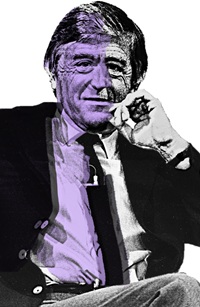
In our series on individual episodes of British television, FINLAY McLAREN watches Kenneth Williams and Jimmy Reid going at it (ooh matron).
Lately I’ve been finding joy – and I mean real joy, the kind others might find in marriage, sport or hard drugs – in watching old debates on YouTube. Not ‘debate’ in the modern sense, involving two Americans calling each other fascists, or ‘old’ as in a telesnap reconstruction of the Mytilenean Debate. Rather, I mean the sort of rosacea-hued, nicotine-stained discussions that filled British television during its golden age.
There is, and I promise you this, readers, no greater evening available than one spent watching Roy Jenkins and Enoch Powell discussing inflation on This Week in 1970, or Denis Healey going head-to-head with three trade union leaders on TV Eye during the Winter of Discontent. If you’ve never seen the post-apocalyptic showdown between Brian Clough and Don Revie on Calendar for Yorkshire Television – filmed the same day Clough was sacked by Leeds United – stop reading and go watch. You’ll thank me for it later.
I think what I enjoy most about these debates is their seriousness. The questions are long, the answers longer. There is no space for soundbites. Rather, discussions take a calm, rational and unashamedly intellectual approach. Sometimes the camera lingers on someone just thinking.
These are debates as conversations rather than contests, standing in total contrast to the simplistic, team sport-style fare that we see today. The kind that monopolises university chambers, internet comment sections and daytime TV schedules, where no one ever learns anything and everyone always wins.
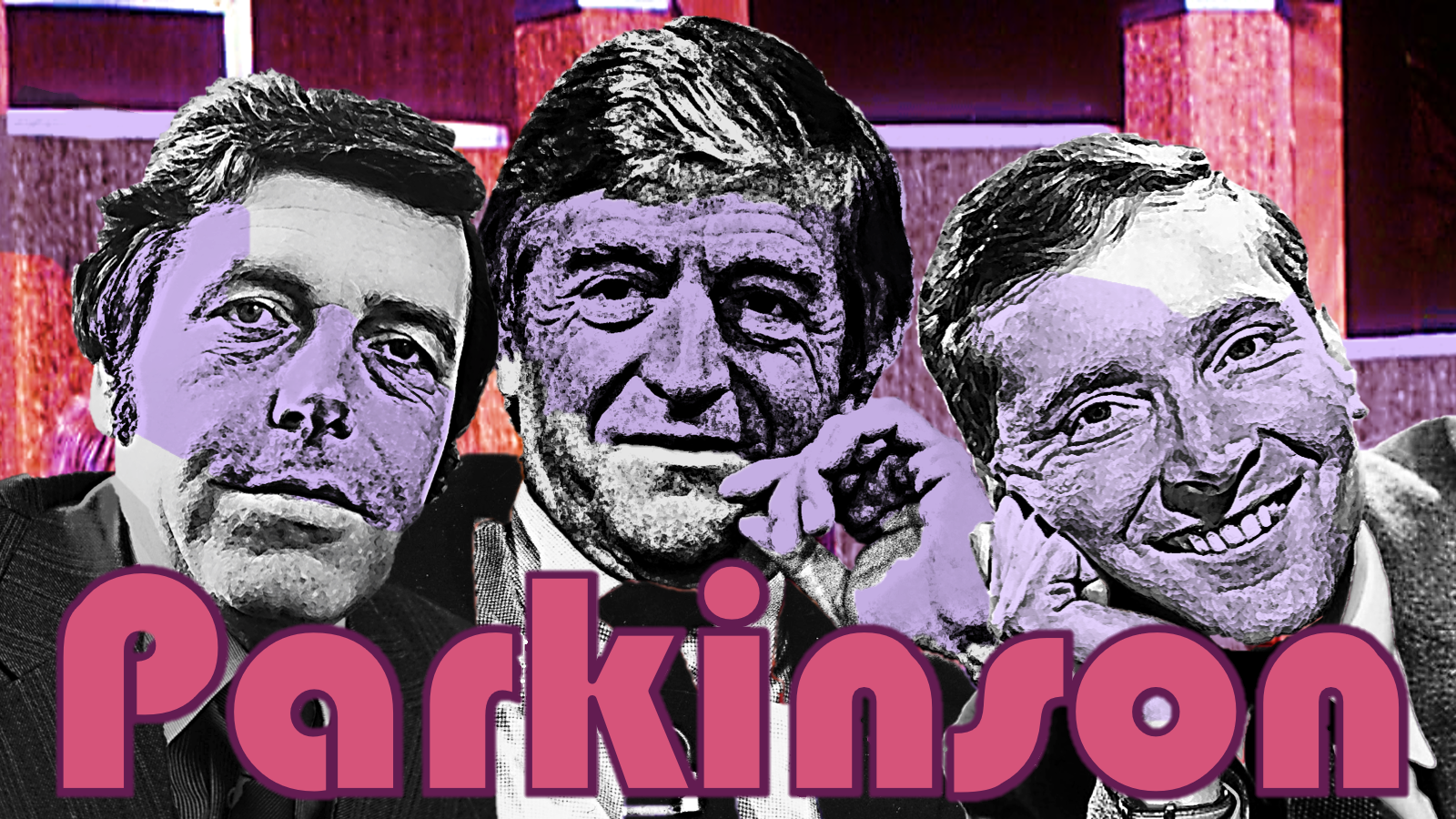
This brings me, by a characteristically circuitous route, to an episode of the chat show Parkinson from March 1973 that saw the comic actor Kenneth Williams, best known for his camp turns in the Carry On films, going up against Clydeside trade union boss Jimmy Reid.
Parkinson was a television institution which ran late on Saturday nights from 1971 to 1982, and was generally a soothing affair, the televisual equivalent of Bailey’s at Christmas, or a comfortable chair in a warm pub. This beige and boozy atmosphere would allow host Michael Parkinson’s various dazzling guests (Muhammad Ali, David Niven, Miss Piggy) to relax and let the public see a less starry and more comfortable side to them. The sight of Parkinson and Michael Caine, standing by Elton John’s piano, with dimpled pint-glasses, singing old pub standards, probably captures the general vibe and appeal of the programme better than anything I could write.
The edition of Parkinson broadcast on 17 February 1973 would prove something of a departure from this. The guests were Kenneth Williams, his friend actress Maggie Smith, and newly crowned poet laureate Sir John Betjeman, as well as footballer George Best. Williams by this time was not merely a regular of the talk show green room, but an undisputed heavyweight champion of chat. For any talent booker, he was a ‘get’ in the truest sense.
On this show, however, Williams eschewed his usual fare of outrageous voices and camp storytelling and steered the programme into a discussion about the then contemporary re-development of London’s Elephant and Castle area. He lamented the absence of homes being built and railed against the abundance of empty office blocks in their place, before pivoting into an attack on the trade unions.
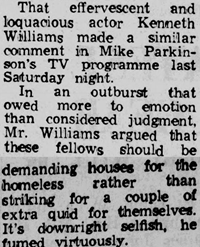
‘They can all get worked up over a couple of pounds in their pay packets or something and go on strike’, he said. ‘If unions really care, if they’re really socialistic and say “we care about our fellow man” why can’t they force, why can’t they march about something like that [building more homes]? Instead of another pound – for themselves.’
Parkinson – who Williams referred to as ‘a north country nit’ in his diaries – attempted a gentle correction, pointing out that the previous Labour government’s failure to implement effective planning laws wasn’t down to the unions. Williams barrelled; unions, he argued, act not out of solidarity but self-interest. Their strikes hurt the very people they claim to defend.
Parkinson cuts in: ‘Kenenth, can I just say I think that’s crap.’ Cue Williams with a theatrical ‘I’ve never been so insulted!’ Soon, the conversation is defused with an anecdote about Voltaire and a reading of Betjeman’s poem ‘Death in Leamington’. In his diaries, Williams recounts the recording and writes: ‘I was foolishly blabbing about train strikes being the essence of socialism etc so I will doubtless reap the whirlwind of indiscretion’.
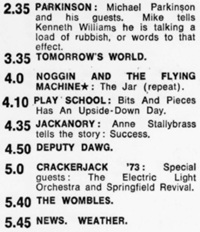
It was only to be expected that, in such a strike-heavy, union-dominated decade, Williams’ comments would cause a stir. Almost as soon as transmission had ended, the BBC switchboard lit up like a Christmas tree. On fire. (Which didn’t stop it getting its usual repeat the following Friday afternoon.)
It is worth pointing out that the unions were an incredibly powerful force in 1970s Britain. Industrial action was rampant, general secretaries regularly traipsed into 10 Downing Street for talks which inevitably ‘broke down’, and by the end of the decade, trade union membership had reached highs of around 17 million. Such was the unions’ stranglehold on British daily life that they could convincingly lay claim to having deposed two prime ministers.
Enter Jimmy Reid.
Reid was a Glasgow-born shipbuilder and communist, and in 1971 had led a passionate campaign against the then Conservative government’s refusal to offer bail-outs for ‘lame duck’ industries, such as the Upper Clyde Shipbuilders (UCS) consortium, which had been placed in receivership. Reid staged a ‘work-in’ – rather than close, the shipbuilders completed pre-existing orders and proved that the shipyards were still profitable. Addressing the workers as the work-in began, Reid told them: ‘There will be no hooliganism. There will be no vandalism. There will be no bevvying … because the world is watching us.’
The shipbuilders’ tactics worked, drawing wide-spread support and endorsement from the likes of Labour MP Tony Benn, ex-shipbuilder Billy Connolly and Yoko Ono’s husband John, who donated £5,000. By February the next year, the government admitted defeat and relented. The yards remained open. Reid was victorious.
Such was Reid’s popularity at this time that he was elected Rector for the University of Glasgow. His inaugural Rectoral address, ‘Alienation’, was proclaimed by the New York Times, who published the speech in full, as ‘the greatest speech since President Lincoln’s Gettysburg Address’. The Glasgow-based Evening Times, on the other hand, afforded the speech only a small mention, underneath its coverage of Glasgow City Council’s plan to invest in a new radio station, and the story of a car crashing into a tree.
It was Reid who was invited onto the 10 March 1973 edition of Parkinson to debate Kenneth Williams on the trade union movement.
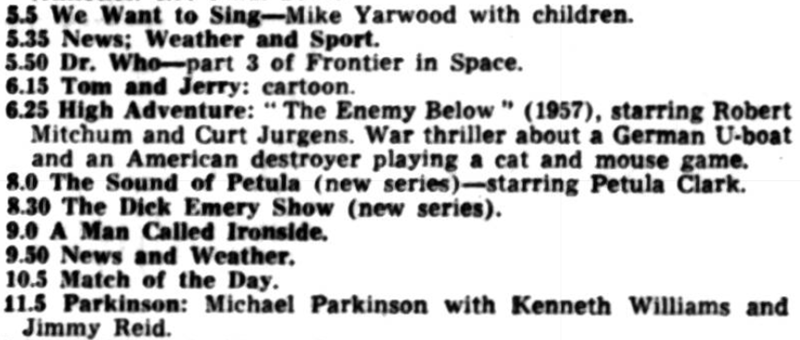
Remembering the 10 March edition, Parkinson recalled that, ‘Kenneth was incredibly competitive. He regarded anybody else on the show with him as someone about to steal his thunder, and he would do anything to put them down.’
Before the programme began, Parkinson asked Williams for a sound level. Williams stood and declaimed an entire poem to the assembled staff, then sat back down and fixed Jimmy Reid with a challenging stare. ‘Was that Yeats?’ Reid asked. ‘Yes, as a matter of fact, it was,’ said Williams, pleased with himself.
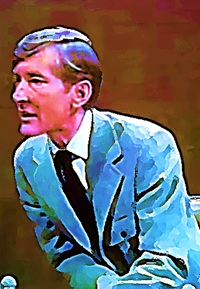
Then Reid took his turn for a sound level. He recited, from memory, an extraordinary poem. When he finished, he turned to Williams and asked, ‘Who wrote that?’ Williams didn’t know. ‘I did,’ said Reid.
Williams was visibly discomfited. Parkinson later described what followed as ‘the worst performance Kenneth ever gave’.
In my view, Williams did not give the worst performance of his life, certainly no worse than Loot or Carry On Emmanuelle. He comes across as warm, engaged and entertaining. Not the political firebrand that was Jimmy Reid, but if anybody had been expecting that from the Rambling Syd Rumpo man, then they ought to have been institutionalised.
Occasionally Williams does stray too far into the one-man-show approach he typically took on chat shows, drawing Parkinson’s ire (‘Never mind about mink jock-straps and all that stuff’), but he makes salient points, gaining the approval of both the audience and even of Reid himself, who at one point jokes: ‘I think you’ll be joining Equity [the actors’ trade union] shortly.’
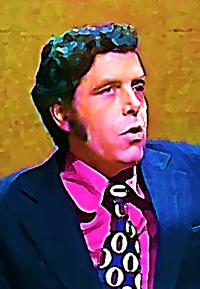
Meanwhile, Reid emerges as the debate’s anchor. Thoughtful, disciplined and morally forceful. Though he sometimes appears withdrawn, even taciturn – this is a condition that affects all Scotsmen as soon as we cross the border – his restraint intensifies the weight of his interventions. He doesn’t need to dominate the floor; every question he poses, every retort he offers, carries latent authority. Reid blends the three modes of persuasion – ethos, pathos, logos – seamlessly. It is he who gives the debate texture and balance, transforming what might have been a spectacle into a genuine conversation.
Beyond the personalities involved, three things struck me after re-watching this episode. First, there is an effort, from both sides, to reach a shared understanding rather than a personal victory. The historian Dr Ewan Gibbs once claimed in Scottish Labour History that Williams’s ‘received English pronunciation and mock-camp voice affected disdain for the manual working class’. I don’t think he would have made this statement had he actually watched the programme.
Throughout the debate, Williams returns again and again to the same conviction: that the unions have lost sight of their duty to the working man, preferring to chase after bigger pay packets while neglecting the provision of essentials – housing, food, clothing and education. He insists these should be made affordable, and that class itself must cease to be an obstacle to learning and success.
Reid agrees. On the fundamentals the two men are almost perfectly aligned. What we see is a conversation between two men of intelligence and pride, occasionally prickly, occasionally ungenerous – Williams with his self-sabotaging poetry stunt, Reid with a small, unworthy aside to Parkinson about ‘being raised in manhood’ – yet neither ever truly hostile.
Second, is the complexity of the arguments. This isn’t the usual television debate of slogans and soundbites, but a meeting of minds that occasionally remember they’re on air. Both men reach instinctively for reference and rhetoric. When Reid invokes Shelley, it’s not name-dropping; it’s a reminder that political passion, at its best, can still draw on poetry rather than polling data or pre-existing biases and beliefs. Williams meets him on that ground, and so what we get is a genuine exchange of ideas.
But what is most striking, watching it now, is not just the sharpness of Williams or Reid, but the intelligence of everyone in the room. Parkinson’s audience – a real cross-section of 1970s Britain, containing mothers, trade unionists and taxi drivers – listens, laughs and understands. The exchange assumes a level of cultural literacy and curiosity that television rarely dares to credit its viewers with today.
I know it’s absurd to feel an aching sense of the lost world over an old episode of Parkinson, but watching this debate now, then glancing at Question Time, or Prime Minister’s Questions, or whatever flares up on Bluesky or Twitter, I can’t help mourning what’s been lost. Political debate once had weight and wit and the unspoken courtesy that comes from taking your opponent seriously.
This would be the last time Parkinson played host to such a spectacle. He got a rocket from BBC management and the following week returned to the slightly safer ground of interviewing Jimmy Stewart. Williams stayed a fixture of the show, while Reid returned in 1979, sharing the set with Billy Connolly and Lauren Bacall (no, honestly).
Now, here’s what I want to say. The next time you feel your brain dissolving under the noise of Instagram infographics and performative outrage, don’t scroll – search. Watch Enoch Powell and Jonathan Miller on The Dick Cavett Show discussing immigration, or the 1975 Oxford Union debate on Britain’s membership of the EEC, or anything else you can find.
Then, watch the pauses, the hesitations, the small courtesies between people who disagree but still want to understand. These old debates aren’t relics; they’re reminders that intelligence and civility once shared the same studio space and that we were all the richer for it.
And if that sounds sentimental, so be it. We could all use a little sentiment these days. But I promise, you will leave these clips not just entertained but steadied, smarter and convinced that debate – honest, awkward and unscripted – might still be worth having.
Kenneth Williams and Jimmy Reid on Parkinson is available on YouTube.
see also:


Discover more from Lion & Unicorn
Subscribe to get the latest posts sent to your email.
