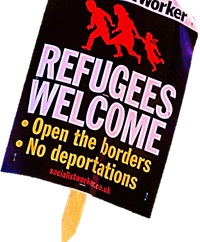
Immigration rose dramatically under the Labour government of Tony Blair, as discussed in this extract from Alwyn Turner’s All in It Together: England in the 21st Century.
In May 2004 the European Union, then fifteen nations strong, expanded south and east, taking in Cyprus, the Czech Republic, Estonia, Hungary, Latvia, Lithuania, Malta, Poland, Slovakia and Slovenia. Two other countries – Bulgaria and Romania – applied but were deemed not yet ready: they joined three years later.
It was the EU’s biggest ever enlargement, increasing the population of the Union by around a quarter, and while Cyprus and Malta were considered straightforward, the absorption of the former communist states raised fears that large numbers of people might leave low-wage, low-employment economies in search of better-paid work. The prospect of mass migration meant that the cherished principle of free movement within the Union was temporarily suspended; a seven-year transition period was implemented, during which each of the existing members was permitted to put its own restrictions on immigration from the east. Most did so, but not Ireland, Sweden or the UK, which set no limits on workers entering the country.
The British government was reassuring: it wouldn’t be much of an issue. ‘The number coming here for employment will be minimal,’ said immigration minister Beverley Hughes. She was speaking as the Home Office published a report estimating that there’d be between 5,000 and 13,000 arrivals a year. This estimate was based on the assumption that other countries – France, Germany, Italy, Spain – would also have an open-door policy. When it turned out that wasn’t the case, no adjustment was made, and the number 13,000 remained; it was still being quoted in the press right up to the date of accession. ‘No minister ever used such a figure,’ protested home secretary David Blunkett, but equally no minister corrected it either. As with the 45-minute claim in Iraq, the government let the error stand, and thereby supplied its opponents with ammunition.
Some disputed the official figures from the outset. The pressure group MigrationWatch estimated around 40,000 would come from east Europe each year. But MigrationWatch was, according to Blunkett, just ‘a tinpot one-man organisation’ and easily lumped in with what Andy McSmith in the Independent described as ‘an ominous coalition of Conservatives, bigots, tabloid newspapers, and anxious intellectuals’. Among those tabloids, the most vociferous was the Daily Express. ‘Millions of poverty-stricken workers plan to invade prosperous western Europe in search of a better life,’ it warned in a typical piece. ‘Tens of thousands will head for Britain alone.’
And therein lay the problem. Even before the accession countries joined the EU, political positions had been taken and battle lines drawn. As the date drew nearer, Tony Blair spoke of ‘a potential risk’ of there being larger numbers than had been anticipated, and was immediately criticised. ‘This is a knee-jerk reaction,’ said Keith Best of the Immigration Advisory Service. ‘It’s pandering to the Daily Mail and Daily Express.’
Free movement had become an article of faith in polite society, and any opposition to it carried the whiff of racism. ‘We live in an increasingly globalised world,’ said Brendan Barber, general secretary of the TUC. ‘Our best response is not to yield to little England, but recognise that the best way of avoiding a rush to the bottom is to fully embrace Europe; and that means accepting the free movement of labour as well as capital and goods.’ The logic was not obvious.
Exact figures were impossible to determine, but in the first five months of the enlargement, the government estimated that 75,000 immigrants made their way to Britain from eastern Europe, prompting a rapid change in government messaging. ‘It was decided to present the figures as good news, evidence of a thriving economy etc,’ noted Chris Mullin.
The good news got better and better; two years on from the accession, there were an estimated 350,000 Polish people living in Britain. Other nationalities were also represented, but it was the Poles that made the most impact, because there’d been nothing on this scale before. ‘From one country, in a very short space of time, it must be the largest influx we have ever seen,’ observed David Coleman, professor of demography at Oxford. (‘Coming over here, doing the jobs we’re not prepared to do because we’ve all got worthless degrees in media studies,’ grumbled comic Al Murray in his persona of the Pub Landlord.)
It was an extraordinary development in British history, and it wasn’t entirely clear why it had come about, why Britain hadn’t imposed any restrictions on free movement like comparable countries. One explanation was that the British government had simply been wrongfooted, hadn’t realised until too late that other members of the EU would abandon such a key principle.
There was also, though, the timing. When the decision was made in 2003, the government’s preoccupation had been the invasion of Iraq. Divisions within the EU on the subject meant that Britain was in danger of losing influence, and the accession states looked like allies. Speaking in the Iraq debate in March that year, Tony Blair drew attention to the fact that all ten countries were ‘in strong support of the position of this government’. Free movement would bring them into Britain’s sphere of influence and, in the words of Jack Straw, ‘rebalance the EU away from Paris and Berlin, particularly after Iraq’.
The other explanation that was offered came from a former Labour speechwriter, Andrew Neather, in an article addressing the unprecedented rise in immigration more generally. And it was unprecedented. In the 1960s and 70s, more people left Britain than arrived, so that in 1968, for example, the year of Enoch Powell’s Rivers of Blood speech, net migration stood at minus 56,000.
That began to turn in the 80s, and by 1997, when Labour came to office, annual net migration stood at plus 48,000. And then there was a surge. In the re-election year of 2001, it soared to 179,000, the highest level yet recorded, and went on to rise still further, boosted by the accession countries, so that it reached 267,000 by the next election. These were the net figures; looked at another way, annual immigration topped 500,000 a year in 2002 and stayed there for the rest of the decade.

Neather claimed this was a ‘deliberate policy’ designed ‘to open up the UK to mass migration’. There was an economic advantage, but that wasn’t the sole motivation: ‘mass immigration was the way that the government was going to make the UK truly multicultural’. An added benefit was ‘to rub the Right’s nose in diversity and render their arguments out of date’.
The government had no wish, however, ‘to discuss what increased immigration would mean, above all for Labour’s core white working-class vote’. It was ‘too metropolitan an argument’, so that ‘while ministers might have been passionately in favour of a more diverse society, it wasn’t necessarily a debate they wanted to have in working men’s clubs in Sheffield or Sunderland’.
Between the census of 2001 and that of 2011, the number of British residents who had been born in a foreign country increased by more than 3 million, so that they now accounted for more than one in eight of the population. As Neather said, ‘Part by accident, part by design, the government had created its longed-for immigration boom.’
Discover more from Lion & Unicorn
Subscribe to get the latest posts sent to your email.
