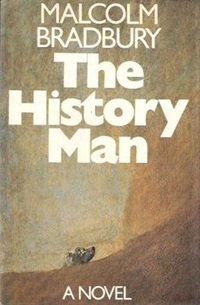
BEN FINLAY celebrates the 50th anniversary of The History Man, Malcolm Bradbury’s comic novel satirising the fashionable politics of academia.
‘Now it is autumn again; the people are all coming back. The recess of summer is over, when holidays are taken, newspapers shrink, history itself seems momentarily to falter…’
One of the great novels of the 1970s, Malcolm Bradbury’s The History Man turns fifty this year. As the opening line of the book (above) suggests, how appropriate for the beginning of the academic year.
The autumn of 1975 was a good time for a particular satirical form of British literature, as Martin Amis’s second novel, the savage Dead Babies, was also published that month. Reviews of The History Man were largely favorable, with Auberon Waugh calling it the ‘funniest and best-written novel I have seen for a very long time’.
Based around the lives of the villainous Howard Kirk, a sociology lecturer (or ‘theoretician of sociability’ as he would have it) and his long-suffering wife, Barbara, Bradbury’s most famous novel is a wonderful dark satire of the goings on within the ‘glass and steel’ universities that grew from the higher education boom in the early 1960s. In fact, Bradbury’s observations are so wholly accurate, scathing and wickedly funny that one forgets the book was written fifty years ago; it reads as something that could only have been written with the benefit of hindsight, rather than amongst the radical zeal of the era.
This is because Bradbury was there as it happened. An academic of some considerable standing, Bradbury, like many others, had thrived through the meritocracy bought about by Rab Butler’s 1944 Education Act. The removal of fees from grammar schools enabled children from poorer families to attend and from there to go on to higher education. New provincial universities of the 1960s consolidated this meritocracy, increasing social mobility while being steeped in intellectual rigor, a serious alternative to the complacent Oxbridge education open only to a privileged few.
Bradbury, who was born to a lower-middle-class family in Sheffield in 1932, had gone to West Bridgford Grammar School in Nottingham and passionately believed in this new university system. In the early sixties he was an adult education tutor at the University of Hull, before teaching at the University of Birmingham between 1961 and 1965. These were also formative years for what would be a huge change in higher education: the introduction of the discipline of ‘Cultural Studies’, spearheaded by the formation of the Centre for Contemporary Cultural Studies at Birmingham University, founded by New Left theorists Richard Hoggart and Stuart Hall in 1964.
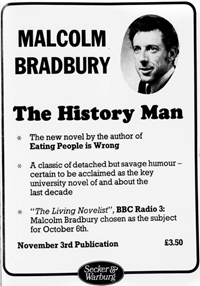
Bradbury then moved to the University of East Anglia (inspiration for the fictional ‘University of Watermouth’ featured in The History Man). It was there, in 1971, that his office was vandalized during a ten-day sit-in to protest the expulsion of an American undergraduate who had received a police caution for smoking marijuana. Bradbury and his colleagues were appalled by the demonstrations and such violent behavior, which they saw as a vulgar challenge to the earnest intellectual pluralism and free debate of the post-war university he so championed.
And it’s this tension that is at the heart of The History Man – the sudden changes of the 1960s, the forceful attempts to debunk all that came before, and the onset of ‘progressive education’, a system that would seek to remove the top-down hierarchies of the past, but ultimately signaled a decline in standards.
The much-lauded May 1968 protests in France had begun through a wave of student demonstrations about university conditions, resulting in some copycat behavior in Britain, particularly at the London School of Economics, but without quite the zeal of our Gallic counterparts.
This is not to downplay elements of the British student’s grievances, but, by and large, we had a lot less to complain about compared to France, Germany or the U.S. Furthermore, Britain was amid some of the most progressive social changes ever seen, presided over by Harold Wilson’s government and the exceedingly liberal Roy Jenkins. Nevertheless, radical Left ideas were in the ascendency, not only with students, but with a new generation of lecturer, personified in the character of Howard Kirk.
The History Man is set in 1972, still in the glow of the post-68 firmament, an era of radical new literature in higher education, with Marxist ‘readings’ of history. For example, 1972 saw the publication of Christopher Hill’s The World Turned Upside Down, a highly influential reinterpretation of the seventeenth-century English revolution, which focused on the radical potential of small sects such as the Levellers and the Diggers. In 1975, the year of The History Man’s publication, the film Winstanley was released, the story of Diggers leader Gerald Winstanley, who had briefly put into practice a proto-communism through the setting up of communes in England in the 1650s.
Radical publications, meetings, workshops and groups were everywhere. By the mid-seventies, this was less of a shock than it had initially been, and universities came to be seen as Left-wing, a perception that is now utterly ubiquitous. Furthermore, by this time, the influence of radical postmodern thinkers from continental Europe, such as Michel Foucault and Jacques Derrida, was becoming prevalent in higher education.
Also, radical cultural Left ideas were ’trickling down’ to the mainstream, with Penguin publishing a beginner’s guide to the theories of Antonio Gramsci, the Italian Marxist of the 1930s who would coin the term ‘hegemony’ to describe cultural dominance. The irony is that it was post-Marxist language and theory that was becoming hegemonic in British universities.

And this is what Bradbury gets so right in The History Man. Moreover, he doesn’t see the normalizing of progressive education as an advance, but a decline, an intellectual straitjacket, and a betrayal of the original premise of the new postwar university system.
The idea that radical leftism and post-Marxist doctrine would challenge the certainties of modernism and give way to a wider breadth of thought is of course completely blown away when Howard openly persecutes a male participant in a seminar. The student, who has written a paper from a conservative viewpoint, rather than using Howard’s preferred sources, also insists on being allowed to present his paper in the traditional, formal way, without being interrupted and without having to answer questions before he has finished his train of thought. In front of the others Howard calls him a ‘heavy, anal type’, and what he has prepared for class ‘an anal, repressed paper’. Without considering his own hypocrisy. Kirk succeeds in having the student, a ‘historical irrelevance’, expelled from the university.
Howard Kirk is in many ways an opportunist, a reader of intellectual fashions and trends. He portrays himself as radical, but at heart he is still a career and company man. Bradbury’s mastery here is that he illuminates a particular hollowness in sixties ideology; as he wrote later in 1998, now Kirk ‘would be enjoying his vice-chancellorship at Batley Canalside University’.

But this is just the tip of the observational iceberg. Bradbury portrays the indulgent baby boomer generational behavior with precision and nuance. Take for instance, the Kirk’s absolute love for parties – the planning, the tradition of phoning invitations split equally between Howard and Barbara, the whole ritual and over-consideration of the process, all shot through with Howard’s passive-aggressive tone.
Their ‘open’ marriage is also examined, with Bradbury describing Howard’s predatory manner without ever lapsing into easy morality or judgement; it is left open for the reader to interpret. Above all, the way the Kirks consider themselves just so bloody important and at the centre of everything is brilliantly done – their children are decidedly secondary to the couple’s own emotional turmoil, tolerated in a particular seventies way far from the over encouragement practised by parents these days. (Seventies kids will know exactly what I mean.)
A mention must be made of the excellent BBC adaptation made in 1981, where Howard was memorably played by Anthony Sher. The scene where he verbally attacks the student is wonderfully done, as is the ending where a caption states that ‘in the 1979 general election Howard Kirk voted Conservative’.
For all its caustic commentary, The History Man is of course of its time. The self-indulgence, sexism and sheer behavioral effrontery of the History Man’s era have passed. And of course, technology and social media now preclude radical protests and meetings, let alone the sheer amount of literature and reading that seventies lefties had to undertake. The digital makeup of 2025 makes the world of 1975 look decidedly analogue.
But The History Man is still hugely relevant. I don’t wish to spoil the book for anyone, but read the passage near the end where there is an attempt by students to no-platform Jewish geneticist Professor Mangel from delivering a lecture titled ‘Do Rats Have “Families’”?’ Sound familiar in any way? Well, in a very Malcolm Bradbury fashion, I’ll leave it to you to read it and work that out for yourself.

Discover more from Lion & Unicorn
Subscribe to get the latest posts sent to your email.

One of my favourite novels ever since I studied it at A level. I have read it a number of times since, and the interesting thing I notice is that I become less and less tolerant of Howard every time. When I first read it, I found him funny, charismatic and rebellious, all the things that many 16 year olds would aspire to be. On my most recent reread I found him unpleasant, self centred and as deep as a puddle! It’s fascinating how your age and life experiences will change your views of even your favourite novels.
LikeLike