
In our series on individual episodes of British television, IVAN KIRBY celebrates a 1979 edition of Crown Court, a forgotten milestone in the television depiction of gay men.
Half past one in the afternoon may not seem the natural home for hard-hitting TV drama, but viewers tuning into ITV at that time in the 1970s and early 80s would often find it there nonetheless. This was the timeslot occupied three days a week by Granada’s courtroom drama Crown Court.
For the uninitiated, Crown Court is set in the fictional town of Fulchester (its name was later appropriated for the home of Viz’s cast of characters) and presents a weekly court case in three daily episodes, culminating in the jury’s delivery of their verdict. It’s a drama, performed by actors, but the engaging twist (inherited from a previous Granada series, The Verdict Is Yours) is that the jury is made up of genuine members of the public. [1]
Premiering along with Emmerdale Farm and Rainbow as part of ITV’s first-ever afternoon schedule in 1972, Crown Court never shied away from controversial and occasionally harrowing subject matter. This might have attracted headlines had it been seen in primetime, but it seemed to fly under the radar when broadcast in the slot before Southern TV’s soporific Loose Women-forerunner Houseparty. Often familiar faces were involved: ‘A Man with Everything’ (1978) features that bastion of lovable sitcom grumpiness Geoffrey Palmer as an alleged paedophile, while in ‘Honour Thy Father and Thy Mother’ (1979), it emerges that Frank Windsor – solid, reliable John Watt from Z Cars and Softly Softly – has been sexually abusing his daughters over many years.

One area where Crown Court was especially pioneering was in the depiction of what we’d now term LGBT issues: in ‘Lola’ (1976) Nicholas Ball appears an undercover cop cruising in black leather years before Al Pacino, while Judy Loe played a male-to-female transsexual (to use the language of the time) in ‘The Change’ (1978).[2] ‘Heart to Heart’ (1979) sees Judy Geeson and Honor Blackman as warring former lovers (which must surely have sent female-attracted viewers of both sexes daydreaming), while ‘Queen Bee’ (1978) features a memorably eccentric gay witness who’s changed his name by deed poll to… Deed Poll. (‘I am an effeminate homosexual’ he dramatically announces, ‘My life is one round of wine, men and song.’)
In his book Playing Gay in the Golden Age of British TV, film and television historian Stephen Bourne includes an excellent section on some of Crown Court’s gay-themed episodes, but one case he doesn’t include is ‘A Friend of the Family’ (1979). That’s not really surprising, as Bourne’s focus is on gay men and ‘A Friend of the Family’ is mostly concerned with a lesbian couple. It does, however, feature an extraordinary moment that makes it an unknown milestone in the depiction of gay men on telly.
The defendant in the case is Diana Graham (Rachel Davies), a divorcee now living with the recently separated Beth Charles (Dorothy White). Diana stands accused of GBH after allegedly pushing Beth’s husband Charles (Geoffrey Bateman) down a flight of stairs. The nature of the relationship between the two women may seem fairly obvious to a sophisticated 21st-century audience but viewers in the 1970s might have needed a bit more prompting. Diana’s defence counsel Charles Hurst (William Gaunt) is certainly blindsided when, after pressing a suspiciously coy Charles to give a motive for Diana’s attack on him, the witness finally announces: ‘She’s bent. She’s queer. She’s a dyke. She’s a filthy, perverted dyke and she’s living with my wife.’
The court adjourns for a scene between defendant and counsel, where Hurst is furious with Diana for not telling him the truth about her relationship with Beth. Diana’s impassioned response, about social prejudice toward lesbians (‘She’s an attractive woman, I wonder how she came to be so sick’), has a whiff of the kind of Guardian Society Section TV that Crown Court sometimes descends to, but it’s nonetheless quite an eye opener about how lesbian parents were treated at the time, as she recalls her battle over custody of her own child:
‘You may keep your daughter for the time being, but your girlfriend will move out. Should your girlfriend visit then there will be a chaperone in constant attendance. Should your girlfriend go to the bathroom then you must stay at the opposite end of the flat with your daughter and the chaperone. Should your daughter go to the bathroom then the chaperone must at all times be with your girlfriend.’
Hurst fears that the jury will now be prejudiced against Diana – but for keeping quiet about her relationship, rather than the nature of it. His disappointment in her also seems to have a strangely personal dimension, which we will soon find out about.

Charles admits that on the night of the incident, he found Diana and Beth in bed together (‘She’s not one of those!’ he insists about his wife), then after evidence from Beth’s daughter we meet a classic example of one of the great Crown Court witness genres: the busybody neighbour (‘I didn’t want to poke my nose in’). In a lapse of subtlety on the part of writer Peter King, this one, played by Geraldine McEwan-lookalike Julia McCarthy, is named Mrs Duguid (pronounced ‘do good’). She saw the incident and is very much on Charles’s side.
Questioned by Hurst, she admits of her neighbours ‘I have seen them… holding hands’, and stands in for the country’s legion of Mary Whitehouses when asked by Hurst: ‘Do you think their way of life is morally reprehensible?’
‘Yes I do! And I’m not afraid to say so. There’s so much of that dirt and that sort of thing these days, isn’t there? It’s everywhere. You turn on the radio or the television and it’s thrust at you. I mean there are no standards any more. And that’s why the young go round smashing everything up. They’ve nothing to look up to. I mean as far as these two are concerned I don’t care about them. But that little girl – it’s not right! I mean what’s she going to grow up to be – like her mother? Oh, it’s awful for a child to have a mother like that. It’s against nature.’
Hurst seems particularly rankled by this witness. ‘What makes lesbians so particularly dangerous as human beings, as parents?’ he asks. ‘What makes them worse than the ignorant, the violent, the inadequate, the crazy? Which of us can claim we have a better right to bring up children?’ Perplexed by this outburst, Mrs Duguid splutters: ‘Are you a homosexual or something?’ And then – one of the most extraordinary moments in 1970s British television – the QC, in front of the court and the jury, replies: ‘As a matter of fact, I am.’

The case resumes, and Hurst’s sexuality is not mentioned again, but when prompted by the judge (John Woodnutt) to begin his case for the defence, William Gaunt conveys the haunted, faraway look of a man who may have just placed his high-flying career in jeopardy.
Gaunt was a highly respected stage actor and a familiar face to TV viewers (he’d been one of the stars of ITC’s The Champions in the 1960s), so at the time Charles Hurst was quite a brave part for him to take. He also returns to Crown Court in the same role several times, making Hurst one of the few recurring gay characters in 1970s and 80s TV drama.
Hurst’s declaration occurs halfway through the case. The remainder of it is a fascinating period piece on gay and women’s rights, with prosecution barrister Jonathan Fry (Bernard Gallagher) questioning Diana on her participation in a gay rights march (carrying a placard reading ‘You Must Be Gay to Be Alive’) and her articles for a magazine called Out; these include such women’s lib sentiments as ‘When a woman gets married, she enters the dungeons of hell’ and ‘We must devote ourselves to the destruction of men’. (From the charming mock-up of the front cover we see, Out looks magnificently of its time.)
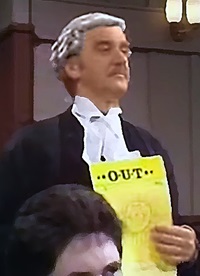
‘It’s almost an evangelism, isn’t it?’ says Fry. ‘What was a cause is now a crusade. You’re not content to say a woman must be liberated, you have another message. Your message for woman is you must be liberated but you must be lesbian to be liberated.’ There’s also an imputation that Diana is normally butch, but has femmed herself up to gain the jury’s sympathy.
An accusation that can be fairly levelled at Crown Court is that its socially conscious writers usually weight the script toward sympathy for the defendant, who is more often misunderstood, or a victim of circumstance than a proper wrong ’un; thus guilty verdicts are fairly rare.
That’s certainly the case with ‘A Friend of the Family’, where both the jury and the audience at home are cued toward taking Diana Graham’s (and indeed Charles Hurst’s) side through their impassioned pleas for tolerance (which, if we’re completely honest, have little bearing on why a man was pushed downstairs). If you don’t want the verdict in this case spoiled then go and watch it now and come back: the jury fail to reach a unanimous verdict so deliver a majority one of Not Guilty. As the case for the defence is essentially a defence of lesbianism, that might be a reflection of where everyday TV viewers were in 1979: mostly tolerant but with a few remaining reservations.
Crown Court remains somewhat unknown territory in British TV history. Its twelve-year run and soap-opera episode count mean that it has never had a full home-media release (the late lamented home entertainment company Network released eight DVD volumes of thirty-six episodes each, in chronological order, and didn’t even cover the show’s first two years).
There was an almost complete repeat run on the digital channel Legal TV in 2006-7, and as I write it’s being shown by the noble Talking Pictures TV. Episodes continue to turn up on YouTube but there are some that even I, as someone who has devoted probably far too much time to the series than is healthy, am yet to see. It is a treasure trove of often groundbreaking drama, even if most people at the time weren’t aware that the ground was being broken.

[1] However, union rules of the time stated that as the jury foreman has a line of dialogue (usually one or two words), he or she had to be played by a member of Equity. Several future familiar faces can be seen delivering the verdict, including Coronation Street stars Bill Tarmey and Fred Feast (and Tarmey’s Corrie wife Elizabeth Dawn had a long-running non-speaking role as the prison officer escorting female defendants).
[2] Behind the scenes, Crown Court employed one of the few openly gay TV writers of the time. Peter Wildeblood, who had been imprisoned after the infamous Montagu trial of 1954 and wrote a book about his experiences, Against the Law, scripted the very first Crown Court case to be broadcast.
‘A Friend of the Family’ is available on YouTube.
see also:


Discover more from Lion & Unicorn
Subscribe to get the latest posts sent to your email.

Pity they never combined it with Rumpole -get John Mortimer to write a Crown Court with Rumpole for the defence and one of his chambers colleagues for the prosecution,presided over by one of the Rumpole judges.
LikeLike