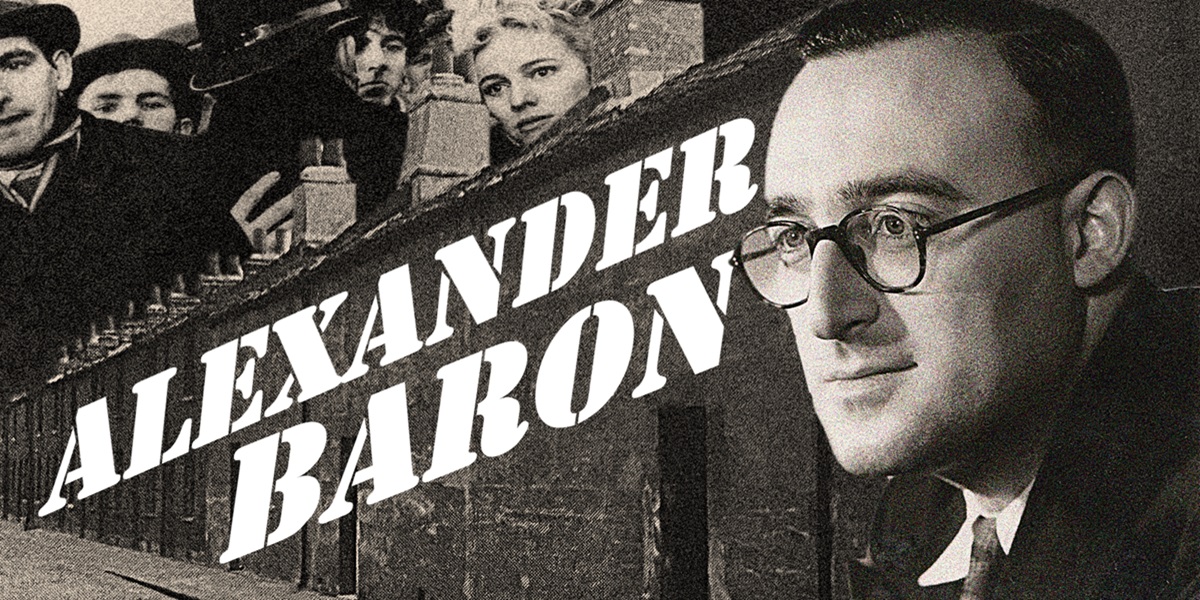
SIMON MATTHEWS explores the life and works of novelist and TV dramatist Alexander Baron
Alexander Baron had an odd career. Acclaimed during his lifetime and employed on much lucrative work by the BBC, he was rediscovered after his demise – which was neither early, nor tragic, he lived to eighty-two – as a forgotten genius.
Born Joseph Bernstein in 1917, his education included a stint at Hackney Downs Grammar School where a later alumnus was one Harold Pinter, who, interestingly, adopted the stage name David Baron when working as an actor in repertory theatre in the 1950s. By that point Alexander Baron was relatively well known and one wonders if Pinter was emulating, or even cashing in, on his predecessor’s success.
Being young and Jewish in Hackney in the 1930s inevitably led to Bernstein joining the Labour League of Youth, whilst simultaneously being part of the Communist Party of Great Britain. Disillusioned like millions by the Nazi-Soviet Pact, he quit the CPGB in 1940 and volunteered for war service. Posted to the Pioneer Corps, a repository for unreliable political and émigré recruits, he served six years, taking part in several key campaigns.
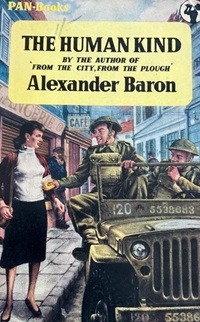
His experiences were recorded post-war in From the City, From the Plough (1948) and There’s No Home (1950). Both were crisply written, highly accurate accounts of soldiering and appeared under the pen-name Alexander Baron. Both were praised.
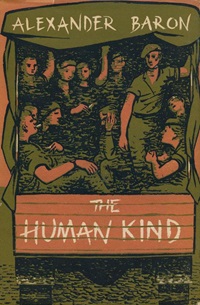
Two London-based novels, Rosie Hogarth (1951) and With Hope, Farewell (1952) did less well, but a third wartime narrative The Human Kind (1953) was exceptional. Its central character recounts meeting amoral survivors of Nazi occupation, whilst still, for the moment, conveying the vague but determined political motivation of those fighting – the desire to see ‘the old muddlers thrown out and people like ourselves doing the big things’, and the expectation that they will meet ‘an army of young men with red stars on their helmets coming to meet us from the East’. Uncle Joe Stalin is much admired (as he is too in Alan Sillitoe’s accounts of this period), but our hero and his colleagues are quickly disillusioned once they meet Soviet soldiers in Berlin.
The film rights to The Human Kind were purchased by the blacklisted US producer/director Carl Foreman. Heavily rewritten around the exploits of a US army unit, filming began in 1962, after Foreman’s immense success with The Guns of Navarone. It emerged a year later as The Victors, a long (two hours, thirty-three minutes), moralising, would-be epic played by an ensemble cast amongst whom – in a cameo at the end – could be found Albert Finney as a drunken Soviet soldier. It failed at the box office.
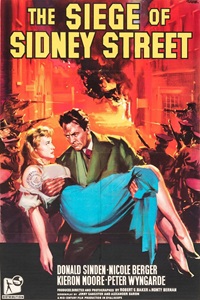
By then Baron was writing historical fiction, a genre he concentrated on from the mid-1950s. He was also working in television. An interesting exception was his screenplay for the 1960 British film The Siege of Sidney Street. It was a subject he came to easily: Jewish immigrants and political revolutionaries in the East End circa 1910. His account is heavily fictionalised, reflecting the mythologies that enveloped the event in later years. Namely the (supposed) presence of ‘Peter the Painter’ a Robin Hood-type figure who miraculously escaped justice and whose exploits were still jocularly referred to by locals half a century later. The film is worth watching: the period detail is accurate, Peter Wyngarde gives a fine turn as Peter the Painter, and there is extensive location footage in areas soon to be swept clear by local authority bulldozers.
After which, there was no surprise to find him scripting a July 1967 BBC adaptation of Conrad’s The Secret Agent. One of eleven TV plays credited to him, his ability to bring fresh insights to familiar material saw him in demand for multi-part, prestige series. Beginning with an adaptation of Tolstoy’s Resurrection (1968) these continued while he was collecting his pension, concluding with sixteen episodes of Vanity Fair (1987).
Looking at the considerable volume of material about him online, this aspect of his career is usually glossed over. Phrases like ‘brilliant but forgotten’ proliferate. But was he forgotten to TV producers? Similarly, his Guardian obituary proclaimed him ‘the greatest British novelist of the last war.’ This is nearer the mark, but what about Nicholas Monsarrat, author of The Cruel Sea (1951), a timeless classic, or Nigel Balchin with The Small Back Room (1943)? It would be more accurate to describe Baron as one of several good, solid, writers who recorded the conflict.
In terms of his fiction, the problem has always been where to place him. Unlike Monsarrat he wasn’t published in the 1930s, so can’t be ranked alongside early social realists like Graham Greene and George Orwell. Two decades later he was older than the proto-Angry Young Man writers John Wain and Kingsley Amis. Nor did he write about life outside London, like William Cooper, John Braine and others.
In fact, post-1945, Baron’s life followed quite a conventional route. His success as a TV writer allowed him to take ‘the north-west passage’ from Hackney, to Golders Green, where he died in 1999. His political outlook changed too, with him rejecting Soviet-style communism in the Fifties, which, according to his son, was something he felt vindicated by when the USSR collapsed in 1991.
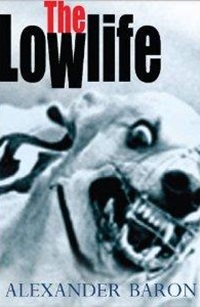
One online comment calls him ‘a Stoke Newington novelist who’s gone under the radar,’ which is true. His later London novels The Lowlife (1963) and Strip Jack Naked (1966) are set in a dying, depopulating East End. A world full of ghosts, with dog tracks, bomb sites, corner shops and tattered old houses that could be bought for a couple of hundred quid. The society they describe is very niche and it was hardly surprising that whatever their artistic merits – which are considerable – they failed to attract much attention in the era of Swinging London and much experimental fiction.
In the meantime, the psycho-geographers have been busy. One advertises A Walk Around Baron’s Manor, starting in Foulden Road N16, where houses like the one he grew up in now retail for £1.4m. Those minded to do so can encounter various odds and ends that occur in his novels, now stranded in an increasingly select, gentrified neighbourhood. There are plans today to finally make a film of The Lowlife. It will be interesting to see how effectively it portrays a completely vanished world.
from the maker of…

see also:
Discover more from Lion & Unicorn
Subscribe to get the latest posts sent to your email.
