
In our series celebrating individual episodes of British television, FINLAY McLAREN casts a vote for Froglet.
Somewhere out there, in the vast, starry stretches of British TV history, nestled between the galaxies of Camberwick Green and Come Back Mrs Noah, there is a very strange world indeed. A world where the air hums with the sound of swanee whistles, where copper trees grow copper leaves, and where everything is always, somehow, alright.
This is the world of Clangers, a series so exquisitely strange, so unapologetically tender and so quietly profound that watching it feels like a whispered lullaby from some distant hand-stitched cosmos.
Broadcast from 1969 to 1972, Clangers was the brain child of Smallfilms, a production company operating out of a disused cowshed in Kent and run by artist and puppet-maker Peter Firmin with animator, puppeteer and writer Oliver Postgate. Together, they were responsible for some of the most warmly remembered programmes from the golden age of children’s television, such as: Ivor the Engine, about a steam locomotive chugging through the top-left corner of Wales; Noggin the Nog, with its Nordic sagas of a kindly king; and, of course, Bagpuss, the saggy old cloth cat, who remains their most famous creation.
The works of Smallfilms all have a charming, homemade quality to them; low-tech and low-key. Their stop-motion worlds are built with love, string and a touch of rustic anarchy. In today’s world of five-second-long algorithm-driven content and CGI spectacle, the work of Firmin and Postgate feels like a slightly shopworn, frayed and folksy rebellion.
But for all their triumphs, Clangers shines as the two men’s finest hour; a joyous, yet melancholic and wholly original vision of what the world, and television, could be.
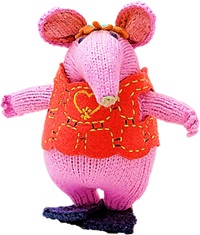
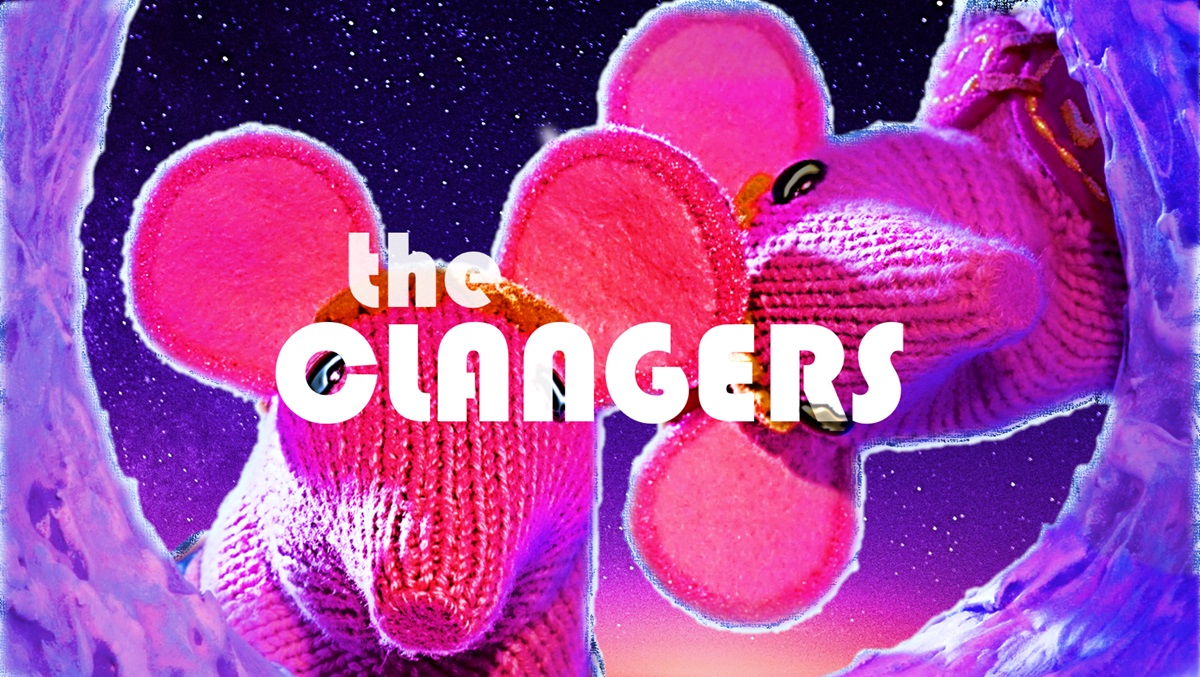
Clangers focuses on the eponymous Clangers; a family of bright pink, nozzle-nosed, mouse-like creatures, who live on a small blue planet, pocked with craters and wrapped in a haze of cosmic whimsy. So-called because of the clanging sound made by the dustbin lids that cover the entrances to their sub-lunar burrows, the Clangers live in gentle, harmonious peace, spending their days building, fishing and making music.
Their ten-minute adventures are narrated by Postgate himself, who – warm and whimsical like all the best fireside storytellers – is the only human voice we hear; because, rather than speak, the Clangers whistle. Dialogue was written in English (see Major Clanger’s infamous ‘Sod it, the bloody thing’s stuck again!’ in the script for the episode ‘Chicken’) then translated into swanee whistle melodies by Postgate and Stephen Sylvester. (For those unfamiliar with the sound of a swanee whistle – you know the ‘woo’ noise made whenever someone’s trousers fall down in a Carry On film? Well, that’s a swanee whistle.)
The result is bewitching: a simple musical language of pure emotion, where pitch and rhythm convey curiosity, indignation, or quiet joy without a single intelligible word. Watch Major Clanger gently scold Small Clanger for some minor mischief and tell me you don’t feel the emotional weight of their exchange, wordless though it is.
The soundtrack, too, is a thing of beauty. Vernon Elliott’s score, all plinking xylophone and mournful bassoon, sounds like the music of the spheres as filtered through a slightly shambolic village hall rehearsal. It’s the perfect complement to the show’s bricolage aesthetic, with sets such as the moon-like surface of the Clangers’ planet and the crystal-lined caves of the underground soup wells built from yoghurt pots, drinking straws and copper wire, while the Clangers themselves – all soft-edged and huggable – were knitted by Peter Firmin’s wife Joan.
But the Clangers are not alone on their little blue world. Their environs are shared with all manner of surreal space-based flora and fauna.
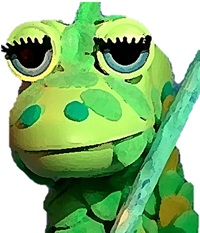
Firstly, there is the Soup Dragon, the green-petalled gatekeeper of the soup wells, who dishes out fresh soup to all the Clangers. Then, there is Tiny Clanger’s friend the Iron Chicken, a sort of Mechano Foghorn Leghorn, who lives in a shrapnel-clad nest hanging in space, talking to Tiny Clanger through a radio hat. We also encounter the Froglets, orange, stalk-legged, bounders who travel the cosmos in an old top hat; the Hoots, who are tripodal trumpets from some ‘distant musical constellation’; as well as the Cloud, the glow-buzzers, the sky-moos, copper trees, cheese trees, cotton wool trees, macaroni branches and jewel berries. There is also the Clangers’ music boat which uses notes from the music trees – sentient trees on the planet’s surface – to sail across the infinite reaches of black-drape space.
The strange biota of the Clangers’ world exhibit Postgate and Firmin’s knack for combining the two juxtaposing cultural obsessions of late Sixties Britain: Edwardian children’s fare and the moon landing fervour of the Space Age. The Clangers are Wind in the Willows written by Arthur C. Clarke, or Peter Pan dressed in Mary Quant. They represent the same heady mix of backwards-facing and forwards-looking Sixties wonder as Sgt. Pepper’s Lonely Hearts Club Band, Syd Barrett-era Pink Floyd, or Doctor Who serials The Web Planet and The Mind Robber.
And yet, for all the Clangers are informed by the contemporary culture of the period, they also represent a quiet handcrafted rejection of then modernity.
Take the second episode of the series ‘The Visitor’, which sees the Clangers find a television set from Earth. Curious, they watch and listen to all the mad, loud, chaos of our planet – from psych rock to pompous politicians – before cheerfully launching the set back into space, Postgate reminding us that: ‘it’s nice to have visitors. But sometimes it’s even nicer to see them go.’ It’s a quiet critique of our noisy, self-important culture, delivered without a trace of cynicism.
Similarly, ‘The Intruder’ ends with the Clangers using a telescope to get a rare glimpse of Earth – represented by black-and-white stock footage of New York – and they are horrified. ‘What an unpleasant looking place,’ Postgate intones, ‘no, I don’t think the Clangers will want to go there.’
Then there is series two opener ‘The Tablecloth’, which sees the Clangers using the USA/USSR amalgam flag planted by a visiting Earth astronaut as (what else?) a tablecloth. A crocheted shrug in the face of the Space Race. Speaking in the 1971 BBC documentary Something for the Children, Postgate said of the Clangers: ‘I think they would be very alarmed if they got tangled up with our sort of life. The life of Earthly civilisation.’
Nowhere is this kind-hearted rejection of 1970s Britain more apparent than in the 1974 election special ‘Vote for Froglet’.

Made in just three days, long after Clangers production had ended, ‘Vote for Froglet’ was Smallfilms’ contribution to the BBC election-night coverage of the October 1974 general election.
The seven-minute short opens, as Clangers always did, with the Earth hanging in space, evoking Michael Powell and Emeric Pressburger’s 1946 masterpiece A Matter of Life and Death. Unlike the silent and serene Earth of typical Clangers openings, this one broadcasts a strange babble of inhuman voices into the cosmos, reaching the curious Clangers.
For the first time, Postgate’s warm, wise narrator directly addresses the Clangers, explaining to them that the odd voices they can hear – those of Ted Heath and Sir Keith Joseph – are campaigning, and that the people of Earth are holding an election. The Clangers, unfamiliar with the concept, prompt Postgate to explain. Soon, they decide to hold their own election, pitting two parties against each other: the Soup Dragon’s party and the Froglets’ party (or rather, one Froglet).
The Soup Dragon burbles and gurgles, like a BBC Radiophonic Workshop arrangement of Teach Yourself Heath, promising free soup for all but none for Froglets. The Froglet candidate counters with a manifesto pledging the opposite of everything that the Soup Dragon offers.
When voting time arrives, the Froglet loses by a single vote, thanks to Mother Clanger’s floating-voter tendencies. But the election soon sparks chaos, and civil war erupts among the Clangers. In the end, they yearn for their old, peaceful ways and democracy crumbles as they reject the divisiveness, deciding instead to restore harmony and give plenty of soup to Froglets.
Postgate reflects: ‘I mean it’s alright for Clangers to sit down together and settle their arguments. But people can’t do that. Well, I suppose people can. In fact, on their own people can be as loving and generous and tolerant as Clangers, but political parties can’t.’
Rejecting Postgate’s entreaties about the importance of democracy, the Clangers, the Soup Dragon and the Froglet dive back into the warm, orange glow of their bedcaves for blue string soup. We end on another shot of the Earth, where campaigning continues and Tony Benn’s voice can be heard.
Between Wedgie and the Soup Dragon, I know who has my vote.
It might seem odd to modern viewers that the Clangers were called upon to engage with the political process, but this combination of puppets and current affairs was not so new.
In its original 1969–72 run, Clangers aired just before the Sunday evening news. BBC schedules had children’s programming running right up until six o’clock, meaning that any current affairs-minded viewer, or grown-up getting in from a long day at work, would often catch a tranquil ten-minute buffer between children’s programming and the early Seventies tumult of economic strife and political anxiety; Clangers, Camberwick Green and Bagpuss were a quiet breath before the storm.
This scheduling proved a hit with audiences. In 1967, when the BBC shifted The Magic Roundabout to an earlier timeslot, it sparked an outcry from parents across the nation, worried they’d miss their beloved small-screen favourites after a day’s hard graft. As one viewer wrote to Points of View: ‘Pay freeze, £50 travel allowance, high taxes and now you have altered the time of The Magic Roundabout. What else are we children over 30 going to be deprived of?’
Today, television has abandoned such simple pleasures. Children’s programming, which once stood as shared delights for general audiences, has been relegated to the dregs of the channel list, or shunted off onto phones and tablets as lazy distractions. We’ve lost the unassuming, calming, simple joy of those handcrafted worlds, where easy-going stories unfold with love and care, and we’ve lost that shared exhale at the end of a long day. I think there’s still a place for Smallfilms and their ideas in the nation’s hearts. Now more than ever.
So, the next time you feel the weight of the world on your shoulders, tune into the whistling, woolly utopia of the Clangers. A world where the air hums with the sound of swanee whistles, where copper trees grow copper leaves, and where everything is always, somehow, alright.
‘Vote for Froglet’ is available on YouTube and DVD.
see also:


Discover more from Lion & Unicorn
Subscribe to get the latest posts sent to your email.
