I’ve been chronicling sport for Lion & Unicorn for the last decade, largely by ignoring the past ten years altogether.
It is a journey that has taken in Jimmy Hill’s goldfish, how sport explains Scottish nationalism, how Leicester City winning the Premier League explains Brexit, Denis Compton’s advice for schoolboy boxers and colonial policemen, how Alexei Sayle invented modern football in a Radio 4 sitcom, how a former Blue Peter presenter invented modern football in an advert for a privatised utility, tales of Team GB’s true Olympic heroes (from the inventor of bodybuilding to a Bullingdon man turned Spanish Civil War hero) and how the 1986 Commonwealth Games were saved (sort of) by Robert Maxwell, Ted ‘3-2-1’ Rodgers and a suspected war criminal.
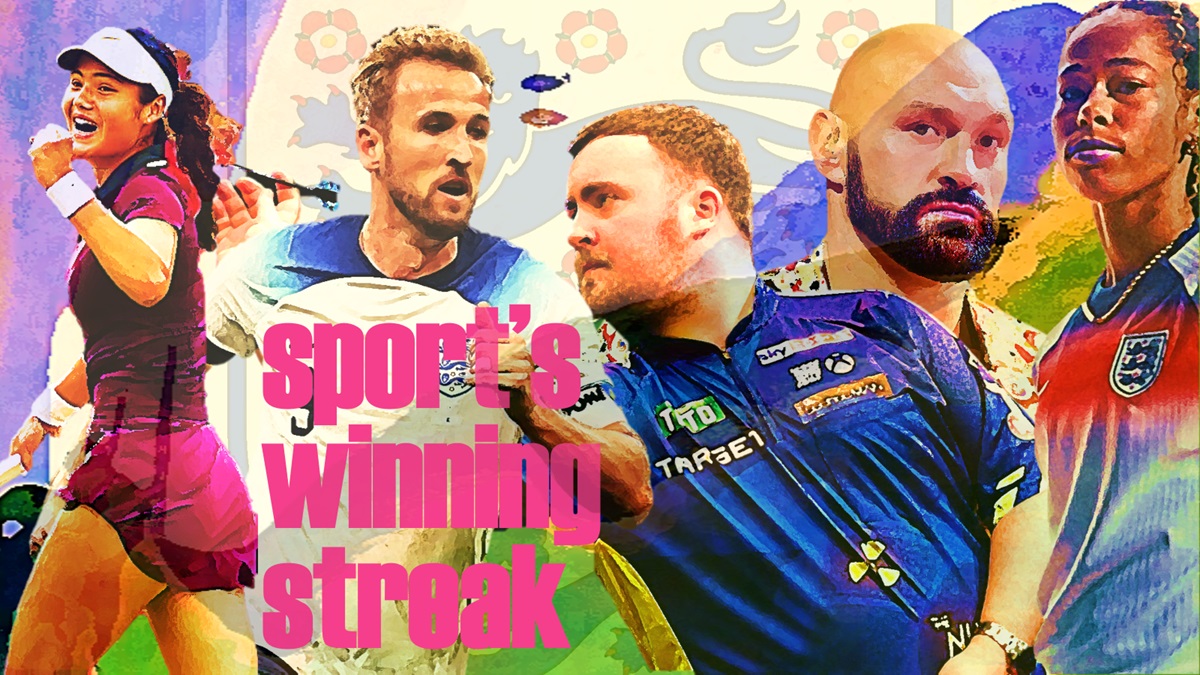
The irony with this recourse to nostalgia is that British sport, unlike say our politics or our economy, has actually had a good decade. Great Britain continues to be pretty good at games (at least as judged by Olympic performances), while England’s football teams have had an unprecedented run of success: two men’s Euro finals, a World Cup semi-final, two Euro Under-21 titles, two Women’s Euro titles and a run to the Women’s World Cup final.
Attendances for domestic men’s football have been growing, despite an interruption for covid, with the largest percentage increases at lower levels – and that’s without considering the boom in women’s soccer, where a decade ago a 2,000 crowd for a top-flight game between Notts County and Liverpool was considered a real breakthrough.
There have been similar stories across disciplines as diverse as golf, netball and cricket, with not far off an aggregate of 80 million people estimated to be going to watch sport in 2025 compared to around 70 million in 2015; this despite inflation in ticket prices well outstripping even the overall increase in the cost of living during the last decade.

Oddly (or perhaps entirely appropriately) a subject I first addressed in 2015 then next revisited in 2025 has enjoyed especially good fortune: darts. (These two pieces are alone in the Lion & Unicorn archive in deploying the phrase ‘slate tycoon‘.) The initial article explained why at the time there were two rival world championships in a sport which, despite having recovered from its near-death experience in the 1990s, had not yet returned to the mainstream it had briefly pierced in the 1980s.
Ten years on, after a boom in attendances and media coverage that made darts pretty much Exhibit A in the case for Britain’s recent sporting explosion, there was no need to add to the column inches now dedicated to chronicling how the game’s renaissance had transpired. Instead I revisited the long-defunct tournament that had fuelled darts’ initial foray into the public consciousness; a championship whose namesake, the News of the World, was no longer in the position to devote a column in any unit of measurement to the arrows, or to anything else. (I also noted how that competition’s roll of honour served as an obituary section for pub culture.)
The other uncanny connection between the birth of Lion & Unicorn and the increased sportification of British culture is that our inaugural article appeared on 2 August 2015, one day after the first Women’s FA Cup final to be played at Wembley. The 30,000 crowd and two million-ish television audience were considered game-changing for domestic women’s football; ten years on, they would be huge disappointments for a sport that can now pack the biggest stadiums and provide British TV’s largest audiences of the year, the players more famous even than darts champions.
Whether a nation losing itself in sport is a good thing is open to question – after all, East Germany punched above its weight in that world. Indeed, the UK took a leaf out of the GDR’s book when National Lottery funding made Team GB into an Olympic force, more than £300 million in annual payments purchasing a trove of medals even as community sport facilities disappeared.

Of course, Great Britain did not suddenly discover sport in 2015 as a response to the twin shocks of the Conservative election victory and Jeremy Clarkson’s sacking from Top Gear. As far back as 2005, Tony Benn was complaining: ‘The real English nature is sport rather than politics’ (when the former BBC tennis commentator was dismayed to find ‘everybody’ at that year’s TUC Congress was more interested in watching the conclusion of the Ashes than in following the debates).
But in the thirty-five years up to 1998, only three times had the most-watched British television broadcast of the year been a sports event: the 1966 World Cup final, the 1971 Muhammad Ali-Joe Frazier fight, and Torvill and Dean’s 1994 Olympic ice dance comeback. Since then sport (usually a major England football match) has topped the ratings on eight occasions, and even Sky Sports’ ever-rising subscription prices have not stopped their audiences soaring.
One reason is obvious. In a fractured media landscape, where little fiction is collectively read or watched on a scale sufficient to form a common culture, sport still has to be experienced live, and ideally not solitarily. In a time – as Leonard Cohen prophesised – when ‘nothing can be measured any more’, sport provides a metric; and a World Cup or Olympics can still unify. As a report last year by Enders Analysis stated: ‘In a world of personalised algorithms and subcultures, sport is one of few glues that bind us together.’
The in-person live experience survived and was even enhanced by the covid hiatus. Rather than breaking the habit of sports attendance, the lockdowns created a yearning for the stadium atmosphere; for many watching on a screen was maybe a complement, but not a satisfactory alternative. The growth in women’s professional sport has contributed to this, adding a younger and unsurprisingly more female audience.
Like TalkSport, I spent much of the pandemic mining the sporting past. My match reports on the stopping and starting of play in 2020 drew explicit parallels with sport’s suspensions during the two world wars. It should be remembered that following an early post-covid-style boom in attendances after WW2, the 1950s saw the start of a decades-long slump – a reminder to those running sport today not to take their paying customers for granted.
Elsewhere, the present was also catching up with the past. During the 2016 Olympics, I celebrated the sole previous cricket match at the Games, in 1900, when a future music hall star captained the gold-medallists. The sport was then dropped for the 1904 St Louis Olympics, but in 2023 it was announced that cricket would return in 2028, in Los Angeles.
Darts’ rise since 2015 is in many ways even more unlikely than cricketers competing for Olympic medals in the USA. But some things sadly haven’t changed during Lion & Unicorn‘s first decade: still no footballer has chosen, like Jimmy Hill, to describe a chapter of their autobiography as ‘a mixture of fun, superstition and odd little items in this book, rather like the frills on a petticoat’. I’ll update you in 2035.
see also:
Discover more from Lion & Unicorn
Subscribe to get the latest posts sent to your email.

Pingback: Blowing the whistle on football | Lion & Unicorn