
SIMON MATTHEWS watches Peter Howitt’s 2003 spy spoof, Johnny English.
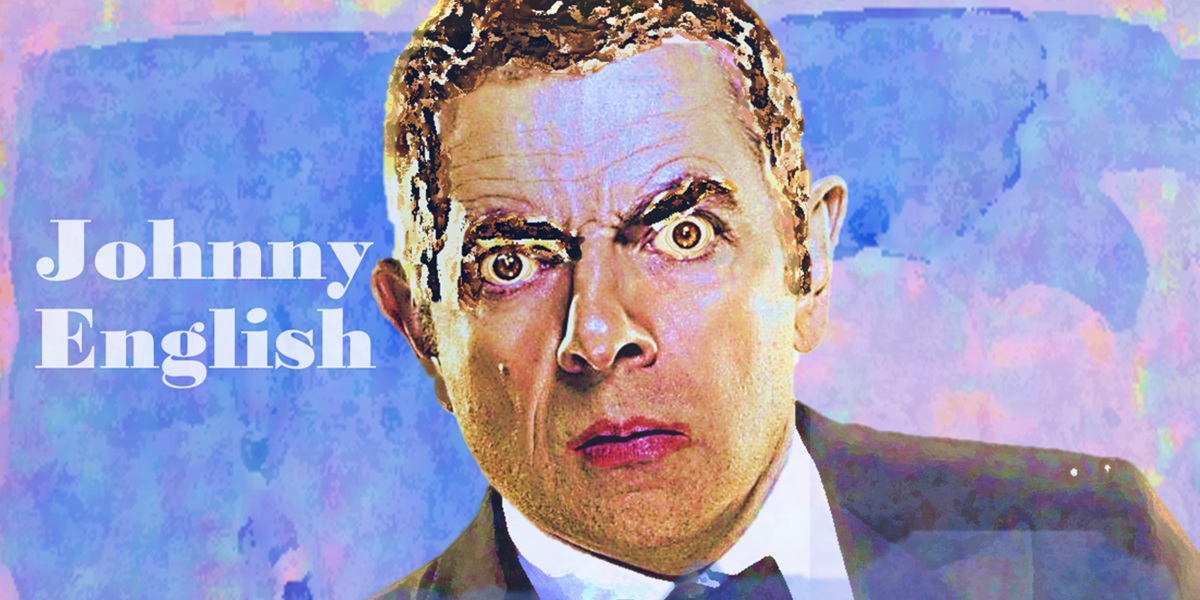
What do you get when you combine James Bond, Inspector Clouseau and the Comic Strip? Quite possibly the 2003 film Johnny English, which combines the key ingredients of all three.
From Bond it borrows the super-villain against whom the hero battles as well as a glamorous female foil who may, or may not, be pursuing the same objectives. Clouseau provides it with its relentlessly comedic tone, rather than the knowing asides, action scenes and vague satire that permeate Bond. There is also a lot of faux 1960s music, reminiscent of A Shot in the Dark (1964) and Casino Royale (1967). English, like Peter Sellers’s Clouseau, is a bumbling, inept, character and like Clouseau has an annoyed sidekick, Boff.
Finally, both English and Boff are played by popular TV comedians. English by Rowan Atkinson and Boff by Ben Miller. Atkinson, has been familiar for over 40 years now, ever since his early success in Not the Nine O’ Clock News (1979); Miller came to prominence on Channel 4 somewhat later with Armstrong and Miller.
All this is clear within ten minutes of the opening scenes. The main title theme – a big, curiously dated, pop ballad – is done by Robbie Williams, no less. Numerous shots of stately homes, the Tower of London and the crown jewels follow. With a screenplay by Neil Purvis and Robert Wade, who wrote two of Pierce Brosnan’s 007 outings (The World is Not Enough and Die Another Day) one wonders, for a moment, whether this might not steer through the same territory, but we soon settle into parody with the introduction of a very twitchy Atkinson as MI7 secret agent Johnny English and Natalie Imbruglia, his Interpol foil.

The producers are Tim Bevan and Eric Fellner who came to prominence in the 1980s with My Beautiful Laundrette and Sid and Nancy respectively. Getting together as Working Title, their subsequent work has included Bean, with Atkinson in the title role, Bridget Jones’s Diary, with Renee Zellweger, and Ali G Inda House with Sacha Baron Cohen, another TV comic. The first two did astonishingly well, the last made only a small profit. Bean generated a sequel; Bridget Jones’s Diary started a lucrative franchise and was co-produced with Studio Canal who do similar here.
As for motive, surely the only reason anyone would make a film like this is to make money. Lots of it. That, and for the script writers, a bit of light relief from the ice-cold calculations of the Bond franchise. Purvis and Wade went on to script all five of Daniel Craig’s appearances as 007, and like these, Johnny English retains a wisp of a politically relevant plot. In this case a desire by French super-villain, and private prison operator, Pascal Sauvage – John Malkovich, excellent as always – to turn the UK into a gigantic offshore incarceration centre for the world’s worst criminals. The politicians lap this up: Sauvage, after all runs a massive, highly successful corporation, with its HQ in Canary Wharf, and seems unstoppable. It turns out that he is also a descendant of James II and the Stuart pretender to the UK throne.
The notion that successful (for which read unscrupulous) businessmen must be allowed carte-blanche because they possess ‘unique capabilities’ that the rest of us lack certainly runs through modern politics. Even the latter idea, a Stuart restoration, briefly flickered into life when Scottish independence looked likely – Alex Salmond memorably stating that he would recommend Scotland remain a monarchy, but the Scottish Parliament would decide to whom the Crown would be offered.
Both raise interesting premises, but the plot here soon tumbles into farce. The Queen abdicates, a coronation (of Sauvage) is organised, and after some mumbo-jumbo with the Archbishop of Canterbury, English saves the day. It runs 88 minutes and doesn’t overstay its welcome. Peter Howitt is listed as director, but there’s no great auteurism on display. Instead, everything chugs along efficiently, rather like painting by numbers. Unsurprisingly, accountancy trumps everything.
Johnny English made a profit of $121m and two sequels, Johnny English Reborn (2011) and Johnny English Strikes Again (2018) did similarly well. A fourth film is on its way. With its simple comedy and gentle guying of British (or is that English?) attitudes, it should please adolescents and overseas audiences everywhere. But the proliferation of films like this – ongoing franchises – at the expense of original drama has changed the nature of cinema greatly in the last couple of decades.
from the maker of:

see also:


Discover more from Lion & Unicorn
Subscribe to get the latest posts sent to your email.
