…and a half-dozen of the other. In an act of pure self-indulgence, I’m marking the tenth anniversary of Lion & Unicorn with a selection of twelve of my own pieces, ones that I’m still happy with.
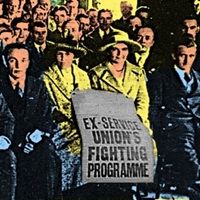
‘The most degrading and bestial business in the world’ (2015)
Part of the point of creating this site, as I saw it, was to pursue stories that didn’t fit elsewhere. I wrote about the National Union of Ex-Servicemen in my book The Last Post, and they turn up again in my forthcoming A Shellshocked Nation, but there wasn’t space in either to get into much detail.
And I wanted some detail, because I find the NUX really interesting. They were formed after the First World War, a militant group of ex-soldiers – 300,000 of them, at their peak – who were inspired by the Russian Revolution and the Irish War of Independence, and who scared the life out of the political establishment. So I wrote about them at greater length than was possible elsewhere. In particular, I wanted to do my bit to keep alive the memory of Ernest Mander, the general secretary of the NUX, an often overlooked figure with a perspective worth hearing:
‘If every ex-soldier would tell his own children the truth, the whole truth, about war, the war-spirit would be stamped out for ever.’

Uncle Bill and his sticky buns (2015)
For the vast majority of people, the name of ‘Uncle’ Bill Mitchell never meant a thing. But if you were a child of the British Army on the Rhine in the 1960s and 70s, it might well evoke half-forgotten memories of the man who dominated children’s broadcasting on BFBS radio in those years. I was one of those children, and I even met the man himself. So when a website began to post recordings of the stories he wrote and told, his tales from Big Wood, I was tremendously excited.
This piece is about Uncle Bill, but it’s more an account of his work – derived from A. A. Milne and Kenneth Grahame, but far more class-conscious. He was never in the front rank of children’s writers, but he does deserve to be remembered, and I believe this is the only consideration of his stories that exists.

After the Referendum: a long month in politics (2016)
Sometimes things go very strange. Diana Week in 1997, for example – it’s hard even for those who were there to recapture the mood of the nation. And it felt to me that the atmosphere in the immediate aftermath of the Brexit referendum in 2016 was a bit odd as well. So I decided to keep a diary of the month that followed the declaration of the result.
These were the weeks that saw the departure from Downing Street of David Cameron, replaced by Theresa May; an attempted coup by the Parliamentary Labour Party against the leadership of Jeremy Corbyn; the publication of the Chilcot Report on the Iraq War; the removal of the England football team from the European Championship by Iceland, with Roy Hodgson replaced as manager by Sam Allardyce… and much, much more. It was chaotic.
I concluded this piece of instant history by saying ‘it felt like a soap opera that had been given notice of its cancellation and was desperately trying to tie up every narrative thread at once’.

Imperial fiction: The Four Feathers (2017)
As a child, I read a good deal of old adventure stories, the likes of H. G. Wells, Rider Haggard, John Buchan and – particularly – Arthur Conan Doyle, the man who’s been the greatest cultural presence in my life. I still like all this stuff a great deal.
This piece on A. E. W. Mason’s The Four Feathers (1902) was the first entry in a series that I collectively (and loosely) titled Imperial Fiction, and that has since run to around 100,000 words. The best entries, I think, are on my old favourites, Buchan’s Richard Hannay and Conan Doyle’s Brigadier Gerard, but this is the first, so it’s the one I’m highlighting.
On a personal level, I submitted some of these pieces as part of my application for the post of Senior Lecturer in Cultural and Literary History at the University of Chichester. I got the job, which endears me to the series still further.

Eddie Amoo: Man Without a Face (2018)
In 1995-96 I worked on a book about 1970s pop music. It never got published, but I had a wonderful time interviewing dozens of those who were involved, not just stars, but also writers, producers, engineers and session players.
Among them was Eddie Amoo, who sang with the Chants and then the Real Thing. At his first gig, the Beatles were his backing band, and thirteen years later he had his first hit. It was an extraordinary career that I think is less celebrated than it should be.
So when he died, I transcribed my talk with him, and posted some of his unedited comments. I did the same with Les McKeown of the Bay City Rollers when he died in 2021.

Revive 45 (2019)
Those interviews with 1970s pop stars were also the basis of a series I started in January 2019, looking back at the charts of 45 years earlier. This episode looked at the top 10 in May 1974, when Sparks had their first appearance on Top of the Pops cancelled, due to violation of union regulations (after all, this was the 1970s), which gave the Rubettes their big opportunity. That story is told here with contributions from Wayne Bickerton, Russell Mael and Alan Williams. There’s also Mike Batt on the critical ridicule directed at the Wombles.
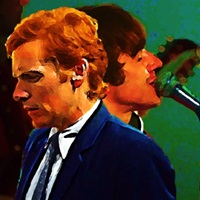
Rockin’ the Detectives (2020)
We all had our own experiences of the Plague Year 2020. Mine was dominated by the loss of my parents. My dad’s funeral was a few days before the first Covid lockdown, my mum’s a few weeks in. The contrast was striking. The disruption of death was exacerbated by the government’s regulations of the time.
As light relief, I began comfort-watching old TV shows. And out of that emerged this piece, a mini-pedia listing fictional pop acts in British TV detective shows. At the last count, there were forty-five entries. It’s an absurd folly, but it’s one of my favourite things I’ve ever written.

The Devil’s Arse (2021)
Last year was the twentieth anniversary of my book on the Biba fashion boutique. So I assumed that the publisher would be bringing out an expanded boxed-set edition, with a stash of extras: my original proposal, early drafts, alternate takes, author’s commentary etc. But it turned out that books don’t get the same treatment as rock albums.
Inevitably, though, there are outtakes from a book, a whole load of stuff that doesn’t fit into the published book. In the absence of the commemorative edition, I’ve taken to putting some of this material online. This piece rounds up some bits that didn’t make the cut for All in It Together, examples of linguistic controversy in the early part of the current century, featuring Patrick Mercer, John Terry and the Devil’s Arse cave system. There’s also discussion of quite what Paul McCartney meant when he called David Blaine ‘a stupid ****’.
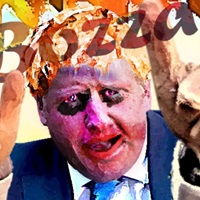
Boris Johnson: an obituary (2022)
This is an occasional series that just pre-dates Lion & Unicorn. On the day that Labour lost the 2015 election, I wrote a piece elsewhere about Ed Milband’s catastrophic leadership of the Labour Party, and titled it ‘An Obituary’.
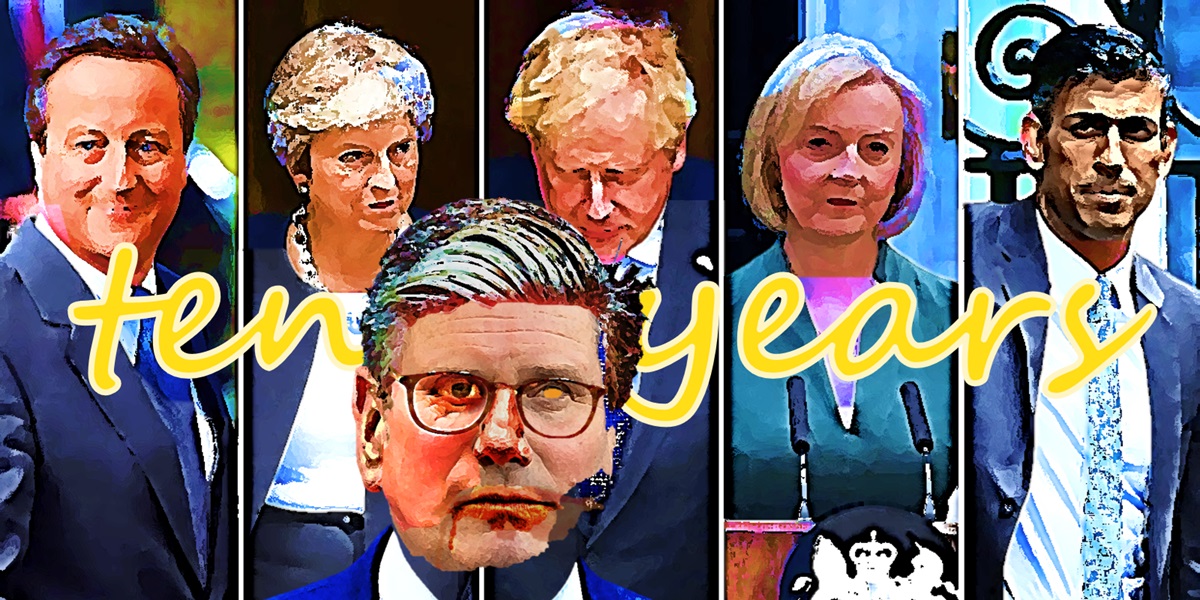
I returned to the format for retiring prime ministers: David Cameron, Liz Truss and Rishi Sunak. (I don’t recall why Theresa May wasn’t accorded this honour.) I’ve chosen here my interim assessment of Boris Johnson’s premiership, largely because it is interim. I wrote then – and still believe – that ‘his future reputation depends on how some truly momentous events play out: Brexit, the future of the European Union and of our own Union, the position of Russia in the world’.

Time takes a cigarette (2023)
Being at a loose end on the Spring Bank Holiday in 2023, I started reflecting on my own decades-long addiction to nicotine, and the cigarette brands I used to favour. It was intended as a jokey little throwaway, but the more I wrote, the more it became a rumination on a lost world when cigarettes were part of the cultural landscape. It ended up running to 3,500 words, becoming one of the most-read pieces here, and winning an award from the pro-smoker group Forest as Best Essay of the Year.
There used to be a fashion for writing autobiographies filtered through a single passion, Nick Hornby’s Fever Pitch (1992) setting the standard for Robert Elms’s The Way We Wore, John O’Farrell’s Things Can Only Get Better, Giles Smith’s Lost in Music etc. This is my version.
Later in 2023, I wrote a piece for UnHerd on the political history of the anti-smoking campaign.

‘Cathedrals are cathedrals’: the first 25 years of Talk Sport (2024)
I listen to a lot of TalkSport radio. Not all of it, of course – I have no desire to hear Alan Brazil or Andy Goldstein – but more than I probably should. My rational defence is that there’s a good deal to learn from observing which news stories filter through to a station that has no interest in the news. Mostly, though, I listen because it’s good aural wallpaper: whole hours can pass without me noticing a word that they’ve said.
Despite which, this is a successful radio station and one that attracts very little attention. Gillian Reynolds, the best of all radio critics, used to write about it a bit, but few others. To fill this gap, I wrote a history of its first quarter-century, from the Talk Radio days of Tommy Boyd, David Starkey and Caesar the Geezer, through its rebranding as TalkSport and up to Covid, when it was – paradoxically – at its peak: with no live sport to cover, it retreated into nostalgia and quizzes.
The title, incidentally, is a characteristically defiant and daft declaration by Mike ‘Porky’ Parry: ‘I think cathedrals are cathedrals.’

The Death of Fiction (2025)
I claim to be a cultural historian, but it’s become increasingly clear to me in the last few years that what I write and teach about is not just the culture of the past, but the passing of culture as a shared enterprise. The tenth anniversary of Lion & Unicorn prompted me to try to formulate this thought. It really needs much greater length to explore fully, but in essence the point is that mass culture was created by technology in the 20th century, and is now dying at the hand of technology. And as it dies, so too does the common fictional framework that has been integral to a stable society. One of the modules I teach is titled From Music Hall to Social Media – and that’s what this short essay is about.
see also:
Discover more from Lion & Unicorn
Subscribe to get the latest posts sent to your email.
