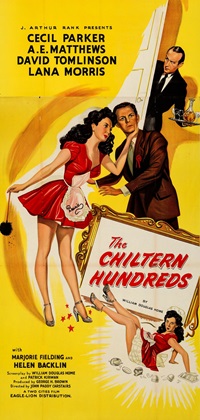
SIMON MATTHEWS watches John Paddy Carstairs’s political comedy The Chiltern Hundreds (1949).
The political film. Discuss. Does the UK do them? A few come to mind; Left, Right and Centre (Ian Carmichael fighting a bye-election) and No Love for Johnnie (Labour MP Peter Finch conforms to ascend the greasy pole) are both of interest. The latter written by Wilfred Fienburgh, one of Jeremy Corbyn’s predecessors in Islington North, with its portrayal of frustration, late night drinking, affairs and no confidence votes still resonates today.
The 1980s brought various bleak parables (Defence of the Realm in particular) and recently there have been a slew of historical dramas about Winston Churchill, but for the most part the British political film avoids real-life characters and actual events.
One exception – possibly the only one – is William Douglas-Home’s The Chiltern Hundreds, adapted in 1949 from his astonishingly successful play staged a couple of years earlier. Set against the Labour landslide of 1945, with its tearful humiliation of the governing class and accompanying, but rather temporary, sniff of revolution, it opens in Brussels in May 1945. With peace just declared a young officer, Lord Tony, tries to wangle some leave so that he can confirm his engagement to his sweetheart. An irate CO refuses, but our hero, played by David Tomlinson with a permanent look of horrified disbelief on his face as he stumbles through events, persists. It’s pointed out that if he stands as a Parliamentary candidate, he gets automatic release from his duties.
He does so, as a Conservative, naturally, and returns to a stately home in rural England, happy that this scam brings him closer to his fiancée. Here he meets his father, the Earl – played by A. E. Matthews as an irascible, open character – attended by Cecil Parker as the family butler, sharp witted, lower class, and loyal to the system. Lord Tony is of course modelled on William Douglas-Home himself, who took leave of absence from the army of three occasions to fight by-elections as an Independent Progressive. Arguing for a negotiated peace with Germany, he came close to winning one (Windsor, June 1942).
The arguments that Douglas-Home made then – basically, a continuation of 1930s appeasement, with jaw-jaw better than war-war with the Nazi regime, however repulsive some may have thought it – are absent here, where a light touch approach to politics is used. Come polling day the inept Lord Tony is knocked aside by the hitherto loyal locals who elect Cleghorn, the Labour candidate, in the ensuing landslide. Much amusement is had at the Conservative defeat, reflecting, one suspects, Douglas-Home’s personal dislike of Churchill.
A glum Lord Tony prepares to return to his regiment, regretting the costs incurred in standing, said to be £800, about £70k today. (An interesting statistic. In fact, a candidate’s deposit in 1945 was £150, equal to £13k now. Perhaps the balance was printing, publicity, and transport). A portrait is painted of an impoverished aristocracy, clinging to their way of life whilst power and influence recedes from them.
The Earl decides to make the best of it. Cleghorn is invited to supper at the stately home. In a scene that surely had theatre audiences chuckling in 1947, he takes a call from Clement Attlee in the drawing room. Attlee offers him the Dominions Office and a peerage, thus causing a by-election. Events now take a preposterous turn, with Cleghorn suggesting that Lord Tony – who isn’t such a bad chap, after all – change parties and stand as the Labour candidate. Lord Tony agrees. He also switches his romantic interest from his fiancée to the house maid. This political and personal flexibility leads us into French farce territory, a feeling that is exacerbated when the butler, outraged at Lord Tony’s disloyalty to his class, decides to contest the seat as a Conservative.
The election generates much media interest and goes to multiple recounts. The butler wins by thirty votes, and, having made his point, immediately applies for the Chiltern Hundreds, thus causing another by-election.
Verbose, and with an intelligent script, the plot is amusing, if unlikely. Beneath the surface, though, Douglas-Home’s view of politics is clearly cynical and reactionary. The Earl, whatever his eccentricities – and Matthews does sterling work displaying these – is a decent figure representing the reliable permanence of a patrician aristocracy. Cleghorn is shifty, reflecting the trimming of popular democracy. The butler understands this and does the right thing. Lord Tony is a mere bumbling innocent. The plot ends with the English class system and way of life secure.
The film, trimmed down to an efficient 84 minutes, appeared in September 1949. Director John Paddy Carstairs, who later worked on many of Norman Wisdom’s comedies, moves everything along at a good pace. It’s a good example of Douglas-Home’s work and typical of the material he produced for the rest of his career: cut glass, drawing room comedies, like The Reluctant Debutante (1955), set amidst the well-to-do.

For many years The Chiltern Hundreds remained a quaint artefact, shot in black and white with vaguely remembered actors. A relic of a vanished England. Interestingly, it was revived in the wake of the 1997 Labour landslide, perhaps on the basis that the theatre-going public in the West End needed a dose of comedy to cope with this. Staged at the Vaudeville Theatre on the Strand, it had a respectable run 1999–2000. Edward Fox appeared as the Earl (the critics opining ‘he produces some marvellous facial features that are wonderful and funny’ and ‘his timing is as impeccable as his drawl is preposterous’) but at 130 minutes, and an interval, most thought it overlong.
The film, allowing for its slightly dated foibles, may be better. One wonders if, in the event of a Reform wipe-out circa 2028, audiences of traumatised Labour and Conservative voters will be treated to another production.
from the maker of:
see also:



Discover more from Lion & Unicorn
Subscribe to get the latest posts sent to your email.
