
SIMON MATTHEWS on Kevin Macdonald’s 2011 film The Eagle.
Gladiator was one of the biggest cinema successes of the new millennium, making a profit of $350m and winning five Academy Awards. It made laudable, though not entirely successful, attempts at achieving historical accuracy and featured a distinguished ensemble cast, bulked out with UK actors to give it some ballast. Led by Derek Jacobi, who remains with us at the time of writing, it was notable for providing Oliver Reed with his final role, as well as late career appearances by Richard Harris and David Hemmings. Big, noisy, with huge sets and elaborate recreations of battle scenes, it confirmed an ongoing public appetite for immense spectacles set in the classical world.
By 2007 repetitions of the same formula had given audiences Troy, Alexander and 300, all of which had British thespians scattered across them: Peter O’Toole, Julie Christie, Sean Bean, Anthony Hopkins, Christopher Plummer, Brian Blessed, Dominic West. The results were variable. Troy was critically panned, but turned a profit of $290m, Alexander was reckoned historically accurate, but barely broke even, and 300, based on a comic book, made its producers $390m. Disputes about national stereotypes also began appearing, the Greeks objecting to their portrayal in Alexander (it was too gay) and the Iranians to 300 (they were too cruel).
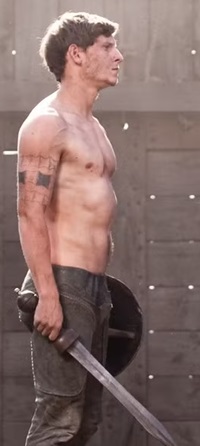
Inevitably, a UK equivalent was explored, and 2004 brought King Arthur which starred Clive Owen and re-imagined late Roman Britain with quirky, possibly accurate, historical details: the famous ‘knights’ are the remains of a Sarmatian cavalry regiment. Filmed in Ireland, where a replica of Hadrian’s Wall was built(!), it made a tidy profit of $80m.
It was hardly surprising, with this kind of money to be made, that anyone searching for source material for adaptation would gravitate toward the work of Rosemary Sutcliff. Emerging as a key author in the early 1950s, alongside Henry Treece and Geoffrey Trease (Leon Garfield came a little later), she led a boom in serious young adult fiction. Dropping the classist and racist stereotypes that peppered previous writing of this type, her plots were meticulously researched, often non-judgemental and avoided romantic episodes. Her narratives allowed readers to understand events in history, and the context within which they occurred.
She wrote for adults too – including a study of Kipling – and was particularly interested with post-Imperial Rome, its collapse and Britain as an isolated peripheral country. Possibly the best known of her forty-six books of historical fiction, The Eagle of the Ninth appeared in 1954 and was followed by no less than six sequels. Partly set in Silchester, a large completely abandoned Roman walled city in Berkshire (how fascinating is that? Most lost cities are in remote parts of the world, not Berkshire), it explores the fate of the IX Legion, which seems to have vanished from the historical record when serving in early second-century Britain. Academic opinion is divided on this, one theory being that it was massacred when attempting to suppress a revolt in Caledonia (Scotland).
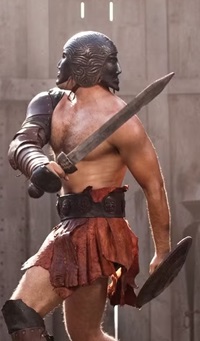
The book was an immense success and adapted for radio as early as 1956. A BBC TV series, with Anthony Higgins, followed in 1977. Post-Gladiator, Channel 4 came knocking in 2010, as co-producers of a feature film version, budgeted at $25m. Which was fantastic for anything made in the UK, but barely 15 per cent of the outlay for Troy or Alexander. We’re not talking about blockbusters here. It was also a brave decision by Channel 4, given that two other films about the IX Legion – Dino di Laurentiis’s The Last Legion (2007) and the UK Film Council’s Centurion (2010) – had been and gone. Both lost money.
With its title shortened to The Eagle, Kevin MacDonald was brought in to direct. The grandson of Emeric Pressburger, and steeped in film history – he’d done a documentary about Donald Cammell – he was a good choice, with an eclectic set of quality credits. The script, by Jeremy Brock, who’d worked alongside MacDonald on their big 2006 hit The Last King of Scotland was a good distillation of the novel.
To give it transatlantic appeal, the leading role of Marcus Flavius, an injured convalescing soldier whose father disappeared with IX Legion, went to US actor Channing Tatum. The plot is very simple. Marcus Flavius Aquila has flashbacks to his father’s departure and demise twenty-odd years earlier. The loss of the IX Legion’s battle standard (‘the Eagle’) is reckoned a disgrace, and he wants to do whatever he can to reverse this.
Whilst staying with his uncle (Donald Sutherland, fine, as ever), he rescues a British slave, Esca (Jamie Bell), from a one-sided duel in the Silchester arena. A decade on from winning a BAFTA for Billy Elliott, Bell’s intervening years had seen him chipping away at a variety of parts, finally enjoying a substantial hit with the 2008 sci-fi drama Jumper. Here he plays a Celtic noble, reduced to servitude. Marcus uses him as a guide when returning to Caledonia in search of news about his father.
The north is brutal. Cold and wet, with blizzards. An empty, harsh, primordial landscape. The long trek through it by the duo is reminiscent of scenes from The Lord of the Rings, written of course at around the same time as Sutcliff’s book. (As were much of C. S. Lewis’s The Chronicles of Narnia and Mervyn Peake’s Gormenghast series.) By chance, they encounter Guern (Mark Strong, unrecognisable behind facial hair), who turns out to be a survivor of the IX Legion. He gives them details of its destruction twenty years earlier. It turns out that he and some of his colleagues either got away, or were allowed to settle. They intermarried and became farmers. As with everything in Sutcliff’s work, it’s an interesting detail, and one that remains topical: DNA analysis of ancient graves often throws up such anomalies; people who are ‘out of place’.
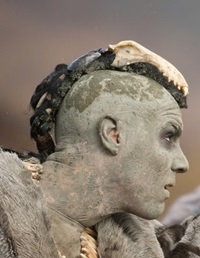
Marcus and Esca press on. Finally, somewhere amidst the Highlands and Islands they encounter the Seal people. Presumably meant to be Picts, about whom we know little, they look like anti-poll tax protesters, covered in a kind of luminescent yellow-green skin pigment (woad?), sporting Mohicans and with a taste for hallucinogenic home brew. Again, it’s historically accurate: their hunting parties – as shown here, a long stream of running men and youths accompanied by greyhound dogs – are attested to by several accounts and stone inscriptions. Their settlement is also rendered very effectively, with torchlight processions and ritual war dances that make this section of the film resemble the classic UK folk-horror The Wicker Man.
At this point, the lost standard is brandished. Marcus and Esca manage to wrest control of it and escape, with the Seal people in pursuit. Run to ground they are rescued by some survivors of the IX Legion, rustled up by Guern, and eventually fight their way back to Roman Britain where ‘the eagle’ is delivered to astonished administrators in Londinium.
It’s a very competently made film, with an interesting Scandinavian connection. The music, from Atli Ovarsson, an Icelandic composer, is effective and the photography, by Anthony Dod Mantle, exceptional. Mantle began his career in Denmark, before rocketing to fame with 28 Days Later and Slumdog Millionaire, for which he won an Academy Award.
Released in February 2011, the plot is wrapped up in an anti-imperialist message. The Romans speak with US accents. They are conquerors, and ‘the eagle’ can clearly be seen as a symbol of US power. (As indeed it is in real life). The Brits are subservient. As the film progresses it flattens out into a Tatum-Bell US-UK bromance buddy movie. The plucky little Brit helping the well-meaning Yank recover his honour, whilst getting to understand the local people better.
Was this an intentional selling point? The ending itself is solemn, heroic. Almost as if we are expecting a sequel. On its release The Eagle recorded a profit of $13m, excellent for Channel 4, but no one in Hollywood gets out of bed for that anymore.

No other Sutcliff adaptations are planned at present it would seem. Which is a shame, because The Lantern Bearers, a 1959 sequel to The Eagle of the Ninth has a particularly fascinating plot: Britain in the early fifth century, coping with being set adrift from the Western Roman Empire. But hardly the stuff of a noisy, surround-sound, blockbuster.
see also:


Discover more from Lion & Unicorn
Subscribe to get the latest posts sent to your email.
