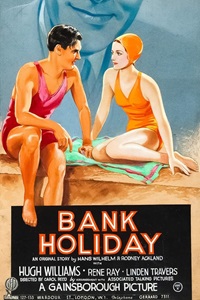
SIMON MATTHEWS on Carol Reed’s 1938 film Bank Holiday.
The career of Carol Reed lasted from the 1930s to the 70s, with claims being made when he hit his peak with The Third Man, that he might just be the best UK director of all time. He certainly won awards – BAFTAs and Oscars – as well as turning out many fine films that were highly rated by his peers. Who remembers now that A Kid for Two Farthings was nominated for the Palme D’Or at Cannes in 1955?
Early on he was consistently praised by Graham Greene. Hence their later fruitful collaborations. Greene enjoyed a major commercial breakthrough in 1938 with Brighton Rock, much of which takes place during a bank holiday weekend at Brighton. It is tempting to think that he appreciated the dramatic possibilities of this setting after watching Bank Holiday, Reed’s fifth film, which appeared in January that year.
A black-and-white Gainsborough production, it opens with shots of a newspaper hoarding that proclaims ‘War Clouds Over Europe’. Given that filming took place in the summer of 1937, when Hitler was for the most part dormant, this is possibly a reference to the Spanish Civil War. Its inclusion highlights the difference between ‘the Continent’ – synonymous with confusion and unpredictable politics – and the UK, a stable country where everyone is determined to make the most of a couple of days off work. Unfolding as a portmanteau of how various lives interconnect on a typical Bank Holiday, we see newsreel footage of huge crowds getting away from London. Coaches, cyclists, and trains hurtle toward the coast.

One man can’t join them: Stephen Howard, a respectable middle-class professional whose wife is having a baby. Cue hospital scenes, and the introduction of Catherine, an attractive young nurse. Sadly, Howard’s wife has a rare condition, and dies in the operating theatre. Although the child survives Howard is left to make his way home alone. He seems to be some type of research scientist: a room in his smart modern mansion flat is kitted out with test tubes and Bunsen burners. The actor who plays him, John Lodge, was an established US star and does well in the part, with no discernible American accent. After a final film appearance in 1940, as Archduke Franz Ferdinand (which also riffed on tragedy), he quit acting and became a proto-Reagan, serving as a Republican senator and diplomat.
Meanwhile, Catherine, played by Margaret Lockwood, prepares for a weekend away at a coastal hotel with her boyfriend. Lockwood, described by one biographer as being a typical south-London bred suburban tennis-club habitué, was one of the highest paid UK actresses of the day, and on the evidence of this outing, an accomplished performer. Haunted by what she has seen, she joins the logjam of trippers at Waterloo Station.
Here the other characters are introduced. Among them are two women en route to a beauty pageant: Doreen (Miss Balham) and Milly, played by Rene Ray and Merle Tottenham respectively as aspirational, unintentionally comic, ‘common’ young women out to better themselves. They are closely followed by Miss Mayfair (Jeanne Stuart) who floats about looking glamorous in a variety of costumes, smiling, and winking at older men, several of whom end up chaperoning her. Her character has no dialogue, and seems to have been included as an in-joke. In real life, Stuart was the subject of famous divorce proceedings brought by her husband, Sir Bernard Docker, after she had been found by private detectives in flagrante with a young actor. Audiences in 1938 would have known this. (Stuart’s pursuit of a wealthy husband was most diligent, she ended up in Monte Carlo with Baron von Rothschild.)
A chaotic working-class family also supply comedic touches, with Kathleen Harrison as the harassed mother and Wally Patch as the father. Patch, noted for ‘character’ roles, is clearly some kind of manual worker and inclined toward fecklessness, being in and out of public bars leaving his family to wait patiently outside.
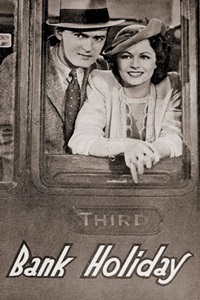
Collectively, they arrive at the unnamed resort, which is completely overwhelmed with trippers. Accommodation is booked to the limit and the take up of rooms in lodgings and bed and breakfasts so absolute that huge crowds sleep on the beach. A massive midnight fracas involving most of the cast ensues, with scenes that are almost Hogarthian and a reminder of how recently, in historical terms, people accepted very limited pleasures.
Catherine expects her beau to have sorted out a room at big swanky establishment. Alas he hasn’t. Clearly unmarried, though a ring is brandished, the scenes as they are rebuffed by the supercilious staff remind one of similar developments in George Orwell’s Keep the Aspidistra Flying (1936). In an interesting detail the hotel has a black bartender, but social class looms over everything. Doormen and bell-boys pander to the wealthy clientele and there are cringing scenes played as comedy. Like the other characters the two would-be lovers end up sleeping under the stars whilst trying to enjoy the lido and pier shows the following day.
By the time we reach the halfway point, it’s clear we are watching what used to be called ‘a woman’s picture’ with three interwoven plots: the nurse who feels increasingly awkward about her boyfriend and strangely attracted to the stricken husband; the participants in the beauty contest out to ensnare husband material; and the working-class wife and mother run ragged by her family responsibilities. One might almost call it a Mills & Boon-type story. Except that this was adapted by Rodney Ackland, an established playwright, from a story by German-Jewish émigré Hans Wilhelm whose pre-Hitler work included a film adaptation of Alfred Doblin’s classic novel Berlin-Alexanderplatz. By the standards of 1938, this was a very classy script.
The final stretch coalesces around Lockwood, with the action cutting between her change of heart about her boyfriend and Mr Howard’s lonely, suicidal vigil at home. There is a flashback sequence showing him and his wife amongst happy crowds at the 1935 Silver Jubilee. Lockwood decides to help him and hitchhikes back to London. (The boyfriend ends up with Miss Balham.) Along the way there is a mix up with the police, which introduces us to Wilfrid Lawson, as the desk sergeant at the local station. What a performance! Brilliantly understated and an excellent example of scene stealing, it demonstrates why he was regarded as one of the finest actors of his generation.
Howard is rescued. Presumably the baby is too, setting up Lockwood with a ready-made family in a fashionable mansion flat.

The fact that Reed’s reputation was enhanced by this film might seem curious today. But such judgements are relative, depending heavily on the context in which they are made. Quite simply he was better than his contemporaries. At 82 minutes long Bank Holiday has a lot of plot, and doesn’t sag dramatically. It remains an amusing snapshot of a vanished England.
see also:




Discover more from Lion & Unicorn
Subscribe to get the latest posts sent to your email.
