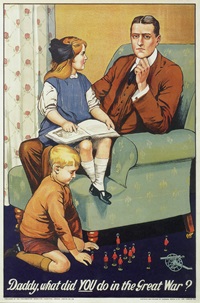
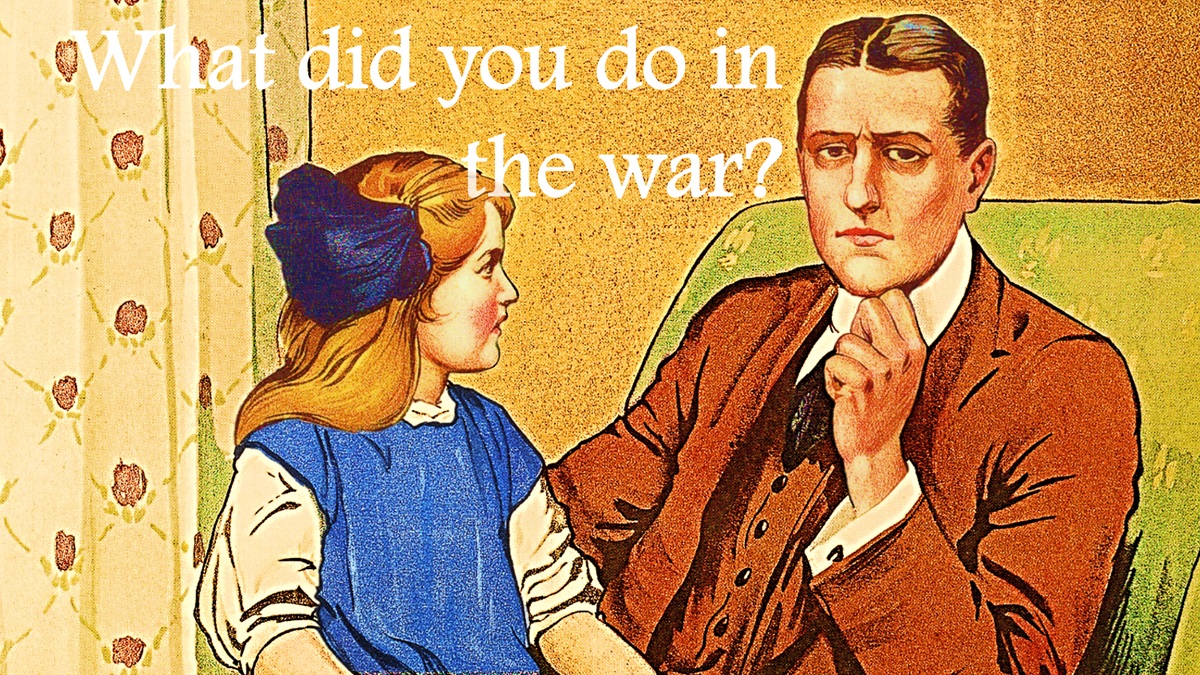
‘Daddy, what did YOU do in the Great War?’ asked a 1915 recruiting poster. Any child issuing a similar challenge in the 1960s or ‘70s knew what they wanted to hear: tales of derring-do, preferably involving Spitfires, or storming beaches, or parachuting into occupied territories.
Regrettably, however, not everyone who served in uniform had the kind of heroic storyline seen in the war comics of the time.
Spare a thought, then, for the men of the Royal Army Service Corps, doing the necessary but unglamorous work of supplying the tents, cookers, lamps, baths, laundry equipment necessary for conducting a war. Paint, as well. Armies always need paint, and towards the end of the war the RASC set up its own paint factory in Naples.
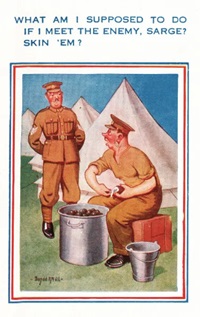
Then there was the Army Catering Corps, only established in 1941, and more often the butt of jokes than the recipients of praise. The 1980s Coronation Street character Percy Sugden used to get teased for bragging about his war service when in truth he’d only been a cook. But, as he said, ‘When you’ve made gravy under shell fire, you can do anything.’
Even without the enemy fire, the logistics were daunting. The corps was responsible for feeding soldiers wherever they were to be found, from remote anti-aircraft establishments in Britain to the massive concentration of troops in France after D-Day. Sourcing the food was part of the problem, particularly in North Africa where the front-line could move hundreds of miles in either direction in the space of days.
That was also an issue for the Royal Army Pay Corps, who had to pay out £50,000 a week in wages to soldiers in North Africa. Local money could never be counted on to retain its value; apart from inflationary fluctuations, it was frequently the target of enemy action, seeking to destabilise the local economy. So it became necessary to introduce a new currency, printing up British Military Authority notes that were declared legal tender wherever the army was currently in operation. (When the Americans arrived in North Africa, this was replaced by a joint currency, the Allied Military Lire.)
If cooks and wages-clerks didn’t get the respect they deserved, the Military Police were downright hated by much of the Army. Yet their contribution was also essential, responsible not merely for maintaining discipline and good relations between soldiers and civilians, but also for dealing with enemy prisoners and directing the traffic of refugees going in the opposite direction to the troops. As Field Marshal Montgomery said, ‘The Battle of Normandy and the subsequent battles would never have been won but for the work and cooperation of Provost on the traffic routes.’
Amid the regiments and corps of the British Army was a single unit that was called a department, the Royal Army Chaplains’ Department. It wasn’t a random linguistic anomaly, it reflected the fact that there are no Other Ranks; all padres are officers. And that mattered in the war, because all those taken prisoner by the Germans were automatically put in officers’ camps. It took a good deal of lobbying from within, and political pressure from home, before spiritual support was distributed more evenly amongst the stalags.
The chaplains moved with the troops. For the Normandy campaign, two three-tonner trucks were converted for use as mobile churches. In June 1944 Reverend J. Fraser McCluskey accompanied the SAS in a parachute drop near Dijon, taking with him the tools of his trade: altar-cloth, cross, hymnals, prayer books and communion vessels.
Also flying in unarmed were the Airborne Medical Services, which included 132 conscientious objectors; they arrived in combat areas via glider and parachute. Similarly there were 588 men from the Royal Army Medical Corps at Arnhem. Alongside them were the Army Dental Corps. They tend to get overlooked, as well, but there was one dentist for every 1,000 men in the Normandy landings, their primary task being jaw reconstruction for those injured by mines.
The RAMC, some 95,000 strong, treated five million cases during the course of the war. The worst was saved for last, with the final advance into Germany and the liberation of the camps, revealing the full evil of the Nazi regime. ‘Atrocious, horrible and utterly inhuman,’ said Colonel James Johnson, who was part of the medical team trying to care for the survivors at Belsen. Disease, malnutrition and ill-treatment meant that many were beyond saving, and more than 26,000 died in the camp after the liberation. ‘It was not a pleasant experience,’ remembered Dr Andrew Dossetor.
And finally, in this roll-call of the less celebrated units of the British Army, let us pay tribute to the Royal Army Veterinary Corps. Someone had to look after the horses of the 1st Cavalry Division in Palestine, the last mounted front-line troops in the British Army. And the guard dogs, messenger dogs and sniffer dogs. And the horses, mules and camels used in the East African campaign. There were animals in Sicily and Italy, as well; by the end of the war, the 8th Army had 7,300 horses on its strength.
The 1944 Chindits campaign – sending troops behind enemy lines in the jungles of Burma – included 250 bullocks, taken as food on the hoof, together with 500 horses and 3,000 mules for transport. Working in Japanese-held territory depended on remaining invisible to the enemy, and in the 1943 operation the braying of mules had on more than one occasion proved a danger to the troops; this time the vocal cords of the animals were cut.
So, what did you do during the war, daddy? Well, I slit the vocal cords of mules.
from the maker of:
Discover more from Lion & Unicorn
Subscribe to get the latest posts sent to your email.
