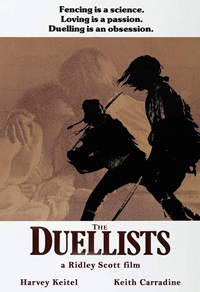
SIMMON MATTHEWS watches Ridley Scott’s 1977 film The Duellists.
They’re not going gentle into that dark night. The generation of film directors who emerged from TV and advertising in the 1960s are still with us, and working away. Peter Greenaway (aged 82), Mike Leigh (82) and Stephen Frears (83) all mere striplings to Ken Loach (88) and Ridley Scott (87). Loach’s reputation for having the most films entered in competition at Cannes, fifteen at the last count, is secure. But in commercial terms, with forty-five Academy Award nominations, and nine wins, Scott beats them all.
He must want more, because the International Movie Database lists eighteen projects in development, including five as director. At an age when polite questioning in a corner of a care home about the identity of the prime minister might be more likely, that’s quite a work load.
His life behind the camera began on 9 June 1965 with ‘Error of Judgement’, scripted by Alan Plater for Z-Cars. Three episodes of Adam Adamant Lives! followed, after which he swerved into the lucrative world of television commercials. By all accounts Ridley Scott Associates, which he ran with his brother Tony, cranked out hundreds of these, including classics of the genre for Wilkinson Sword, Maxwell House and, lest we forget, Hovis.
Money isn’t everything though, and in due course, artistic credibility beckoned. Both brothers wanted an entrée to mainstream cinema. After a proposed film with the Bee Gees collapsed (during their transition from delicate, whimsical pop to disco), they found it with a 1974 Henry James adaptation, L’Auteur de Beltraffio, co-produced by the BBC and French TV. A toss of the coin meant Tony directed it, but Ridley was up and running.
Its success led to French TV putting up $250,000 for a feature film. To keep costs at an acceptable level he chose material in the public domain. One option was The Gunpowder Plot, a big screen re-telling of the Guy Fawkes story, decked out with the period detail that was second nature for UK cinema. Written by Gerald Vaughan-Hughes, whose only other credit at that point was a semi-forgotten 1968 Dirk Bogarde espionage thriller Sebastian, not a single British studio would back it, citing Ridley’s lack of experience in anything other than TV commercials. As a fall back, he and Vaughan-Hughes selected Joseph Conrad’s 1908 novella, The Duel. The French were happy with this, and to secure matching funding David Puttnam, a fellow graduate from the world of advertising, was approached.
Pretty much the last man standing in the UK film industry at this point, Puttnam’s output between 1971 and 1976 included retro rock ’n’ roll hits like That’ll Be the Day, a Michael Moorcock adaptation, The Final Programme, and Ken Russell’s bombastic, but entertaining, classical music bio-pics, Mahler and Lisztomania. He thought both Scott’s projects worth a punt, and put the word out at the 1976 Cannes Film Festival, where he was promoting Bugsy Malone. David Picker, at Paramount was interested, and agreed to advance $1,500,000, for The Duel. After all, who cared about Guy Fawkes and the Fifth of November in the American mid-west?
For Paramount, backing a UK costume drama after the runaway success of Stanley Kubrick’s Barry Lyndon wasn’t a risky decision, but the budget remained limited. And the piper called the tune: Scott wanted Oliver Reed and Michael York for the leading roles, only to find both unavailable. Their replacements, Keith Carradine and Harvey Keitel, were selected from a list helpfully provided by Paramount, in exchange for funding. Renamed The Duellists, and with French TV no longer involved, filming began in the summer of 1976.
Gerald Vaughan-Hughes’s script is literate and presents Conrad’s short story in episodic fashion, as a series of duels connected by a narration from Stacy Keach. Albert Finney and Edward Fox have co-starring roles. Not that Finney loitered long on set; he did his scenes in one day, between stints at the National Theatre in Hamlet and Tamburlaine. It was his only big screen appearance in the seven years between Murder on the Orient Express (1974) and Loophole (1981) and clearly a busy time for him: he did this whilst also recording an album of self-written material for Tamla Motown. Seeing him here, in a brief cameo, after the colossal impact he made earlier in his career is rather odd.
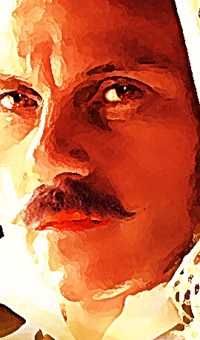
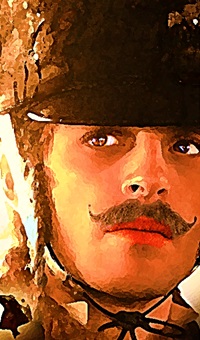
Frank Tidy’s camerawork is brilliant, and the soundtrack, by Howard Blake, is also effective. Like Scott, both had immense experience in TV commercials. Carradine and Keitel are initially jarring. But you get used to them because they are excellent actors. Carradine plays D’Hubert, a diligent, professional soldier whose paths cross, largely by accident, with Feraud (Keitel), a manic obsessive who constantly tries to remedy imagined slights. The duels stretch from the pinnacle of Napoleon’s achievement through to 1816 and can be seen as a metaphor for Bonaparte’s (and France’s) fortunes during that period.
Carradine, who had filmed in France and Italy, and Keitel, known as one of Scorcese’s ensemble cast, had both appeared in Alan Rudolph’s Welcome to LA immediately prior to making The Duellists. Much of Scott’s film was shot in the Dordogne and London, with Aviemore in Scotland used for the retreat from Moscow scenes. With such a surfeit of long hair, beards, flute playing and greatcoats, at times it has the ambience of a late-hippy, rustic piece. It really is very good, and, as with many UK films, much helped by the quality of the supporting cast: Robert Stephens, Tom Conti, Jenny Runacre, Diana Quick and Pete Postlethwaite in a key early role.
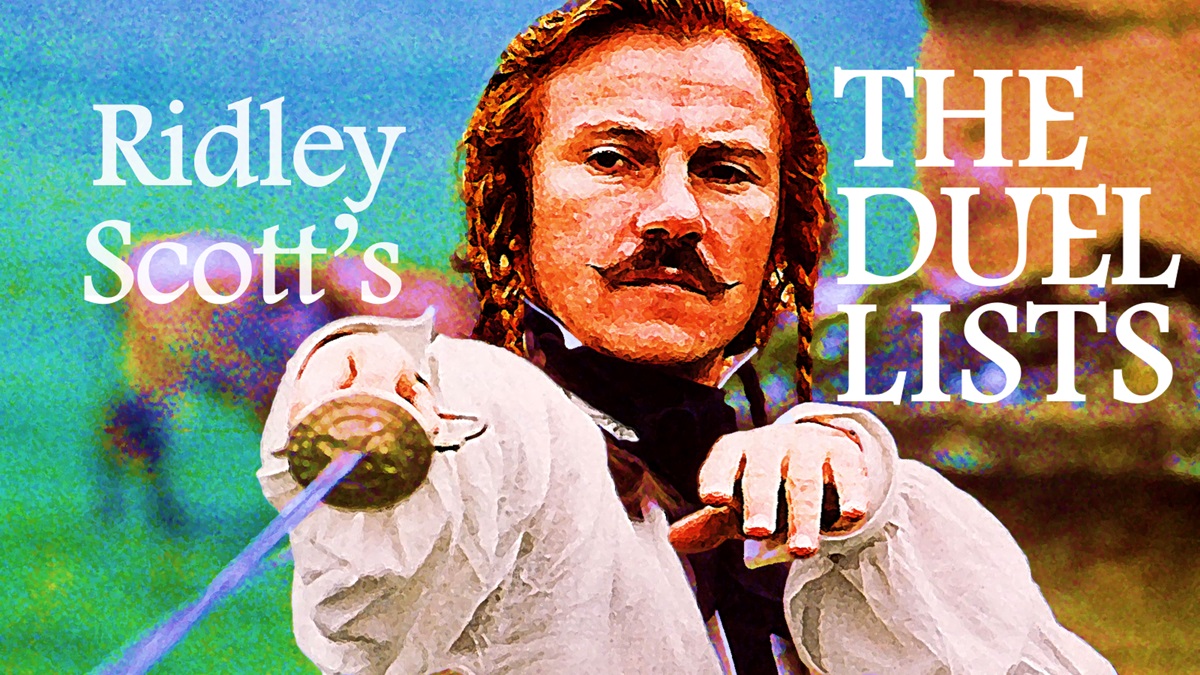
It premiered at Cannes in May 1977, as one of three UK entries alongside Black Joy and The Naked Civil Servant. Nominated for the Palme D’Or, it didn’t win but bagged instead (unanimously) the prize for Best First Work. French critics, who go wild about anything Napoleonic, loved it. At forty, Ridley Scott had arrived, and his output since has been hugely successful, even if unlike – say – Hitchcock, Welles, Fassbinder and many others, there seems to be no philosophy, point of view or morality at play. What Scott provides in his big studio pictures is gigantic, commercial entertainment. Some of which is interesting, some less so. What is undeniable is that he tells stories well, in a bold unpretentious fashion.
To return to The Duellists. It remains the only one of his films to have been feted at Cannes. Who knows how his career might have developed had the UK film industry been healthier. As chance would have it a trio of US producers were impressed by his debut and brought him onboard their next project: Alien. That, and the gleaming modernism of Blade Runner followed, as did a spate of US funded projects. A case of their gain, our loss?
see also:


Discover more from Lion & Unicorn
Subscribe to get the latest posts sent to your email.
