
SIMON MATTHEWS watches Les Blair’s 1985 film Number One.
The straight-to-video production was an odd hybrid, which for a moment in the 1980s accounted for a substantial number of the films circulating in the UK. Invariably shot on 16mm and using natural light and sound – to minimise production costs – most had simple plots and familiar casts, the objective being to deliver 80–90 minutes of popular entertainment in a neat package that could be purchased, or rented, at a store with your shopping (or a takeaway) for an inexpensive, stress-free evening in.
A cinema distribution might still happen, particularly overseas, and so might TV screenings. What drove this phenomenon was the view, widely embraced in the UK, that ‘traditional’ cinema was finished. After all, the argument went, it had been in sharp decline for over a decade and the future now lay in TV and home entertainment. Production companies that catered to this outlook duly emerged, one such being Videoform who were behind the 1984 Michael Winner slasher thriller Scream for Help. When this was released its US distributors, Lorimar, pointed out ‘To our knowledge, this is the first time in home video history that a company has approached advertising for a home video feature as if it were a theatrical release.’ Part of Scream for Help was shot in the UK and the company stayed there to make Number One a drama set against the burgeoning professional snooker scene.
A high proportion of those involved would have been familiar to TV viewers, particularly anyone who liked the 1978 mini-series Law and Order. Director Les Blair, associate producer Raymond Day, writer G. F. Newman and five of the cast members migrated over, helping to establish the misanthropic atmosphere that permeates in the story. We are in no doubt that we are about to watch something downbeat as the credits roll to a gruff bit of gravelly blues rock, ‘Savin’ Face’ sung by Joe Fagin of Auf Wiedersehn Pet fame. This is south London, 1984: lots of cockneys, smoke-filled shabby pubs and pool halls. Everything is murky with no natural light, and dialogue is hewn from Performance, Get Carter and The Sweeney. There is an abundance of f-words and c-words.
The plot centres on Bob Geldof as Flash, an Irishman adrift in London. He has debts, plays cards and seems to be a police informer. As in Law and Order, the police are corrupt. He lives in a shabby bedsit in a substantial nineteenth-century house in Cranfield Road SE4. How times have changed – now part of the Brockley Conservation Area, a pile like that would cost you about £2m today. There are scenes shot in Deptford Creek, then a messy area of waterfront scrapyards with no student accommodation in sight, and in the boxing gym above the Thomas a Becket public house on the Old Kent Road, where casual drinkers could relax with a pint whilst admiring the local pugilism.

Flash is spotted messing around at a pool table by Mel Smith, a local turf accountant who is looking for a prospect he can promote. Smith has a rasping sidekick, played by P. H. Moriarty, a Deptford born character actor, and former boxer, from the cast of Law and Order, who also appeared in Scum and The Long Good Friday. With few options open to him if he wants to avoid being framed by the police, Flash grudgingly allows Smith to become his manager.
Alison Steadman provides the love interest. She lives in the bedsit opposite, and floats around in a nightie, vaguely reminding one of Abigail’s Party. But this is darker fare. She entertains gentlemen clients for a living, and is similarly adrift in a corrupt world, looking for a way out. Alfred Molina makes a good impression as the rough and ready CID man tapping up Flash. Supporting roles are played by Phil Daniels and Ray Winstone. Both are effective, but their appearances here, coming so soon after starring in Quadrophenia, Breaking Glass and Scum is proof, again, of how rapidly UK film production declined once the safety net of state support was removed.
There are also cameos from Ian Dury (three scenes, as a low-life street criminal) and Gene October (one scene, as a violent drunk in a Chinese restaurant). With Geldof best known as a rock star and Daniels and Winstone also attempting singing careers – Winstone even appearing at one point in a band with ex-Sex Pistols Paul Cook and Steve Jones – much of this feels like a study of new wave/punk hopefuls, a couple of years after that bubble had burst.
Instead, it focuses on snooker, with Geldof soon kitted out by Smith in one of the tight, neatly cut three-piece suits worn, like a piece of working-class performance art, by its players in even the shabbiest of surroundings. He makes his way to the top, from local knock-out tournaments to the UK finals at Wembley Conference Centre, and eventually to the World Snooker Championship at the Crucible, Sheffield where the prize money is a hefty £35,000. He takes Steadman with him, and they sneak off for a couple of nights in Blackpool.
It’s bleak. His manager has rigged the tournament. There is a fracas in a pub with some mouthy locals. The Lancashire Constabulary are as corrupt as the Met. Geldof decides to play it straight, and wins the tournament. The film concludes with him wielding the trophy amid much audience adulation, whilst the end credits roll. In true G. F. Newman style, no one is allowed a happy ending: freeze-frame pictures of each of the main characters are screened, accompanied by a semi-comic sentence saying what happened next to them. They all go back to their bad ways.
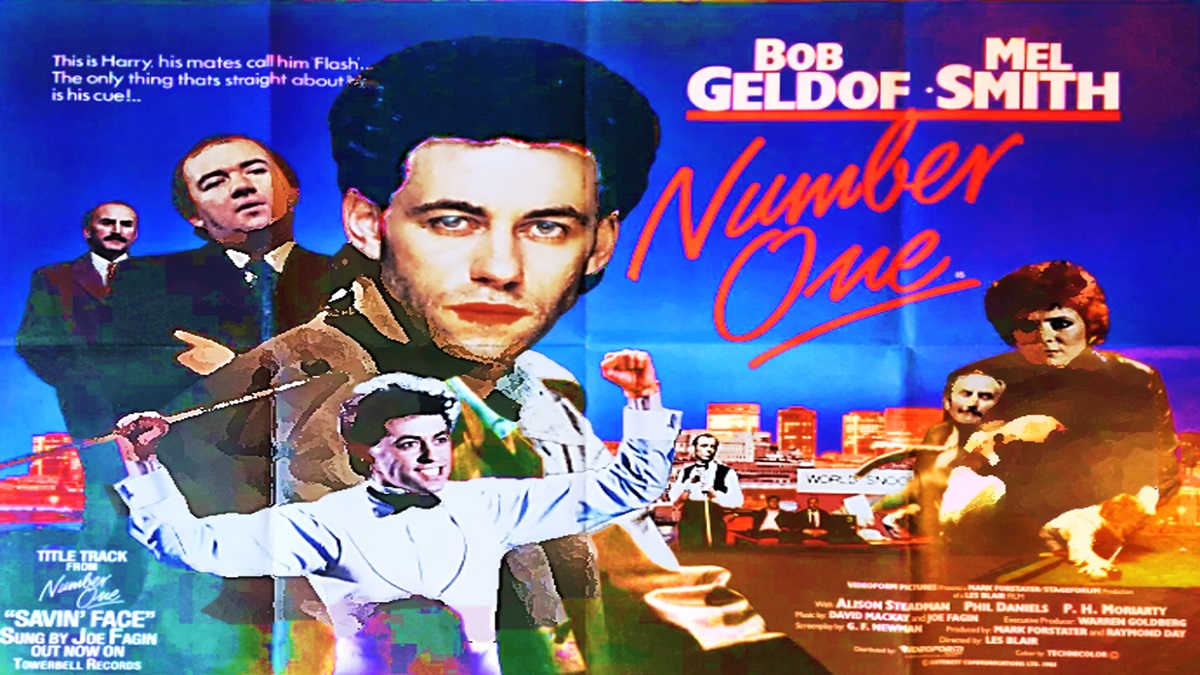
Number One premiered at the London Film Festival in November 1984, and achieved a limited theatrical release in March 1985. It should have done better, and remains quite a watchable drama. The big surprise in it is Geldof. He performs with fluency and confidence. Given this, and his equally deft turn in The Wall, one might have thought a Hollywood career beckoned.
But the timing wasn’t great. The Boomtown Rats hit the skids after a final flop album, In the Long Grass, and by the time Number One appeared he was organising Band Aid. Famine relief in Africa took up a lot of his time thereafter. That eventually morphed into Tony Blair’s Commission for Africa and assorted campaigning on debt relief and AIDS, some of which attracted criticism. He punctuated it with a stuttering solo career, but never went back to acting.
from the maker of:
see also:


Discover more from Lion & Unicorn
Subscribe to get the latest posts sent to your email.
