This is extracted from ALWYN TURNER’s All in It Together: England in the Early 21st-Century.
Although the disputes within UKIP continued, the party was beginning to look more stable. It was again under new leadership, Jeffrey Titford having been succeeded by Roger Knapman in 2002. With a decade in Parliament as a Tory MP under his belt and a couple of years as a government whip, Knapman – uncharismatic as he was – had the kind of solid experience not previously seen at the top of UKIP. ‘Very grown up,’ was Nigel Farage’s verdict, ‘far more politically astute than anyone else in the party.’

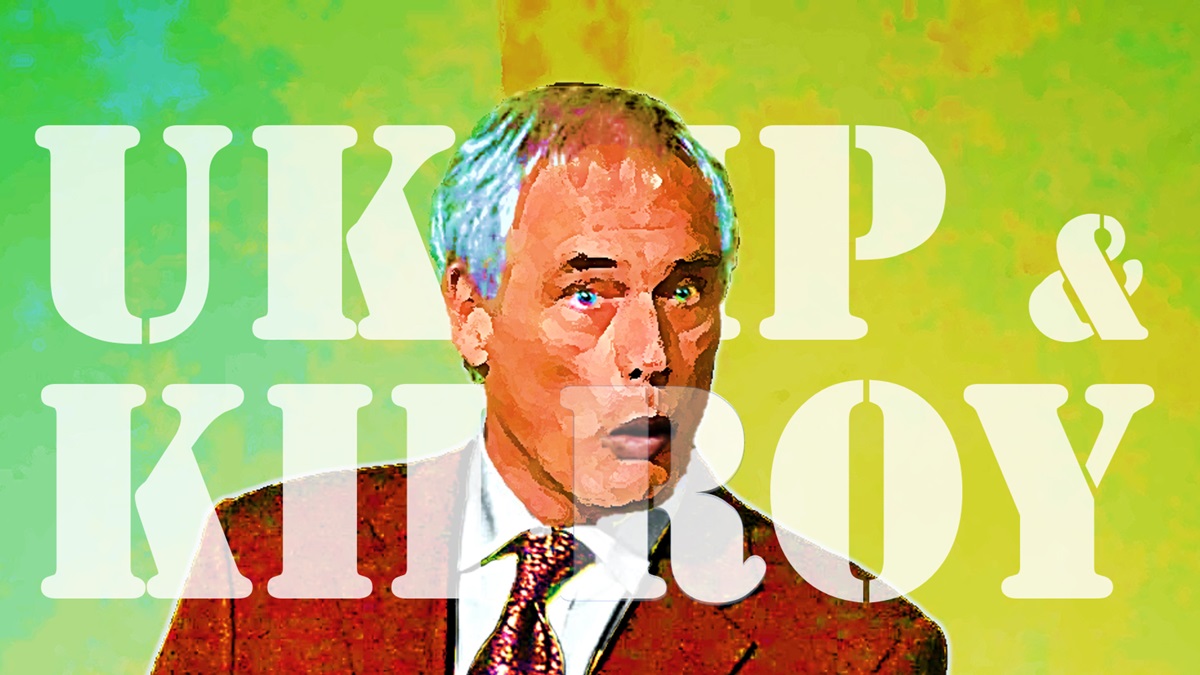
Knapman was leader when Robert Kilroy-Silk joined in the spring of 2004. Kilroy-Silk had spent twelve years as a Labour MP, but was far better known for his more recent incarnation as host of a daily television talk-show in which he discussed emotional issues and topics from the day’s news with a studio audience and guests. That came to an end following a Sunday Express column in which he addressed concerns that the War on Terror was ‘destroying the Arab world’. Even if we were so doing, he argued, why should we care? ‘After all, the Arab countries are not exactly shining examples of civilisation, are they?’ Arabs might loathe Westerners, but equally the West had no love for ‘suicide bombers, limb-amputators, women repressors’. The BBC cancelled his show, issuing a statement that ‘these comments do not reflect the views of the BBC’ (as if anyone really thought they might).
Now he was hitching his wagon to UKIP, promising to speak up for ordinary folk. ‘They are fed up with being lied to,’ Kilroy declared. ‘They are fed up with being patronised by the metropolitan political elite.’ His arrival generated much publicity, enabling UKIP to overtake the Liberal Democrats, first in the opinion polls and then at the ballot box. In the Euro-elections of June 2004, the party came third, having gained an additional two million votes, and won twelve seats in the European Parliament. It was the big story of the poll.
Less noted at the time was the fact that in European elections, where proportional representation gave a broader choice, England was – like the rest of the kingdom – becoming a multi-party state. A decade earlier, there was a 40-point gap between the first- and fourth-placed parties; now that was down to 12 per cent. Traditional loyalties were splintering. Veteran Marxist Ken Coates noted that UKIP was getting a lot of support in the old coalfield areas, and agreed with Tony Benn’s perception that the party was ‘appealing to the disillusioned working class’.
Among the dozen UKIP MEPs, the dominant figures were Nigel Farage and Robert Kilroy-Silk. Both were committed to the idea of converting UKIP into an electoral vehicle, though few believed it would be sturdy enough to carry both their egos. ‘I told Nigel that there was only one person Kilroy-Silk was interested in,’ warned publicist Max Clifford. Sure enough, within a week of their election triumph, the two men were reported to have had ‘differences’.
As far as the media were concerned, Kilroy-Silk was ‘UKIP’s star turn’, its leader-in-waiting. But he didn’t wish to wait. The man who’d once called on socialists to act with ‘a tint of arrogance’ was now sixty-two and impatient. At the party conference in October 2004, he set out his stall in a typically assured performance. There had been talk of not fielding candidates against Eurosceptic Tory MPs, but he was having none of it. ‘The Conservative Party is dying,’ he declared. ‘Why would you want to give it the kiss of life? What we have to do is kill it. That is our destiny.’ He could be quite sinister at times.
The next day, the wind in his sails, he made his move. He told the media that Roger Knapman had promised to step down as leader after the European elections, and had reneged on that commitment. But a general election was expected the following May, and it was essential that a change be made now, so that he, Kilroy, could turn UKIP into an ‘effective electoral fighting force’.
This was his carpe diem moment. ‘What everybody tells me they want is for the current leader to accept the inevitable and to stand down,’ he declared. ‘I have been told by every senior member of the party that they would like me to be leader. I am told there is a vast majority of the party who would like that to happen.’
He was exaggerating. The membership was far from convinced by the new kid on the block. ‘Kilroy must prove himself,’ said one scathingly. ‘He’s only a minor celebrity after all.’ The ‘senior members’ didn’t seem impressed either. Farage, who now saw Kilroy as ‘a mini-Mosley’, said a contest ‘would set us back years’, and Jeffrey Titford – the only former leader still in the party, and therefore its de facto elder statesman – shook his head sadly: ‘It’s a terrible thing, ego, isn’t it?’ Knapman denied saying he’d step down and insisted that he was staying.
Kilroy-Silk responded by resigning the UKIP whip in the European Parliament and by trying to force a vote of no confidence in Knapman, but the attempted coup failed to take off. His image wasn’t helped when a demonstrator threw a bucket of slurry over him, shouting, ‘This is in the name of Islam.’ (‘Kilroy-Silk dung over’ was the unsympathetic headline in the Daily Mirror.) In January 2005, a year on from the Sunday Express column that cost him his BBC job, he announced that he’d left UKIP altogether.
Just eight months before, Knapman had welcomed him into the party: ‘He is hugely respected as a journalist and broadcaster, and firm in his views.’ Now, the still-incumbent leader was less than distraught: ‘He’s gone, we wanted him to go, it only remains to break open the champagne.’
Discover more from Lion & Unicorn
Subscribe to get the latest posts sent to your email.
