
In a world where what an eighteen-year-old named Luke Littler has for tea is considered newsworthy by the Daily Mail, we have come a long way from the time when darts wasn’t something that could make one rich or famous.
The idea of darts as a sport that could be played professionally, with a circuit of televised tournaments, did not emerge until the late 1970s, and almost died out in the 1990s. But now the world championship is viewed on pay TV by millions in the UK alone, is having to expand (twenty-eight sessions in front of thousands each day at Alexandra Palace cannot come close to meeting demand for tickets), and is won by a star like Littler, able comfortably to share the Sports Personality podium with an athlete and a cricketer without collective eyebrows shifting a millimetre vertically.
Indeed, this is a remarkable phenomenon, especially to those in the non-dart playing countries (or at least the dart-playing but not dart-watching territories). But actually, something perhaps even bigger existed decades before, uniting both Ally Pally and the newspaper that massively outsold today’s current circulation-leading Mail, the News of the World (NotW).
It might not be totally accurate to call darts a pub sport now, but that is a literal description of the News of the World Individual Darts Championship, which ran from 1927 until the 1990s and was, for most of its existence, the most prestigious title in the game.
Darts had become a staple of pubs after the First World War, as breweries responded to competition from cinemas and spectator sports, and to official disapproval of public houses existing merely to serve alcoholic drinks. Leagues were set up by brewers, who also came together to organise a National Darts Association (NDA) to standardise rules.
The NDA organised the early editions of the NotW Championship, which began with individual pubs holding qualifiers, from which a player would go forward to an area competition and then the regional finals. The inaugural 1927/28 London-only edition, co-sponsored with C. N. Kidd & Sons brewery of Dartford (don’t look for it, it’s not there any more), attracted 1,010 entries and was won at Holborn Hall by Sammy Stone – a Boer War veteran and father of nine – representing the New South-West Ham Workingmen’s Club. The NotW did report on the final but got the scoreline wrong, perhaps the most egregious error the venerable organ of record was to make it its long history.
Over the next decade other regional tournaments were set up under the NotW banner, with tens of thousands entering each of them by 1939. The London finals were held at the Royal Agricultural Hall and attracted a crowd of 14,534, most presumably waiting in vain for big screens to be installed, with the decider surprisingly won by Marmaduke Brecon, representing the Jolly Sailor, Hanworth (don’t look for it, it’s now a Esso station with accompanying Londis) against Jim Pike, the star player of the day.
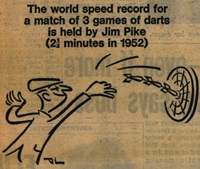
The tournament obviously went into hiatus for a few years, while the dart players of Great Britain stepped up to the one oche on which they could get greater honour, as Mr Punch would put it. That darts had gained prominence was underlined by NotW assembling the Team of Darts Champions – led by Pike – to give exhibitions during the War, raising money for the Red Cross and similar charities, a tally of around £200,000 (over £10 million in today’s prices) the most accrued by any such effort by any sport.
When the NotW Championship returned in 1947/48, nearly 300,000 people entered and a national finals was held for the first time at the Empire Pool (the future Wembley Arena). Around 17,000 were present to watch Harry Leadbetter win the trophy as the representative of Windle Labour Club, St Helens (do look for it, it is still there).
The Guardian featured the event, but noted that it was too much of a domestic affair to join the lists of major sporting events: ‘No Von Nida or Walter Hagen [respectively Australian and American golfers] has yet appeared in the darts world, nor anything out of a French stable. If St Helens goes down it will only be to Gloucestershire or Durham and no cups will go irrecoverably abroad.’ The paper also suggested that the event had been postponed to coincide with the forthcoming Olympics to pique international interest: ‘Darts is so much more a game to play than to watch; and are not the spectators responsible for most of the hullabaloo attaching to more “organised” sports?’
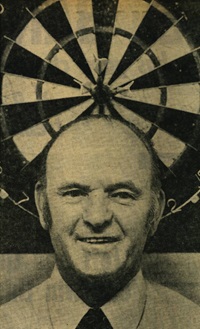
Darts continued to indeed be a largely a (hugely popular) domestic participation sport with the NotW the main annual competition, the finals held variously at the Empire Pool, Earl’s Court and, from 1963, Alexandra Palace. Few stars were created but Tom Barrett’s feat in winning two years in a row (in 1964 and 1965) did gain him some fame, and darts manufacturer Unicorn took him to the United States where he appeared on the Tonight Show, where he showed his skills by knocking a cigarette out of Johnny Carson’s mouth with a with a dart, to the delight of the watching Zsa Zsa Gabor.
When darts did make a real breakthrough as something for people to watch rather than play in pubs, the NotW Championship was the catalyst. Other than a regional tournament on Westward TV, no darts was broadcast on television until ITV decided to show the 1972 NotW finals on World of Sport, at the suggestion of the newspaper. The hullabaloo of the 12,000 fans at Alexandra Palace (most of whom had travelled specifically to support one or other of the sixteen regional champions) was enjoyed by several million viewers, and made a celebrity of fiery Welsh representative Alan Evans, who had been followed by coachloads of equally ebullient fans from the Valleys.
He eventually lost the final to Brian Netherton from the Welcome Home Inn in Par, Cornwall (do look for it, it is still there), but Evans was the break-out star (at about the same time Alex Higgins was becoming a celebrity beyond snooker), and went on to do well on Yorkshire Television’s new Indoor League in the next couple of years. By 1976 Evans himself was invited on to the Tonight Show, and was asked by Carson to throw darts backwards through his legs using a mirror, but instead of obliging Barrett-style, stormed off, proclaiming: ‘I’m a dart player, not a bloody clown.’
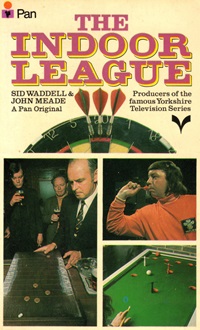
By now, not least thanks to Evans and Indoor League, darts was starting to gain a profile, and even spreading abroad. The NotW Championship opened up to foreign qualifiers. Stefan Lord of Sweden, who had the opportunity to watch NotW winners Barrett and Barry Twonlow in exhibitions, ended up winning in both 1978 and 1980, by which time the finals had switched back to Wembley Arena after a fire had burnt down much of the original Alexandra Palace. There were still huge crowds and Lord admitted: ‘The atmosphere was great … like a football match where I was the away team.’
In between those two victories, Bobby George – Alan Evans but with good looks, an even temper and streetwise business sense – had won the title, but darts fame no longer rested on the NotW Championship. The competition had been organised by the National Darts Association of Great Britain (NDAGB), who had failed to turn the sport’s high level of participation into one people might watch (beyond the five-figure crowd that turned of for the NOTW finals).
But with ITV showing the NOTW finals and Indoor League, slate tycoon Ollie Croft set up the British Darts Organisation (BDO) in 1973 and a World Darts Federation (WDF) the following year. By the end of the decade they were organising a circuit of televised events on BBC and ITV including, from 1978, a world championship. The sport now had a professional circuit, from which stars like George, Eric Bristow and John Lowe were emerging, rather than one annual championship starting with pub qualifiers.
The BDO also introduced a wider range of formats and standardised the oche distance at 7 feet 9½ inches rather than the range of regional variations – leaving the NOTW Championship an outlier, played with a quickfire best of three legs throughout and sticking with its 8-foot oche distance.
The NOTW Championship continued through the 1980s, and was invariably won by the new-breed professionals (who still had to start in pub qualifiers, such as Bristow’s Foaming Quart in Norton Green, Stoke-on-Trent – still there). But at the end of the decade, the sport’s boom had turned to bust, ITV dropped their darts coverage, and the NOTW dropped their competition after 1990.
The NDAGB disappeared, trumped by the BDO. But ironically that body itself was soon to face its own challenge from a more dynamic organisation, as the top players and promoters – frustrated by the sport’s decline and Croft’s seeming indifference – set up what is now the Professional Darts Corporation (PDC), which organises the £20 million year-round (and international) circuit of televised tournaments that Littler and his chums play in.
In its salad days the PDC did organise a one-off NOTW Championship revival in 1996/97, played with the same pub-based format as its heyday, eventually won in Birmingham by the sport’s dominant figure, Phil Taylor, representing the hostelry he owned, the Cricketer’s Arms in Newcastle-under-Lyme (still there, even if no longer owned by the sixteen-time world champion). It meant a lot to Taylor, who had been part of a darting world that still held to the NOTW as the gold standard it had once been, but entries and general interest meant it remained a one-off.

Occasionally nostalgists call for another revival (if not, presumably, under its traditional name), but actual attempts have not attracted the big-name players that would give it the credibility it once had. In any case, it would be hard to find a couple of hundred thousand dart pub players due to the decline in the number of pubs, let along those with dartboards.
Its spirit probably more lives on in evolved form. The PDC World Championship has been played at Alexandra Palace since 2007/08. While the West Hall in the rebuilt Palace that is now used for the darts holds around 3,200 rather than the 12,000 that used to pack the pre-fire Great Hall, the raucous atmosphere recalls the hullaballoo of the NOTW Championship rather than the more staid order the BDO tried to promote to give the sport respectability. Wembley Arena also welcomed back darts for the finals of the PDC’s Premier League, before it moved to the O2, the culmination of a seventeen-week series of weekly events in major arenas in the UK, Ireland and western Europe that attract the five-figure crowds once the preserve of the NOTW Championship.
Darts in pubs has not quite gone the same way as the News of the World (although the fate of the home inns of many of the championship’s winners is telling), but the tournament that bore the name of the now defunct newspaper does speak of a different era. Then, hundreds of thousands played the game to a level that they would enter a national competition; now, millions watch, more likely to pick up fancy dress when attending an event rather than a dart itself. But a competition that was happy to wear the badge of pub sport did take darts to the very arenas where dry ice and glitz has replaced smoke and hullaballoo.
Discover more from Lion & Unicorn
Subscribe to get the latest posts sent to your email.

Pingback: Sport’s winning streak | Lion & Unicorn