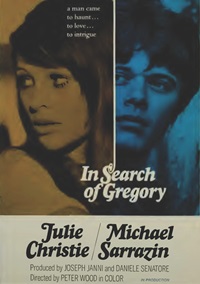
SIMON MATTHEWS watches Peter Woods’s 1969 movie In Search of Gregory.
The reputation of Poor Cow has risen somewhat in recent years. When it was released in 1967, critics were dismissive, even if audiences liked it enough to ensure it turned a profit. Thus, director Ken Loach, for whom it was the first part of a two-picture deal, was surprised to be rebuffed by producer Joseph Janni when he suggested an adaptation of David Storey’s novel Flight into Camden as his second work. Janni reputedly advised ‘the North is finished’ and declined to release funds.
Loach retreated to Liverpool where he made two BBC TV Wednesday Play’s, and, with some help from Tony Richardson, eventually raised the money to make Kes, clearly a ‘northern’ drama and one of his greatest successes. Janni instead chose In Search of Gregory as his next production, seeking something that combined commercial success (particularly in the US) with critical kudos, and that would be written about and examined at length for years to come.
Given the mismatch today between the continuing acclaim for Kes – rated seventh in the BFI list of all-time great UK films – and the on-going invisibility of In Search of Gregory, that was a striking, but not irrational, decision.
To start with, it had a script by Tonino Guerra, co-author of Michelangelo Antonioni’s Blowup, which had landed the Grand Prix at Cannes whilst taking ten times its cost at the box office. Then, as director, Janni selected Peter Wood, who had enjoyed major West End stage success with The Private Ear and the Public Eye (1962) and The Prime of Miss Jean Brodie (1966). The former repeated this on Broadway, the latter ran internationally. In Search of Gregory was to be his debut feature film, but, like Loach, he had a solid background in television drama, responsible for eighteen plays between 1958 and 1963.
Julie Christie, making her fourth appearance in a Janni film, was cast in the starring role of Catherine, with John Hurt as her brother and ex-Bond villain Adolfo Celi as her father. The part of Gregory was taken by rising Canadian actor Michael Sarrazin, who turned down Midnight Cowboy to make this.

It starts with Christie collecting a message from her father at the local Post Office, which, in a poppy gimmick typical of 1960s cinema, has been recorded on a 45rpm record. When played, he tells her that he is getting married. He wants her to come to the wedding in Geneva where an ‘extraordinary young American’ who is ‘unattached’ will be a guest. Obediently, she heads to Geneva where her brother says of the mystery guest, ‘sometimes he’s here, sometimes he’s not,’ whilst admitting to having met him.
Christie’s character is a an eligible, attractive woman. We are reminded of her previous appearance in Darling! (1965) during a scene where the mysterious Gregory’s face is plastered slowly across a billboard, in the same way that Christie’s is during the opening titles of Schlesinger’s film. In another echo of Darling, which centres on a three-way relationship between Christie, Harvey and Bogarde, the Hurt-Christie relationship shown in In Seach of Gregory (which never extends to including Sarrazin) is peculiar, hinting at incest, or of Hurt being either gay or in some way unbalanced. In both films Christie has choices to make, with the audience also invited to judge on her behalf.
Over ninety minutes there are lots of young people on show, fast cars and a vague plot. The landscapes are elegant and it’s very nice to look at, like a superior TV commercial. As with Blow Up, the enigmatic puzzle element (there, revolving around a photograph that may or may not show a murder; here, about whether a central character exists) is centre stage, leaving it unclear if it isn’t just an elaborate fantasy. The plot finally achieves some purpose in the last fifteen minutes. Still unknown to each other, they book into the same airport hotel, and arrive at the same departure lounge. Christie briefly sees someone and thinks it’s him. But it isn’t. Tantalisingly, despite being so close, they never meet.
Critics weren’t impressed when it finally appeared in November 1969, more than a year after filming completed: ‘Muddled film, set in Geneva, about two lovers who fantasise about, but never meet each other’; ’English-Italian melodrama a la Antonioni’; ’Irritatingly pretentious Pinterish puzzle-drama’; ’however lively the surface, the centre remains depressingly inert’; ‘more maddening than enigmatic.’
A US release followed in May 1970 but it never achieved the success Janni anticipated. A novelisation by Bonnie Golightly, who produced a great deal of US pulp fiction, abandoned any trappings of sophistication with the strap line ‘brother, sister, lover – a most irregular triangle’ implying that casual readers (and viewers) were in for something pornographic, which certainly wasn’t the case.
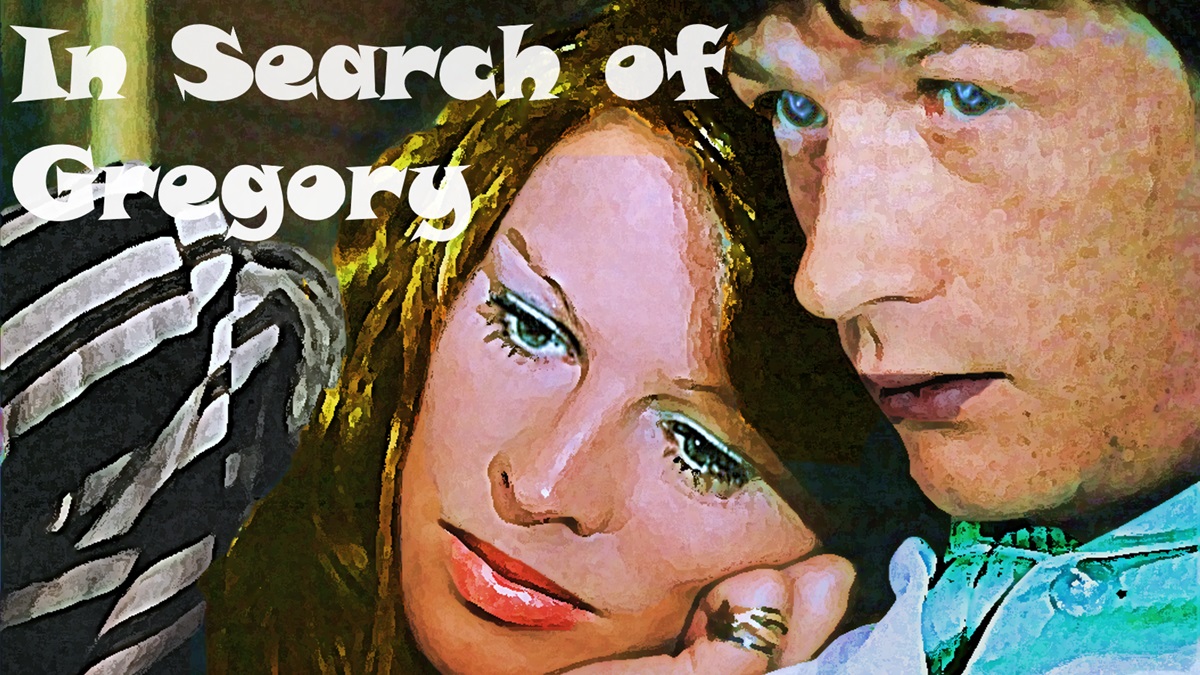
One of its other oddities was the absence of a soundtrack album, particularly as a lot of money was thrown at the score. Don Black, of Thunderball and Born Free, was hired along with Ken Howard and Alan Blaikey, then cranking out a stream of hits for the Herd and Dave Dee, Dozy, Beaky, Mich and Tich. Both provided songs which are sung in the film by Georgie Fame: ‘Dreams’ by Black, and ‘Close’ by Howard/Blaikey. Neither were released in any format.
The rest of the music, put together by Ron Grainer, is rather nice, veering from some smooth lounge easy-listening to a weird musique concrète piece, composed in real time by Michael Sarrazin in a scene where he decides (for reasons never really explained) to spend a bit of time in a recording studio. Despite Grainer’s standing – Steptoe and Son, The Prisoner, That Was the Week That Was – none of it was released.
In the end, audiences weren’t much interested in Janni’s European coffee table film for intellectuals. He returned to the UK with Sunday, Bloody Sunday (1971), another drama about a three-way relationship, which was a major critical and commercial hit, and the grimly realistic Made (1972), with Carol White, which wasn’t. In Search of Gregory slipped into obscurity, and despite a DVD release remains there. Someone really should release the music though.
from the maker of:

see also:


Discover more from Lion & Unicorn
Subscribe to get the latest posts sent to your email.
