This extract from Alwyn Turner’s A Classless Society: Britain in the 1990s concerns the most shocking murder of the decade…

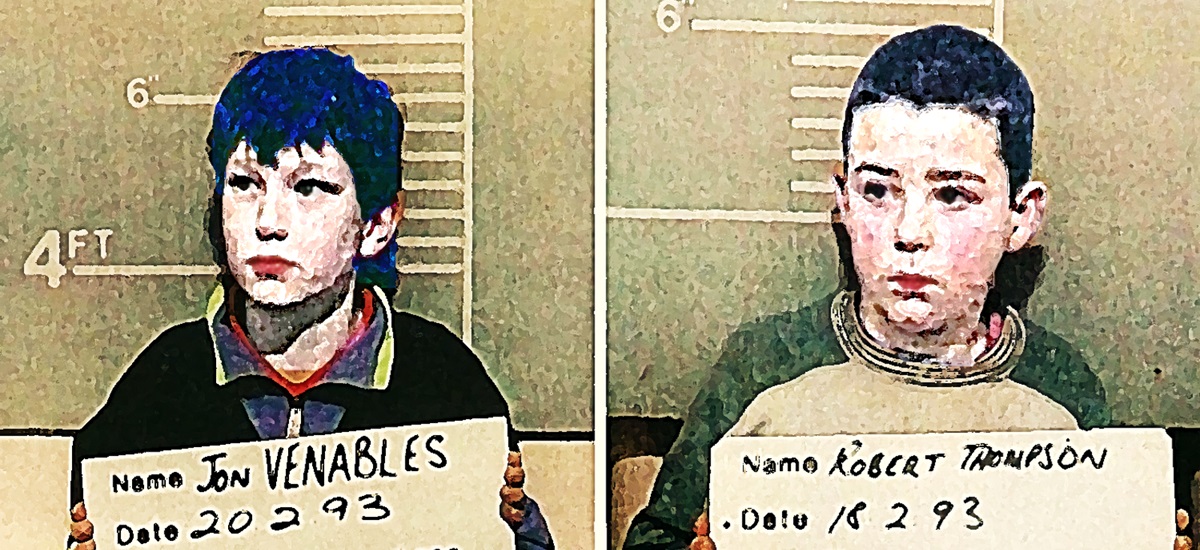
In February 1993 James Bulger, a two-year-old from Kirkby, Lancashire was abducted from a Bootle shopping centre by two ten-year-old boys and brutally tortured to death.
It was a particularly horrific murder, even without the added factor of the killers’ age. The public reaction was one of shock and distress, amplified by the release of grainy CCTV images showing the toddler being led away by his murderers.
‘Wherever you go, whoever you talk to,’ wrote Andrew Marr, a week after the killing, ‘there is only one subject that interests people at the moment. The murder of James Bulger hangs over the whole country like a dark cloud.’ The crime sparked a national outpouring of emotion and comment as the country tried to find some meaning in a meaningless act of violence. There was an insatiable need to discover what had gone wrong with Britain that such a thing could happen.
Into this debate stepped Labour’s shadow home secretary, Tony Blair. ‘Very effectively I made it into a symbol of a Tory Britain in which, for all the efficiency that Thatcherism had achieved, the bonds of social and community well-being had been loosed, dangerously so,’ he wrote in his memoirs.
It wasn’t an argument that stood up to any scrutiny. By the same token, one might blame Harold Wilson for the two killings committed by ten-year-old Mary Bell in 1968, or David Lloyd George for fifteen-year-old Harold Jones, who murdered two children in 1921. Nonetheless, Blair’s intervention did his career much good. ‘At the time, politically, there was a big impact on my standing, which rose still further.’
Blair acknowledged, as the Labour Party had too rarely done in recent years, that it was not enough simply to talk of social deprivation, that there was a question of morality here: ‘If we do not learn and then teach the value of what is right and wrong, then the result is simply moral chaos which engulfs us all.’
He spoke too of the need for community, and if none of this came with much idea of how it was to be achieved, other than by locking up more offenders, it undoubtedly did its job of stoking public unease. An opinion poll published a fortnight after the Bulger murder showed that law and order was now second only to unemployment as the issue causing greatest concern to the public, the numbers mentioning it having doubled in the last month. Levels of youth criminality, many felt, had reached crisis point.
The belief that there was a terrifying rise in juvenile crime was hardly borne out by the statistics; the number of young people under eighteen cautioned or convicted of an offence had fallen by nearly a third in the last six years. But the perception was allowed to remain and Blair found that his rhetoric captured the public mood more effectively than did that of the government. There was a look of campaigning zeal about him, which outflanked the more reassuring tone of John Major, even when the prime minister promised a ‘crusade against crime’ and adopted a strange position that ignorance was the best policy: ‘We should condemn a little more, understand a little less.’
Major’s ‘back to basics’ speech the following autumn was perhaps a more considered response, though any chance that it might steal Blair’s thunder faded away with the first whiff of Tory sexual impropriety.
Meanwhile the home secretary, Kenneth Clarke, was shocked out of the political complacency he had displayed just a few months earlier at the Conservative conference. ‘We are the party of law and order,’ he had bragged; ‘the Labour Party know it, and the general public know it.’ That was in the midst of Tory troubles over Europe, and offered some reassurance that there was one issue where the party remained untouchable.
Now, with Blair outflanking him in talk of hard-hitting measures, Clarke responded in kind, promising that more detention centres for juveniles would be built, though many experts in the field felt that the contest to be tough failed to shed much light on the problem of teenage criminality. ‘The two of them arguing about whose penal institution is bigger gets us nowhere,’ shrugged Frances Crook, director of the Howard League for Penal Reform.
When Michael Howard became home secretary shortly afterwards, he ramped up the rhetoric still further. He also took pot shots at tried and tested targets, announcing ‘the toughest-ever crackdown on violent videos’. (The judge in the Bulger case, followed by much of the media, had wrongly suggested that videos, including the 1991 film Child’s Play 3, had played a part in the murder.)
It didn’t take much foresight to predict that the proposed measures would do little to prevent another case arising to capture the public mood of anguish.
available in paperback:

Discover more from Lion & Unicorn
Subscribe to get the latest posts sent to your email.
