On the afternoon of Wednesday the 20th of January 1965, Basil King, the trumpet major of the Queen’s Royal Irish Hussars, was playing football in Wolfenbüttel, West Germany, when the orderly officer appeared on the touchline and called him over. He was told to put on a tracksuit and to report immediately to the colonel. Still wearing his football boots, covered in mud, and worrying that he was about to hear bad news concerning his family, King rushed to the office, where he was told to sit down.
‘What I tell you now doesn’t go past this room,’ the colonel said. ‘You’re going to London on Saturday on the boat-train, and you’ll be playing at Churchill’s funeral.’ ‘But he’s not dead,’ protested King, and the colonel replied: ‘He will be by Sunday.’
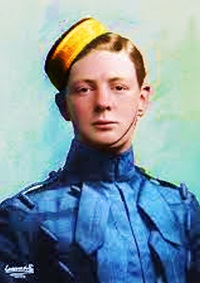
The colonel was right. When King landed at Harwich at breakfast time on Sunday morning, he was greeted with the news that Sir Winston Churchill, the former prime minister of the United Kingdom, had died at home, nine days after suffering a stroke. Seventy years earlier, Churchill had been commissioned as a junior officer in the 4th Queen’s Own Hussars, who had subsequently been amalgamated to form the Queen’s Royal Irish Hussars, of which he was the honorary colonel. Now the principal trumpeter of his old regiment had been summoned home to mark his death.
In London, Basil King was introduced to Corporal Peter Wilson of the Royal Horse Guards, one of the State Trumpeters. These were the two men selected to sound the Last Post and then Reveille at the funeral.
No one else seemed much concerned as to who played which call, but neither was particularly keen on the Reveille, a long, complicated piece that had greater potential for mistakes. They tossed a coin for it, and Wilson won. Situated up in the Whispering Gallery of St Paul’s Cathedral, he would sound the Last Post; King, placed in the West Window, would play the Reveille.
The two men were very experienced trumpeters – King had played at the Queen’s Coronation in 1953 – but this was an event of such weight and moment that the most skilled musician could be forgiven for feeling nervous about the possibility of fluffing his lines. There was even a recent precedent.
Fourteen months earlier the funeral had been staged at Arlington National Cemetery of President John F. Kennedy. The man chosen to play Taps on that occasion was Keith Clark, the principal bugler of the United States Army Band. It was a freezing cold day and Clark had to wait for three hours in the cemetery to do his duty to his former commander-in-chief. Worse yet, the demands of television meant that he was placed in front of the firing party, so that he had to play immediately after hearing three rifle volleys fired in close proximity.
Perhaps unsurprisingly, his performance was not quite perfect; he failed to hit the sixth note in the call, a mistake broadcast to the nation and to the world. It was immediately seized upon by the American media as a symbol of the nation’s grief over its murdered leader. ‘The bugler’s lip quivered for the nation,’ was how it was reported, and the missed note was referred to as ‘a tear’. Clark received a mass of letters, thanking him for his contribution: ‘In your one sad note, you told the world of our feelings,’ read one.
Despite the accolades, it was not what Clark would have wished. ‘I missed a note under pressure,’ he reflected in later life. ‘It’s something you don’t like, but it’s something that can happen to a trumpet player. You never really get over it.’
Now Peter Wilson and Basil King were called upon to play at what the newspapers were referring to, perhaps justifiably, as ‘the greatest funeral in world history’. The circumstances were very different from those of Kennedy’s interment, but the potential for making a mistake was exactly the same. The funeral was being televised in Britain, where twenty-five million were to watch it, and around the world, where hundreds of millions more would join the audience.
For this, after all, was Winston Churchill, the man who had participated in the last great cavalry charge of the British Army, at the battle of Omdurman in the previous century; the man whose personal heroism during the Boer War would have won him a Victoria Cross had he still been in uniform rather than acting as a war correspondent; the man who had served in cabinet during the First World War and as prime minister during the Second World War. When he was born in 1874, Queen Victoria had yet to be proclaimed Empress of India; now the Empire was no more. For the best part of a century, he had embodied the history of the nation, had helped to make that history, and had written it afterwards.
As his body lay in state in Westminster Hall, more people came to pay their respects than had attended the last king, whilst others slept on the streets of London to ensure that they would bear witness to the funeral procession as it passed. Many of the hundreds of thousands who lined the streets were Londoners, but large numbers had travelled from other parts of the country and from beyond. ‘We have come across specially to pay our respects,’ said a man from Brittany, ‘and now we will salute him with a farewell.’
Avoiding the worst of the crowds, Peter Wilson and Basil King arrived at St Paul’s three hours before the service was scheduled to start, and began the long, nervous wait. ‘It was a bit of an ordeal,’ remembered King. ‘We were professional musicians, but you’ve always got that bit of butterflies in the tummy because of the importance of it.’
They took their places in the cathedral shortly before the three thousand-strong congregation began to assemble – the politicians and heads of the armed forces, past and present, the official representatives of more governments than had ever previously met at such a gathering, the wartime allies and colleagues: Dwight D. Eisenhower, Ivan Koniev, Charles de Gaulle.
More extraordinary still, there was the Queen, sitting with the Duke of Edinburgh and the Prince of Wales. State funerals for non-royals had been staged before, but never had the reigning monarch attended such an occasion, not even for the Duke of Wellington in 1852. The Queen’s presence emphasised the profundity of the moment.
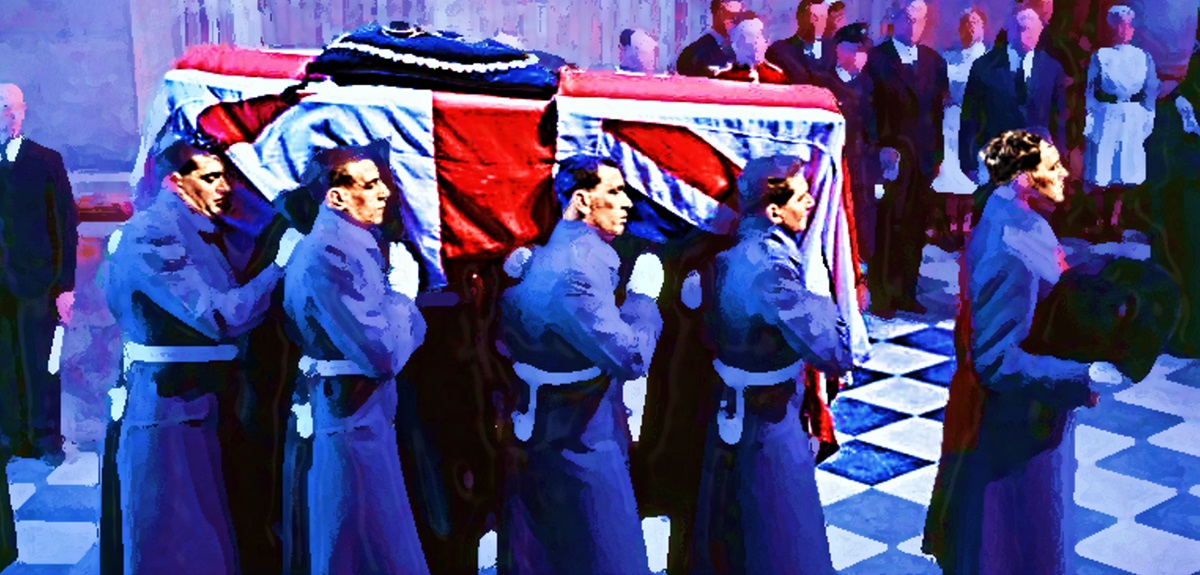
When the service did commence, the intensity simply increased still further. ‘I heard no sighs. I saw no tears,’ wrote the Daily Mirror’s star columnist Cassandra. ‘This was grief exultant.’
And then, after all the tributes had been paid and all the hymns had been sung – a fine, eclectic mixture that included ‘The Battle Hymn of the Republic’ as well as ‘Oh God Our Help in Ages Past’ – it came down to just two solo trumpeters to articulate the emotions of the nation as it mourned the death of its greatest son, the most celebrated and feted leader of the free world. After an eternity of waiting, Peter Wilson’s moment arrived, and he delivered a flawless Last Post, its clear tones echoing through the cathedral as though mourning the loss not simply of the man of Empire, but perhaps too of the Empire itself.
But the order of service at a soldier’s funeral does not end with that call. ‘The Last Post is the Nunc Dimittis of the dead soldier. It is the last bugle call,’ Stephen Graham of the Scots Guards had written in 1919, before adding: ‘It is the last, but it gives promise of Reveille – of the great Reveille which ultimately the Angel Gabriel ought to blow.’ For if the Last Post speaks of grief and loss, then the Reveille offers faith in the resurrection and rebirth of the man, of the spirit and, in this instance, possibly even of the nation.
There came the two minutes’ silence, two minutes of absolute stillness, timed to the second by the director of music of the Welsh Guards, as Basil King waited for his signal to play. ‘I could look down and see all the royal family, all the cabinet and the high command, and I thought: God, don’t muck this up,’ he remembered. ‘I fixed my gaze on some stone figure on the wall. And I played and it just went perfectly, no cracked notes or anything. Richard Dimbleby turned round and gave me the thumbs-up. It went right.’
‘High up in the gallery,’ reported the newspapers the next day, ‘the Last Post echoing under the Dome and leaving on the air an incense of sound. Silence. And a single trumpeter’s answering call – Reveille.’
Discover more from Lion & Unicorn
Subscribe to get the latest posts sent to your email.
