
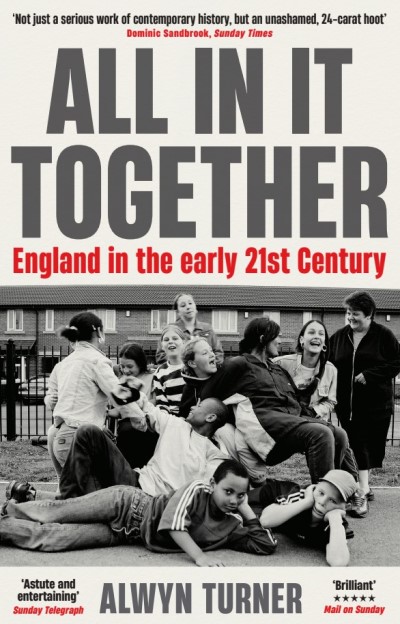
This extract from Alwyn Turner’s All in It Together: Britain in the Early Twenty-First Century opens with Ann Cryer, who was elected in 1997 as Labour MP for Keighley in West Yorkshire.
It was in early 2002 that Ann Cryer first heard stories about gangs of men in her constituency exploiting young girls for sex and prostitution. Information was hard to come by, but gradually a picture began to emerge.
It appeared to be not just a couple of isolated individuals, but a network, a loose association of night workers, men employed by minicab firms, takeaway restaurants and the like. They were targeting the girls they met, enticing them with alcohol, presents and drugs, and ultimately having sex with them. There were stories of girls being shared with other men, and of them being prostituted. Some were underage, and crimes were certainly being committed, but it was difficult to get the victims to talk; some were emotionally reliant upon the men, others too drunk or damaged to remember what had happened to them.
A 2003 report from Bradford Youth Services confirmed that there was a serious problem in the area. Of the forty-five teenage girls interviewed for the survey, around 80 per cent said they had had sex before they were sixteen, sometimes because they were forced, sometimes for money or to get a bed for the night.
A spokesperson for Barnardo’s, who’d been working with victims of child prostitution for some time, welcomed the study: ‘Young women across Bradford and Keighley are systematically trapped and exploited in sometimes extremely dangerous sexual relationships when they are still children in the eyes of the law.’
After eighteen months of investigation, Cryer announced that her office now had ‘a list of more than sixty names of men who are alleged to have lured girls, some as young as eleven, to have sex with them’. And in the most explosive revelation, she added that there was a racial dimension to the story: ‘I am merely pointing out fact in saying that all the victims of these terrible crimes are white girls and all the alleged perpetrators are Asian men.’
The men on Cryer’s list came from the Pakistani and Bangladeshi communities, and the allegations of gang rape and prostitution suggested that the abuse might have become culturally entrenched.
The local police, however, were unconvinced. ‘Superintendent Whyman said he did not think there had been any systematic exploitation of young girls,’ reported the local newspaper. ‘He stressed he did not see the problem confined to the Asian community and that grooming girls for sex was endemic.’
The first conviction came in November 2003 – twenty-four- year-old Delwar Hussain found guilty of having sex with a thirteen-year-old – and in 2004 others were arrested and charged. The official account remained that there was no racial or cultural element to the offences. ‘The investigation we have done has arrested both Asian and white men,’ said Colin Cramphorn, the chief constable of West Yorkshire Police, pointing to Britain’s high rate of teenage pregnancies, ‘with the fathers being of all races’.
Cramphorn’s comments came in response to a Channel 4 documentary, Edge of the City, that featured some of the victims. Anna Hall, the producer and director of the programme, explained that she’d stumbled into the subject, her original intention having been to document the daily lives of social workers. ‘We weren’t looking for this issue,’ she said. ‘It just kept surfacing. Social workers said, “You can’t do that story because it’s too difficult.” What did they mean by “too difficult”? Too racially sensitive?’
The stories in the documentary were jaw-dropping, including a thirteen-year-old said to have more than a hundred sexual partners, and the programme’s conclusion was firmly in agreement with Cryer’s findings: ‘What’s devastating for such a multiracial area is that in Bradford the girls are white and the men overwhelmingly are Asian.’ Hall’s overriding sense was one of horror that ‘blatant abuse was going on under people’s noses, and no one seemed able to prevent it’.

Edge of the City was scheduled for transmission in May 2004, but was postponed at Cramphorn’s request. ‘The broadcast will increase community tension across Bradford with the consequent risk that it will provoke public disorder,’ he said.
Furthermore, it was an insensitive time to be screening such a programme since there were local elections that month, and then, in June, elections to the European Parliament. Anything that reflected badly on a particular racial group might help the far right in those polls. In short, warned Lee Jasper of the National Assembly Against Racism, the documentary ‘could inadvertently act as a recruiting sergeant for the BNP’.
Discover more from Lion & Unicorn
Subscribe to get the latest posts sent to your email.
